Revisiting the Old Haunts
As we find ourselves in the midst of the years’ most frigid days, we are also at our most reflective. Seasonal solitude coinciding with holiday festivities creates a space to contemplate relationships past and present. Do you traipse around your house in the shadows of early nightfall? Catch a glimpse of a specter of the previous you? Or maybe, someone you used to know? Film grants us the opportunity to explore these experiences of isolation, contemplation, and fear of someone near and dear not being exactly the same as you remember. Let’s look at some examples that run the gamut from horror to hilarity.
House (1977) dir. Nobuhiko Ôbayashi
Imagine—you’re going on a trip with your besties to visit your cool witchy aunt. When you get there, it’s all lush until, one by one, your friends are picked off in terrifying but aesthetically pleasing ways! In House (1977), Nobuhiko Obyashi explores the relationship between the whimsy of sheltered youth and the harsh realities of life that have yet to come. Auntie (Yōko Minamida) and her cat, Blanche, live in a glorious, tucked away house. It’s the stuff of dreams. Heroine Gorgeous (Kimiko Ikegami) is blindsided by her father’s new romantic prospect and decides (with six friends in tow, all with names like Fantasy and Sweet that describe critical aspects of their personalities) to make visiting her aunt a reality. Except, even when they arrive at the House, it’s no less dreamlike than anything else we’ve seen thus far. And in fact, the only sure thing about this film is that you can’t decipher dreams from reality, and it’s quite foolish to try. Just buckle up and enjoy the ride.
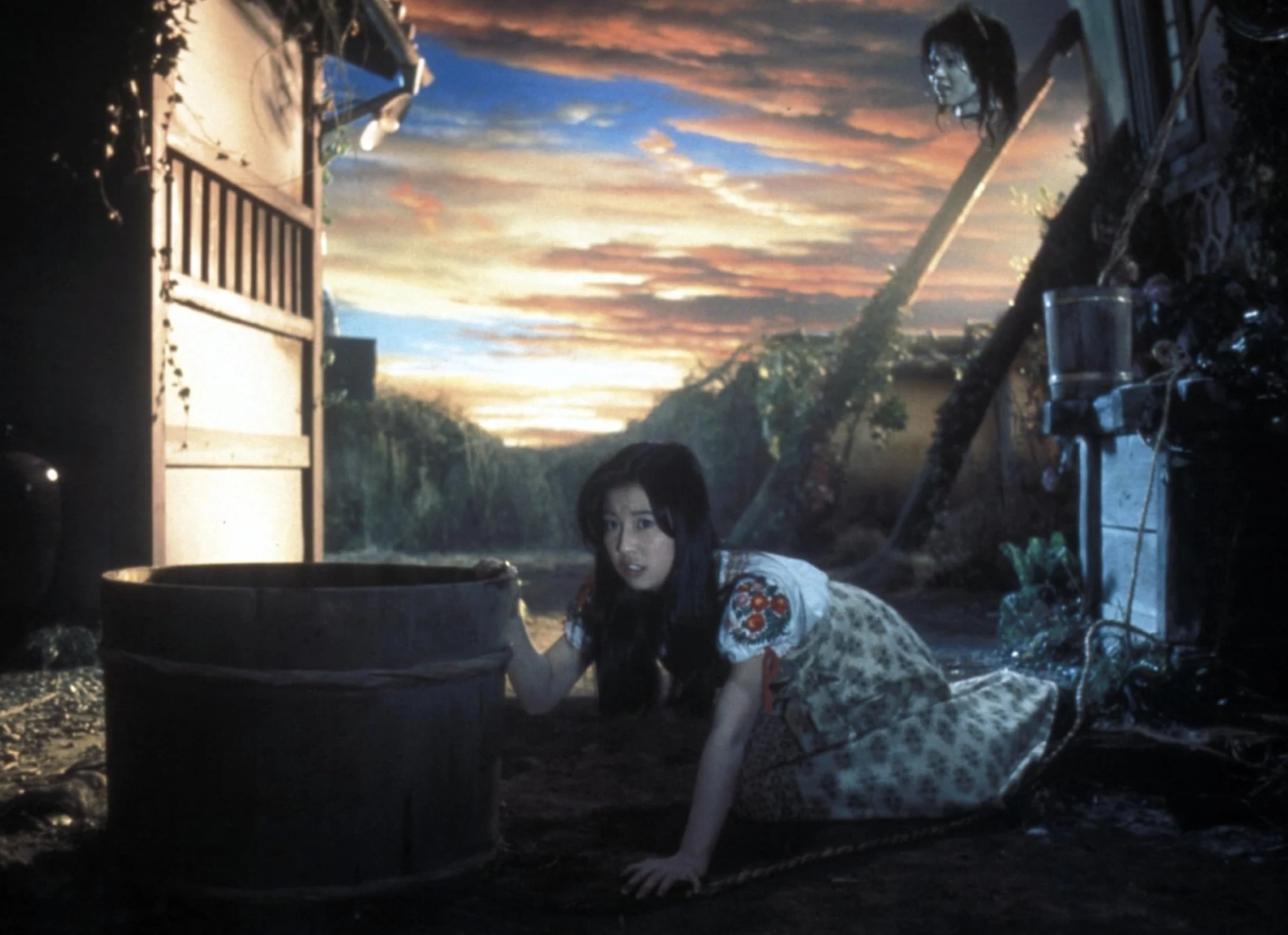
House (1977) Image via IMDB
Auntie tells the girls the story of losing her true love in WWII. Since then, she’s been so lonely, and therefore thrilled to have seven lively ladies to keep her company. Not long after do the inexplicable deaths begin: First, the character Mac meets her end whilst trying to retrieve a watermelon from a well, and whose flying, decapitated head later takes a bite out of Fantasy’s bottom. From there, it’s a slippery slope to evil mattresses, a piano with a grand appetite, and a hanging light fixture that’s sure to shock. After finding her aunt’s diary, Gorgeous reveals that Auntie has been an illusion the whole time, damned to reside as the spirit of her dwelling and consume all unmarried girls who inhabit it. In a pivotal scene in the middle of the film, we see Gorgeous reflected in her aunt’s vanity mirror, followed by a merging of personas that would make Bergman poo his pantaloons.
Described by filmmaker Ti West as “[a child’s] manic perception of a horror movie,” (Ti West on HOUSE - The Criterion Channel) the visual language of House is something that can’t be described in a line or two, and has major weight in experiencing this film, but it’s not all spectacle. At the center is a yearning to understand and empathize with the struggles of family, to recognize that lived traumatic experiences can be dealt with, but remain present in the familial fabric, and each generation’s struggles have the potential to mirror their elders’ in one form or another. Gorgeous had to undergo this journey in order to understand that you can’t bank on everything coming up roses, that you should accept new love when it’s presented to you, because you might not have the chance to see it through. At the same time, Auntie was always an illusion to Gorgeous, as she never really gets to meet her. The message is siphoned away in layers: hazy landscapes, disembodied limbs, blood and mirrors. Maybe Gorgeous learned to accept her step-mother-to-be through Auntie’s struggles, or perhaps Auntie was never real to begin with.

Blithe Spirit (1945) dir. David Lean
Blithe Spirit (1945) is a screwball comedy that dips its ghastly toes into the afterlife. What if your ex was summoned in a seance only to be stuck in the walls of your home, forever heckling you and your new spouse? This is the premise of the stage play-turned David Lean-directed outfit. As much as this film is about a second chance to dissect a relationship after its abrupt ending, there is equally an opportunity to poke and prod at each partner’s shortcomings. This is where much of Blithe Spirit’s humor is rooted, and rest assured, no one is safe from the insults (or from being stuck between realms). Main character Charles (Rex Harrison) reminisces about his first wife, Elvira (Kay Hammond, who brought the character to life in the stage production), remarking on her immense beauty and even more mammoth personality. When the great Madame Arcati (Margaret Rutherford, also reprising her stage role) inadvertently summons Elvira, Charles is shocked at first, then elated; even more so when his current wife, Ruth (Constance Cummings), becomes jealous at the pairs’ otherworldly flirtations. One thing leads to another, and Elvira meddles with the family car with the hope of Charles joining her in the beyond, however, Ruth gets caught in the crossfire and ends up as Elvira’s partner in crime, much to Charles’ annoyance. In one final attempt to be rid of his wives for good, he calls on Madame Arcati once more, who performs a ritual that doesn’t quite work. She encourages him to leave the house for some time, but as Charles blissfully leaves to partake in his newfound bachelor lifestyle, the wives intervene once more, and the ghost of Charles plops down between the pair, forever encapsulated in eternal marriage(s). Did I mention that all ghosts are painted with a green-ish hue? It’s a silly film, it’s camp, it’s a bit of the good-old-fashioned sexism you can expect from a 1940s romp such as this one.
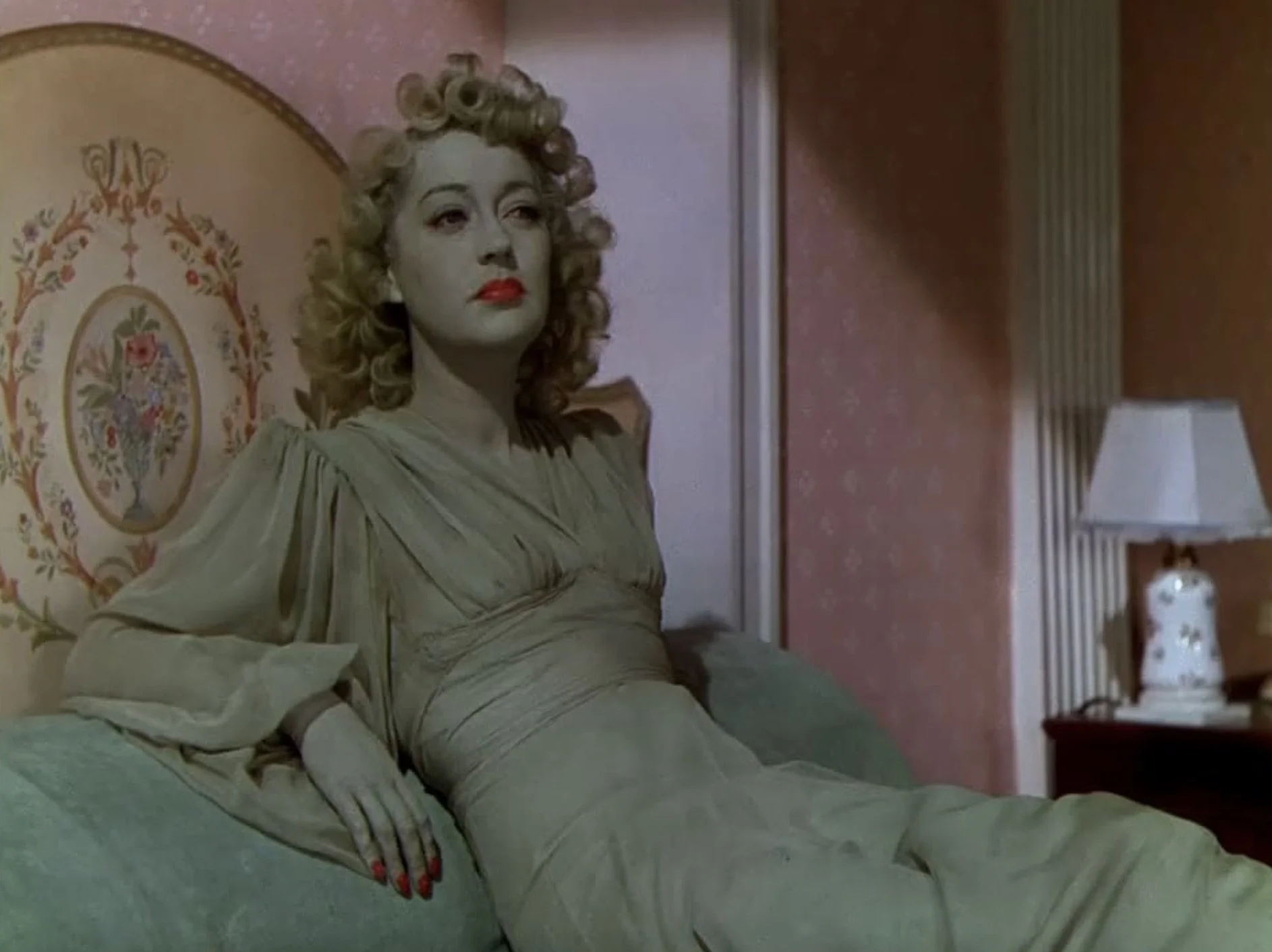
Blithe Spirit (1945) Image via IMDB
Ultimately, Blithe Spirit was not well-received, with audiences wondering how anyone could make such a farce about the dead in a time of war. Critics heralded the film as a lesser translation of the stage play—and we’re left with an oddball picture whose lesson seems to be…be careful what you wish for? Marriage is eternal damnation? We’re forever doomed by the romantic relationships we partake in? But at least we can laugh about it.
Eyes Without a Face (1959) dir. Georges Franju
Though Georges Franju’s 1959 film Eyes Without a Face isn’t exactly about a ghost, I’ll make the argument that its central character, Christiane (Edith Scob), is ghost-like in several ways. Her father, le docteur Genessier (Pierre Brasseur), is responsible for a car crash that resulted in Christiane’s severe facial disfigurement, condemning her to wear an expressionless mask over her wounds. After reporting Christiane missing, Genessier claims another woman’s body as hers, effectively faking her death, so that he and his assistant Edna (Juliette Maynel) can kidnap and surgically remove the faces of young women until they find the perfect replacement for Christiane’s visage. On one hand, you see a guilt-ridden father who wants to help his daughter; on the other, you find a man who would rather control her life and keep her out of sight than face his inability to accept her in her new form. Edith Scob’s performance, which Guillermo del Toro described as “an undead Audrey Hepburn,” (Guillermo del Toro on EYES WITHOUT A FACE - The Criterion Channel) is easily one of the most haunting in cinematic history, with Scob herself noting that because she did not have the privilege of facial expression, she had to move her body in sweeping, uncanny gestures to convey Christiane’s tattered emotional state. Still, she plays it cool. Her acts of rebellion are small, yet striking. It’s clear through her dialogue (“He has to control everyone, even on the road,”) that she resents him, but we never see outright aggression until the conclusion, when she releases her father’s pent-up pack of dogs, which go directly for his throat. Even then, she never directly strikes; it’s as if an unseen presence simply lets them free.
The three aforementioned films offer us amplified familial dynamics due to one person’s otherworldly transformation. When a character emerges in a different form, their shift in physicality both mirrors their living relatives and reveals their darker, instinctual natures. I don’t want you to read this and think that I’m endorsing you sic a dog on your Uncle Bob, or violently disrupt cousin Lily’s piano performance (though if you feel like that would be the most effective route for working through something, I cannot control your actions), but there’s something cathartic about exploring the relationships and conflicts that make us feel most alive. More so, maybe it’s worth it to visualize yourself as the apparition who comes back into another character’s narrative, to snuggle up to the dark pieces of ourselves no matter how much they spook us. Take a vitamin D supplement and spend some quality time with the ghosts you know.
Article written by Alyssa Waldron
Alyssa Waldron is an avid film lover and artist. When she’s not traipsing around the city or laughing at a silly joke, she's probably lying on the floor crafting miniature furniture (with Shudder streaming in the background). You can find her work @faintlygrainy.