
Strange Relics, Stories of Archaeology and the Supernatural, 1895-1954
Strange Relics, Stories of Archaeology and the Supernatural, 1895-1954, is the latest utterly enchanting anthology from Handheld Press, bringing together the best in short story explorations of the past and supernatural literature. Edited by Amara Thornton and Katy Soar, Strange Relics is easily on par with Handheld’s wildly popular Women’s Weird: Strange Stories by Women, highlighting the oft-neglected parts of horror’s literary history.
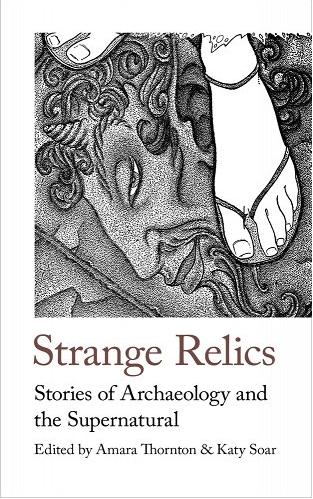
Strange Relics’ introduction from the editors highlights a very thoughtful approach to compiling the anthology. Determined not to include stories with racist tones or themes, the editors also explained that it was difficult to find stories that omitted these elements completely. Many of the explorations of the past in Strange Relics’ tales center around Roman ruins found in Britain, or British-occupied Egypt. But even with the motif of the colonizer, this assemblage of stories introduces an incredibly compelling idea: that we, the living in our forgetfulness, are colonizing the half-forgotten past of the dead.
Strange Relics opens with one of my favorite stories to date, Arthur Machen’s “The Shining Pyramid,” in which a friend goes to visit another who keeps seeing symbols composed of flints made on his property. Machen’s dedication to evocatively describing a haunting landscape adds a level of the strange to an already bizarre tale, as the Weird asserts its presence in ways no one could expect. How the tale is drawn together, by the end, is incredibly evocative of M.R. James’ own antiquarian horror tales, demonstrating that how we stitch together our knowledge of the past is just as important as its relics.
“The Ape,” by E.F. Benson, is another standout tale of an Englishman sojourning in Egypt, an incredibly strange time highlighted by how antiquities were bought and sold at market as if they were nothing more than food or trinkets. Between his travels and his finds in the market, the protagonist discovers a powerful ancient Egyptian ape amulet, imbued with the inherent power of all ape-kind. When the woman who toys with his heart pushes him too far, he runs the risk of losing his humanity due to the amulet.
Though each story brings its own value and charm to this collection, with this lineup of authors also including E. F. Benson, Algernon Blackwood, and Arthur Conan Doyle, I leave it up to the reader to explore the eerie wonders Strange Relics has to offer.
As an anthology, Strange Relics brings to the fore some of the lesser-mentioned excellence found in the work of authors like James and Blackwood, especially the duality of historical and occult knowledge. In tales like these, one form of knowledge begets the other, and in the end, they certainly belong together. This also indicates a much more personal approach to history and the past—that in being on old ground, we know that the ancestors are with us, and soon we will pass on to join them.
This approach to constructing stories about the past, and especially how we’ve come to think of archaeology as a field, makes looking at history a two-way process. As we look into the past, the pagan past peers back. With tales of Roman ruins found in the British countryside, and walking the grounds of Egypt in the shadows of ancient monuments, the past seems on the verge of erupting into the present. Though we may hold the line in the present, the monolith of the past casts a shadow over us all.
For fans of The Mummy, to those who have an interest in archaeology, and supernatural stories in particular, Strange Relics is an incredibly rare anthology that strikes the chord of wonder that enchants us as children. When reading these stories, you’ll remember that the past is always with us, just out of sight—and the strange figure in the woods, with goat horns and a telling gaze, is certainly staring back.
Article written by Laura Kemmerer
Laura tuned into horror with an interest in what these movies and books can tell us about ourselves and what societies fear. She is most interested in horror focused around the supernatural, folklore, the occult, Gothic themes, haunted media, landscape as a character, and hauntology (focusing on lost or broken futures).
