
Book Review: Circle of the Snake
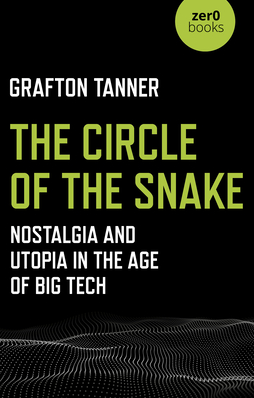
With an authorial skill on par with some of the best in critical literature, author Grafton Tanner, in his latest book Circle of the Snake: Nostalgia and Utopia in the Age of Big Tech, criticizes the intersection of the nostalgia industry and Big Tech and underscores the imminent need for dreaming a better future that is not at the behest of the surveillance state.
In Circle of the Snake, Tanner argues that nostalgia, as we have it today, is partially a result of the attention economy. However, there are other factors at play as well: nostalgia for the past—particularly the ’80s to the pre-Recession early to mid-2000s—that arises during economic uncertainty, and how nostalgia, like anger, is readable by AI. As a result, Big Tech’s predictive algorithms have trapped us into nostalgic feedback loops, making engagement with history itself a tourist’s game and resulting in cultural amnesia. Tanner examines different media ranging from Black Mirror to It Follows (2015) in his look at the myth of the digital utopia and the very real danger of nostalgia being weaponized to spread fascism.
As someone who is still very early in reading leftist literature, what remains the most important to me about Tanner’s work is that both Circle and his first book, Babbling Corpse: Vaporwave and the Commodification of Ghosts, provide a blueprint and a map for understanding where we are in the cultural landscape. He does this by delving into distinctions such as personal and cultural nostalgia, how our understanding of the feeling has changed over time, and how there is a lack of novelty in the very recommendation algorithms that guide so much of our media watching and purchasing power. All of these elements, plus so many others, reach insidiously into different facets of our lives. Even things seemingly as innocuous as coloring books for adults, part of the “kidult” industry, encourage people toward compliance. The perpetual revising of canon in movie franchises is an attempt to control the past, as well as encourage a simplistic understanding of the world. And these are just a few examples. Nostalgia is an emotion of control.
With many of the technocrats that developed social media still preaching the myth of the digital sublime and the algorithms they designed keeping the average person locked in a feedback loop of a manufactured, dangerously oversimplified version of the past, we find ourselves with no vocabulary for our present, let alone capable of dreaming up a future that is not controlled and surveilled by Big Tech. We cannot hope to escape the haunted house until we understand its layout, and Circle of the Snake is a critical part of that blueprint.
Tanner’s work has the uncanny ability to describe exactly what you are experiencing in your everyday life, from choosing something to watch on Netflix to the poor mental health brought on by social media. Paired with this ability to hit so close to home, Tanner’s adept, approachable writing style leaves the doors open for the novice and well-read alike, encouraging conversation and further attention to one’s own social media and tech habits. What is just as important, though, is that though this book is a crucial word of warning, there is still hope: The tech we engage with every day is written and perpetually updated to target weak points in our psychology, but on the other side of that, we are incredibly messy, unpredictable creatures and no AI can truly always predict what a person will do. To me, that finicky behavior—that uncertainty, warts and all, the real side of being human that does not fit neatly into recommendation algorithms and nostalgia feedback loops—is a crucial part of the road out. Humans were the ones to build these systems, and we can dismantle them. We can draw from the past to help inform a better future, but we cannot go back. We also cannot let Big Tech write the future for us.
Fundamentally, the success of Big Tech is the success of killers in slasher movies. The killer knows how and when to anticipate human mistakes and weaknesses, but herein is the same downfall: Big Tech, like the killer, cannot 100% predict what people will do. That erratic side of us may very well be the final girl that survives the killing spree. Though these tech giants may market to us on a nearly microscopic scale and try to guide our behaviors and preferences, our erratic, messy, imperfect sides may be what draws us to see the dawn after the slaughter, after the age of Big Tech.
I received a copy of Circle of the Snake in exchange for an honest review.
Review written by Laura Kemmerer
Laura tuned into horror with an interest in what these movies and books can tell us about ourselves and what societies fear. She is most interested in horror focused around the supernatural, folklore, the occult, Gothic themes, haunted media, landscape as a character, and hauntology (focusing on lost or broken futures).


Filmmaker Bari Kang discusses Itch!, from its practical gore and zombie influences to filming in his own NYC store and directing his daughter.