Movie Review: Haunt (2019)
An incredibly well-paced haunted house-slasher hybrid, Haunt (2019) both demonstrates some of the most solid screenwriting I’ve seen in the slasher subgenre in recent years, but also highlights how much growing up horror still has yet to do.
Like other similar haunted house attraction flicks, Haunt revolves around a group of friends who, on Halloween night, brave their darkest fears by visiting an extreme haunted house, heralded by a liability waiver. Dogged by both a rocky relationship with an abusive boyfriend and traumatic family past, Harper (Katie Stevens) must confront her own demons in order to pass through Hell on Earth.
Written and directed by Scott Beck and Bryan Woods—known for their work on A Quiet Place (2018)—Haunt hits many of the same beats in terms of structure, pacing, and scares. A structurally sound script keeps the viewer both engaged and feeling on edge, while the scares themselves are largely jump scares—something that, across the genre, generally fails to build dread effectively. It could be argued that part of the success of slashers lies in being able to build fear, even with the expected fun kills. However, once you pair slasher with the haunted house attraction flick, the fun comes more from the “gotcha” moments and kills combined, and Haunt certainly has plenty of those.

One of the elements that caught me the most about Haunt was the writers’ treatment of the mind as a haunted house, though the way the theme was handled hit as hard and as obviously as the killers’ sledgehammer. This narrative choice put me immediately in mind of the discussion of fate to be found in the first Halloween, and though Haunt resolves in much the way you assume it will, I maintain that adding that little bit of thematic meat to a usually spare genre skeleton makes things just that much more relatable and fun.
Cast performances were on par for what you’d expect from a movie like Haunt, making things relatable and that you felt like you were along for the ride. Bailey (Lauryn Alisa McClain), Harper’s best friend, roommate, and would-be interventionist, delivered one of the better performances through her emotive range. The writing ultimately let the character down, however, as we never get to know Bailey on her terms—even just a couple of minutes of exposition about her and where she’s coming from as a person were completely missing. This is where I start to face some snags with Haunt: Though character simplicity could be argued to be a staple of slasher movies, there is a distinction between that and a Black woman character being written solely as an emotional support character for the White protagonist. Almost no one makes it out of a horror movie alive, but that isn’t a reason to not do right by your characters.
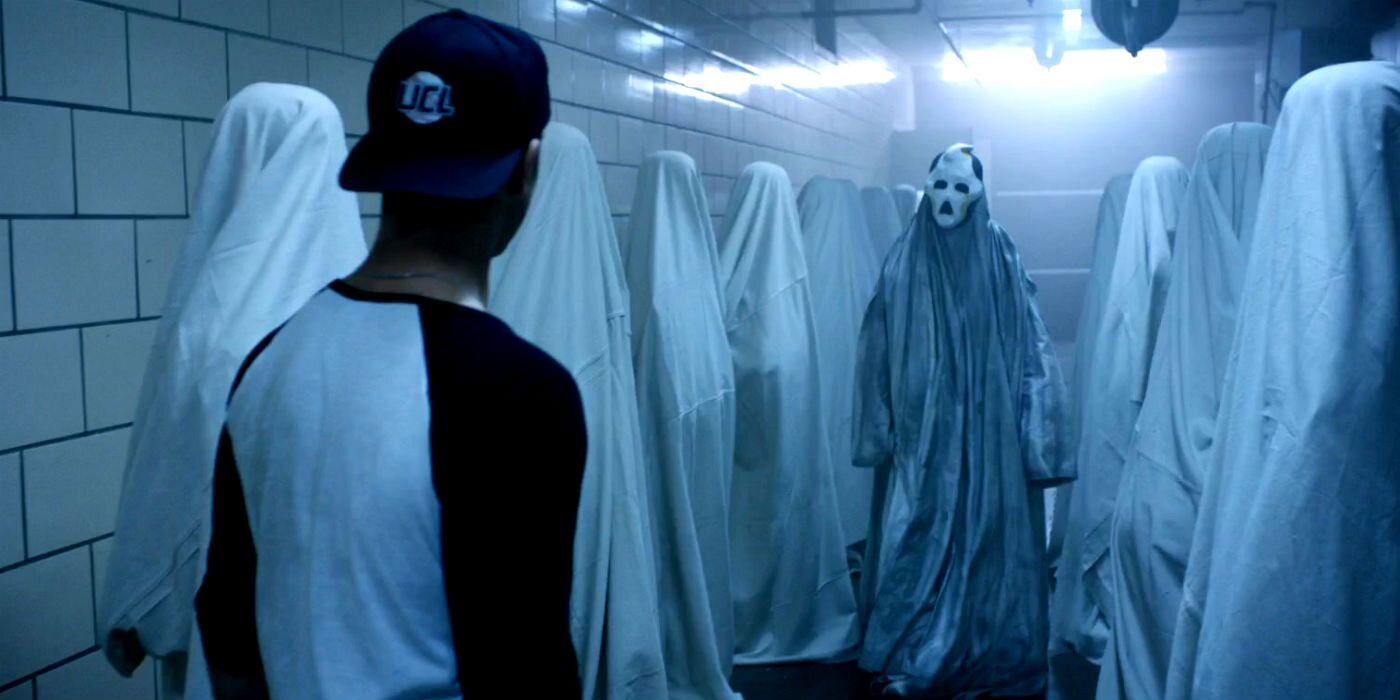
Major kudos are due for both practical effects and special effects make-up, as gore delivered on that visceral discomfort that marks the high-quality stuff. Killers’ makeup was also visually interesting and well done, but the implicit coding of all of these killers being heavily pierced, tattooed, and scarred made me raise my eyebrows more than once. The actors did their job well, but this is also a moment that shows a growing pain spot. Given Harper’s own traumatic past, having the killers look like nothing more than nondescript White men would have been far more effective. The horror of movies like Haunt is being unable to tell the difference between what is real and what is staged. Having killers that look so starkly “different” seems to be a copout when Harper’s lived horror and trauma is rooted in the reality that we can never know what an abuser, let alone a murderer, actually looks like.
For my criticisms, though, Haunt is an incredibly fun Halloween horror watch, capturing the thrills and chills of the season and the extremes we’ll push ourselves to for the sake of October. Though I wish I could go to a haunted house this year, Haunt is as close as I can get for right now.
Article Written by Laura Kemmerer
Laura tuned into horror with an interest in what these movies and books can tell us about ourselves and what societies fear. She is most interested in horror focused around the supernatural, folklore, the occult, Gothic themes, haunted media, landscape as a character, and hauntology (focusing on lost or broken futures).
