
TV Review: The Haunting of Bly Manor
Hopefully by now all the binge-watchers and casual series-strollers have made it through the latest season of Netflix’s The Haunting anthology series, The Haunting of Bly Manor. Created by Mike Flanagan, Bly Manor successfully held up to its predecessor but innovated more creatively by using different approaches. In the retelling of Shirley Jackson’s 1959 classic The Haunting of Hill House, viewers were met with many things people love about horror: lurking spirits, jump scares and traveling back and forth through time, the viewers eagerly searching for rhyme or reason as to why the house was so haunting.
On the contrary, Bly Manor seemed to have a way of slowly walking you through the trauma, love and mystery of what haunted its characters in the loose retelling of Henry James’ 1898 novella The Turn of the Screw and other short stories. While in the written story readers are left to determine if the hired governess was troubled or haunted, Bly Manor does a beautiful job in revealing the true ghost story.
What’s the story? Well, if you haven’t finished the series . . .
Spoilers ahead!

The Haunting of Bly Manor (2020)
Program Creator: Mike Flanagan
As the Turn is told to us as a borrowed ghost story, our narrator recollects that some time ago, a young governess was hired to care for a wealthy man’s recently orphaned niece and nephew at the family’s estate, Bly Manor. Over time, however, things become sinister and strange as the governess begins seeing spirits—or so we think—and grows to believe that there could be something wrong with the children. Later, the estate’s servant, Mrs. Grose, tells the governess about a forbidden romance between Miss Jessel—the children’s previous caretaker—and another Bly employee, Peter Quint, both having since passed prior to the governess’ arrival. One could assume that these are the characters haunting the estate and later, conversing with and possessing the children. Yet the story never actually provides proof for the theory.
Differing ever so slightly, Bly Manor, too, begins with a borrowed ghost story and takes us right into the ’80s, where Dani Clayton (Victoria Pedretti) has moved from America to the U.K and is seeking a job. Although living out of a hostel for some time and running from something we don’t quite know about yet—we just see hints of grief in the coverings over her mirrors, worried calls and accusations—Dani lands a private teaching position, only after an awkward interview and unexpected drinks with the children’s uncle, Henry Wingrave (Henry Thomas).
Once at Bly, having been driven by Owen (Rahul Kohli)—the estate’s chef and sometimes driver—Dani is quick to meet orphans Flora (Amelie Bea Smith) and older brother Miles (Benjamin Evan Ainsworth), as well as somewhat distracted housekeeper Mrs. Grose (T’Nia Miller). Dani is instantly charmed by Flora’s perfectly splendid charisma and slightly annoyed by Miles’ boyish curiosity. The two seem rather normal having experienced such a traumatic life event so early in their lives. However, it doesn’t take long after first impressions are made to see that the children aren’t quite right.
Eventually, we learn that every character is a little off one way or another, having suffered from their own story of grief or tragedy. With Dani, we discover that she is deeply haunted by the tragic loss of her fiancé (which she feels guilty for), constantly seeing the ghost of his silhouette and headlight-lit glasses reflecting in mirrors. With Owen, his story involves the sad return to a life he never wanted, and had even escaped from, to take care of his sick mother—who, in some ways, has already passed on. Mrs. Grose grieves, like the children, for the unexpected loss of Charlotte and Dominic Wingrave, as well as for the deceased Rebecca Jessel (Tahirah Sharif), who we are originally told killed herself in the estate’s lake. Henry Wingrave, too, grieves for his lost family members, but also feeds his guilt scotch, brandy and an overbearing work schedule for having had an affair with his brother’s wife. Peter Quint (Oliver Jackson-Cohen) and the estate’s gardener, Jamie (Amelia Eve), also share similar grieving stories, both related to their families and abusive upbringings.
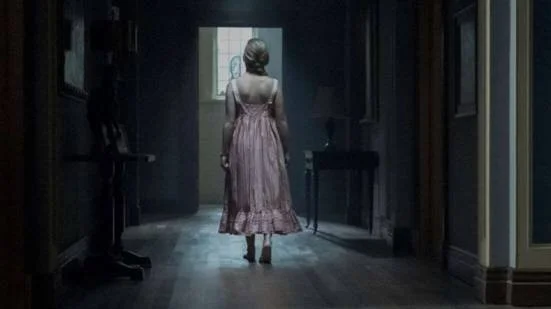
However, getting further into the series, viewers learn that these stories and memories are just chapters in this tale of terror. Similar to Hill House, hidden ghosts haunt the estate’s rooms, some so present they have Flora-created dolls or talismans made to represent them in her dollhouse manor replica. While I think most can agree that all dolls are creepy, especially in a horror film or series setting, the creepiest of all is Flora’s adaptation of the Lady in the Lake. This faceless figurine features skeleton-like hands and is most commonly placed under Flora’s dresser or somewhere out of sight. That is, until she decides to come into the house.
Yes, as aforementioned, dolls are creepy. And while the Lake Lady takes the cake, all of the dolls in Flora’s collection are strange, moving room-to-room in sync with their real-world counterparts. This is how Flora knows if guests are staying in their rooms or if the Lake Lady is roaming inside. While it takes some time to pick up on these features, everything the viewer learns in the meantime is compelling, providing a seemingly constant underlying dread.
And then, when the time is right, the truth begins to unfold and the mirrors are uncovered.
We learn that Dani feels guilt over her dead fiancé because she broke up with him just moments before; Owen’s mother actually dies; Henry Wingrave might actually be Flora’s father; Peter Quint was taken by the Lake Lady and sometimes posses Miles; Miss Jessel had fallen in love with Peter prior to his passing, and was tricked by his ghost into dying so that she could be with him forever; and Mrs. Grose has been dead since the day Dani arrived.
As much as I wish I could take you through each beautifully portrayed episode of this story—each named after the title of one of James’ short stories—you’ll know if you just watch. However, the most notable episode would have to be the eighth, “The Romance of Certain Old Clothes.” This black-and-white feature gives the viewer what they’ve been patiently waiting for: the explanation of how Bly Manor came to be haunted in the first place.
In another rather tragic story dating back to the 17th century, sisters Viola (Kate Siegel) and Perdita Willoughby (Katie Parker) share Bly Manor. In a downturn of events, Viola gets “the Lung” and grows gravely ill for years and years, until Perdita takes her life after growing tired of caring for her sister. In her death, Viola finds that she is trapped in her bedroom, which now serves as the inside of a locked trunk, filled with gowns and jewels intended for her daughter. Every moment she sleeps, she wakes and she walks, waiting for her daughter to open up the chest. However, impatient again with finances threatening the estate, Perdita opens the chest herself. Viola, outraged, strangles her sister to death through the sleeves of her own gown. Following the tragedy, the chest is thrown into the estate’s lake, where Viola’s spirit continues to sleep, wake and walk to her old room in Bly Manor, waiting for her daughter.
She never stops looking. Even as she’s slowly forgotten, her face fades from memory, but her routine never ceases.
She sleeps, she wakes, she walks.
After centuries of haunting Bly, Viola’s spirit finally finds a resting place within Dani during a crucial moment where Flora’s life is at stake. Left feeling haunted yet again, we feel our heartstrings pulled when Dani decides to spend the rest of her years with Bly gardener Jamie until the pull of the Lake Lady takes over, summoning her back to Bly. Some 20 years later, we are found at the end of the telling the borrowed ghost story, with none other than Jamie as the narrator.

Full disclosure: I cried at the end of this series and I am unashamed. While the story has undergone much criticism for choices made, its lack of horror aesthetics as witnessed in Hill House or the faulty accents, I found it to be just as the bride and Jamie described it as its end—both a love story and a ghost story.
Flanagan knew that, and that’s why I think he chose to portray the story in this way. In a statement, Flanagan said, “Gothic romance is often misunderstood––something about the ‘romance’ lends itself to expectations of something tawdry, syrupy. Sappy even. But in Henry James’ world, ‘romance’ had a different connotation. Romance meant mystery and excitement––and Gothic romance meant horror and ruin. Romance held buried secrets, supernatural agony and the sense of encroaching doom. Gothic romance, it turns out, has teeth.”
In those terms and on the screen, I completely agree and stand by the opinion that the retelling of Turn was successfully executed, possibly even better than some of its adaptations, specifically The Turning (2020) or The Turn of the Screw (2009). While a ghost can haunt us in the traditional way—a lurking spirit or some strange encounter—the same can be said for a painful memory or lost loved one. That’s the romance of it: “To truly love another person is to accept the work of loving them is worth the pain of losing them.” We feel pain when they’re not here, we feel pain when we think we see them, we feel pain when we remember and we feel pain when the memory fades. Contrary to popular belief that you need to see a supernatural figure to be haunted, sometimes all you need are your memories and a void.
Article Written by Destiny Johnson
Destiny writes about true crime and thrillers. She likes movies and stories that make you question the world around you, more so than what makes you jump.

![Letters To The Purple Satin Killer [Book Review]](https://images.squarespace-cdn.com/content/v1/5d3e481bc5a6e40001b215a8/1737827737735-EBFQ2I9BEDMC4HTPK5ZJ/purple-satin-killers-cover.jpg)


If you’re someone who frequents oddities or metaphysical shops (hell, even antique shops in some instances), you start to get pretty good at sensing the authenticity of not just the items around you but the people, too. You’re able to distinguish whether or not those standing behind the counter love the stuff as much as you or if they’re in it for some other reason, be it money, fad, or something else.