
Letters To The Purple Satin Killer [Book Review]
Released in August 2024, Joshua Chaplinsky brought a new angle to the crime horror scene with Letters to the Purple Satin Killer. Unlike other crime fiction novels, or even true crime for that matter, readers were able to follow the story of Pennsylvania native and serial killer Jonas Williker entirely through letters written to him by his mother, the bereaved, investigators, and even self-proclaimed “fans.” In a twisted world where Americans’ obsession with murderers is brought directly into the spotlight, by reading this novel, one submits themselves to a sort of dance where every entry in the collection makes them feel repulsed by the serial killer’s actions, but also forces them to confront their own fascinations with him, and those writing the letters, too.
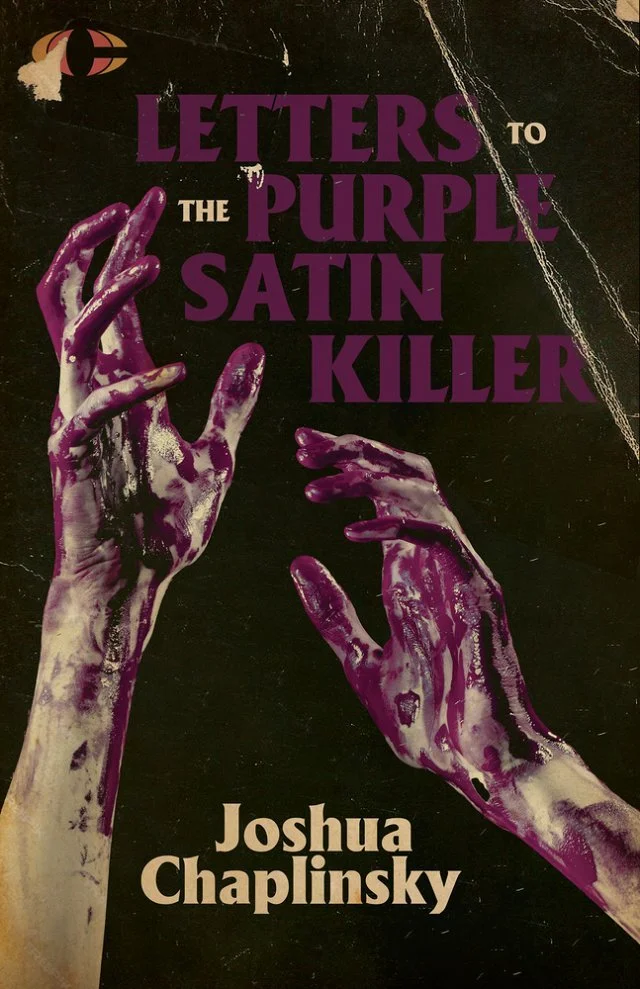
As you’ll learn from the book’s description and in the novel’s foreword, Jonas Williker was arrested in the early 2000s for the rape and murder of 23 women across five states. However, like other prolific serial killers, he was suspected of committing over a dozen others. His signature and reason for his nickname the Purple Satin Killer (PSK)? Leaving a piece of torn purple satin fabric on—or inside—the bodies of his victims.
Crime Horror Fiction
Having grown up in western Pennsylvania myself, it was really easy to immerse myself in the setting and several locations mentioned where Williker’s crimes took place. While this was a creepy and unexpected personal connection, I also found several similarities pulled into his story from other historic serial killers of our time. Ted Bundy’s story likely held the most parallels, with Williker’s self-representations in court, attempted escape, marriage during court hearings, and later, conceiving a child despite being behind bars. Of course, the malice of his crimes and acronym also being notably similar to BTK (Bind, Torture, Kill) was something I picked up on as well. I thought that having these dots for readers (likely fans of true crime) to connect, didn’t necessarily cut corners in terms of unique storytelling, but gave us a real connection in an otherwise, completely fictitious crime story. Strangely, I think that this was perhaps ingenious in that fans of true crime could find themselves segueing into a world of crime horror fiction without sacrificing some of the aspects that pull us into the nonfiction genre. In the same breath of this realization, I believe this form of crime horror also makes the reader look in the mirror and address what our real fascinations are and determine what pulls us to these sadistic stories.
Apart from how one might feel about themselves after reading this story, it’s certainly worth the risk for the style and emotional roller coaster that Chaplinsky takes you on. Broken into letters just as the title describes, the book gives readers the ability to pick up and put down the book without feeling like they’re stopping at a crucial point in the case’s investigation or court testimony as described in traditional nonfiction books. No, in something much less dense that provides just as much of a gut punch, we get to peek inside the minds of those writing to PSK and what their motive might be in writing to a serial killer. Is it because he’s a family member? A long-lost friend? Is he the one who took your loved one out of this world? Is he someone you think is sexy? Were you the only surviving victim? Or perhaps, he is someone that you’re studying? There are countless reasons why a person may feel so compelled to write to such a monster in the eyes of society. But just like every story has two sides, most letters also have a reply—which we never get to see from Williker himself. This leaves a sort of mystery to his character, other than what we can piece together from the foreword and subsequent letters.
Unlike what seemingly has made documentaries like Conversations with a Killer: The Ted Bundy Tapes or This is the Zodiac Speaking so popular, readers don’t ever get the killer’s perspective in any capacity; we never get a glimpse inside his mind and yet, we are still soaking up every letter for hints, clues, and takes on his character and the many writers’ fascination with his crimes, and for others, his potential innocence. Everyone wants to know, was he always a bad seed? They’ll diagnose his upbringing, his family, and his otherness. Others will search for an almost switch-like instance in his life where things just—changed. I think that in every crime story, this is the question we chase the most: Why? And while you won’t find the answer to that question in this book or an accumulation of fiction and nonfiction take on crime, you will find that answer for folks writing in, and perhaps, an answer in yourself.
Article by Destiny King
Destiny is a supporting member of the Horror Writers Association who’s been working in B2B publishing for nearly a decade. Her favorite horror subgenres are true crime, found footage, and psychological thrillers. Find her on Letterboxd.
Other Articles You May Enjoy…
![[Book Review] “Lucky Day” by Chuck Tingle](https://images.squarespace-cdn.com/content/v1/5d3e481bc5a6e40001b215a8/e8575a10-be74-4271-a16d-82f382a697de/lucky-day-cover.jpeg)
![[Book Review] The History of Transgressive Canonical Horror in ‘Infernas’](https://images.squarespace-cdn.com/content/v1/5d3e481bc5a6e40001b215a8/1780334508834-FPWJNG55Y5B961VWDIV2/infernas.webp)
![[Book Review] ‘Women’s Weird 2’ from Handheld Press](https://images.squarespace-cdn.com/content/v1/5d3e481bc5a6e40001b215a8/1603651527264-WJM6E7YN6ZH9DCJADIUJ/HP_Womens_Weird2_Jan2020-500x800.jpg)
![[Book Review] ‘New Blood: Critical Approaches to Contemporary Horror’ (2021)](https://images.squarespace-cdn.com/content/v1/5d3e481bc5a6e40001b215a8/1771939414929-RYHRUZYSVD519FZITQQ1/9781786836342.jpg)

Through a blend of horror studies, philosophical analysis, and aesthetics, Ordinary Horror: The Aesthetics of Deformation from Leopardi to Ferrante by NYU professor of Italian studies Andrea Capra explores undiscussed nuances in contemporary and canonical Italian literature alike.