
WSB x Moving Picture Review: Wolf Man
As Leigh Whannell’s Wolf Man began playing on the screen at Pittsburgh’s AMC theater in the Waterfront, I thought for a brief moment that the movie would not be as bad as some of the screener review headlines I tried to avoid were claiming. I haven’t seen many werewolf movies in their entirety, mostly snippets and reference scenes. What I have seen, however, is a collection of folk horror and urban legend films, like The Windigo (2024) and The Ritual (2017), among others. Noting this, I thought perhaps my lack of familiarity with the subgenre would give me a fresh lens. While in some ways it did, in others, I think the shortcomings were simply just points where the movie unfortunately missed the mark.
In the very opening scene of the film, viewers are prompted with a text-told story about a hiker in the 90s who went missing. It was believed that the hiker became lost and suffered from what folks in this remote part of Oregon called “Hills Fever.” The term refers to an animal-borne virus that Indigenous people also had a name for: “the Face of the Wolf.” Given the world’s recent brush with viruses, I thought this was a good attempt in grounding the condition to reality.

Planting the idea in our brains, the camera pans over Pacific Northwest landscapes where clouds gently wrap themselves around thick, pine-covered mountains and spew into wide valleys sprinkled with rock-filled creeks. Like many folk horror films, the landscape, although beautiful, reminds us that it’s unknown—and perhaps the knowledge we’ve learned from inhabitants in the years before us—could be the death of us if we’re not careful. This theme is further implied by Blake’s (Christopher Abbott) father, a local farmer and hunter (Sam Jaeger) who comes off as much more authoritarian, almost military-like, instead of a warm dad role. Although we never learn what happened to Blake’s mother, it’s clear that it left an impression on the remote duo. While hunting deer, Blake’s father sternly explains how people can be taken from you in an instant—“It’s not hard to die; it’s the easiest thing in the world.”
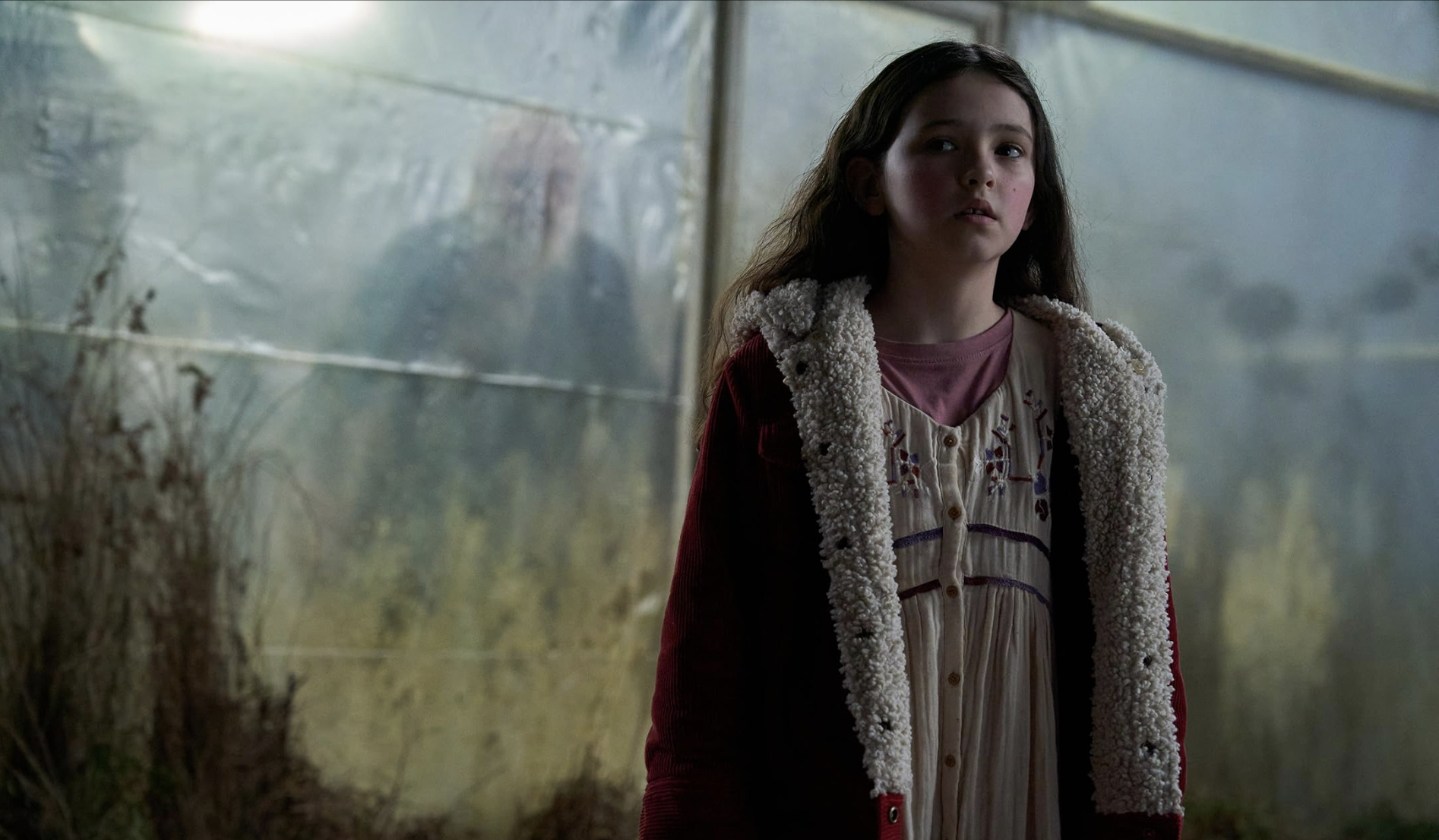
Flash forward 30 years and we learn that Blake has left the remote mountains of Oregon and traded the seemingly peaceful homestead life alongside his dad for a bustling city. In the same scene, we meet his daughter Ginger (Matilda Firth), and soon after, his work-driven wife, Charlotte (Julia Garner). While it’s shown more than told how rocky things are in not just their marriage, but also in Charlotte’s relationship with her daughter, a letter in the mail provides an opportunity to break away from everyday life and give their family some time to regroup. Like the hiker in the 90s, it seems that some time ago, Blake’s father went missing and the state had finally pronounced him dead despite never finding a body.
Without giving anything else away that the previews wouldn’t already tell you: it’s clear that while on this trip to pack up his late father’s belongings over the summer, Blake will become infected with the Hills Fever and transform into the Face of the Wolf. What isn’t explained is how much of this transformation the viewer gets to see from the perspective of Blake’s family, as well as his own perspective. I thought that this was a unique take, both in terms of playing with special effects and infrared cinematographic aspects, but also in that it centers around what I found to be the true focus of the film: relationships. Specifically, communication and how our relationships transform as a result of lack of, or rather, inability to communicate.
From the beginning of the movie, we witness how Blake and his father’s relationship affected him. That so much pain and desire to protect your family could turn you into a pain for them. We see how this chased Blake to the city and how the loss of his job and being everything his dad wasn’t to Ginger, also affected his relationship with Charlotte, who likely fell in love with him for his ambition. They’re both writers but haven’t been able to speak a word of truth to one another until being confronted with this monster and virus that inevitably destroys their lives as they once knew it. In putting these pieces together on my own, I think the movie would have been more successful if it was able to explore this more deeply, and perhaps provide a greater weight into why we should care about Blake’s very real, and ultimately, very heartbreaking transformation.
Despite the shortfalls in characterizations, I do think the film is worth watching—if nothing else, then for the scenery and cast performances. However, if you were looking for a strong connection to the story or a new werewolf film to scare you under a full moon, this probably isn’t it.

WSB x Moving Picture Reviews is sponsored by the Pittsburgh Moving Picture Festival. The Pittsburgh Moving Picture Festival celebrates both the art of cinema and the rich motion picture exhibition tradition of the City of Pittsburgh. Our goal in this series is to highlight new and upcoming genre films and, wherever possible, to support local, independent movie theaters in the process.

Article Written by Destiny King
Destiny is a supporting member of the Horror Writers Association who’s been working in B2B publishing for nearly a decade. Her favorite horror subgenres are true crime, found footage, and psychological thrillers. Find her on Letterboxd.