
Kids These Days Don’t Walk Abroad Among Their Fellow Men Anymore
Hauntings are a very well-known horror phenomenon. From Shirley Jackson’s The Haunting of Hill House and its many adaptations to the countless haunted houses that pop up every October, to haunted house movies like J. A. Bayona’s The Orphanage (2007) and The Conjuring (2013), directed by James Wan, horror audiences are no strangers to ghosts. But a horror story that is often unjustly left off of horror lists, though it features prominently on many Christmas ones, is Charles Dickens’s A Christmas Carol.
A Christmas Carol is widely known as a Christmas story, but, although the ghosts are the driving force of the whole thing, it’s not considered a horror story. There are two problems here. The first is that I am a firm advocate that horror can be smart, funny, and heartwarming, and denying or not acknowledging a horror story as a horror story adds to the belief that anything that is called horror could not possibly be any of those things. The second problem is that, while it is indeed a Christmas story, A Christmas Carol isn’t really about Christmas. While the season is very important to the goings-on, Scrooge isn’t being asked to change his attitude about Christmas—he is being asked to change his attitude about humanity using Christmas as his lens. These two pieces of information are vital to keep in mind while analyzing A Christmas Carol, and its place in the horror canon, where it belongs.
As previously established, A Christmas Carol is about a haunting. While it may not be a typical haunted house story, its plot revolves around the ghosts that visit Scrooge to convince him to change his ways. Whether it’s his dead partner, Jacob Marley, or the exuberant Ghost of Christmas Present, Scrooge is haunted throughout the story until he learns to be kind and “walk abroad among his fellow-men” (Dickens, 26). The scene where Scrooge is taken to the cemetery is genuinely chilling, as are the scenes that precede it, of various London townsfolk pawning off his belongings, celebrating his death, and laughing about his life. It hits all the notes of a good horror story, from ghosts to cemeteries to existential dread, and is still one of the most lasting and famous Christmas stories ever.
Due to this longevity, there have been many filmed adaptations of A Christmas Carol over the years, from miniseries to animated musicals to Muppets. And each of these adaptations plays a little differently with the horror aspects of the story. The adaptations in particular that I would like to draw attention to here are Richard Donner’s Scrooged (1988), A Christmas Carol (1984), directed by Clive Donner, and Brian Henson’s The Muppet Christmas Carol (1992). The main difference between these three movies—barring the obvious style choices—is in the ways that Scrooge is played, and the reaction he has to his torment.
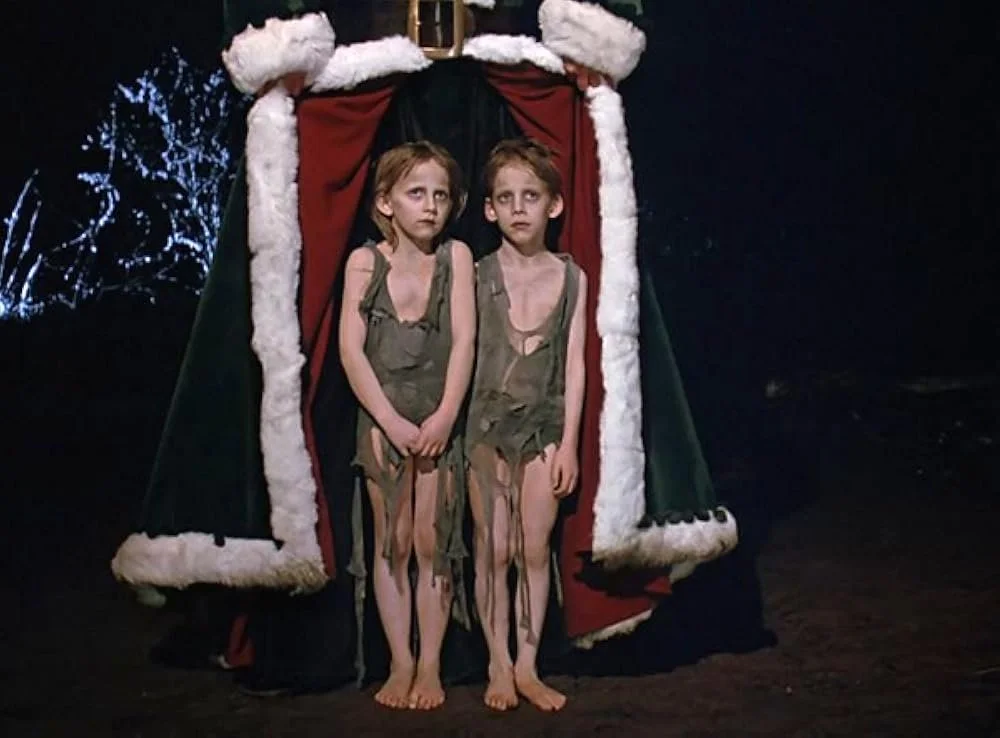
“Ignorance” and “Want,” in A Christmas Carol (1984), Image via IMDb
In A Christmas Carol (1984), the most down-to-earth of the three, George C. Scott’s Scrooge is irritated right up until he wakes up after the third spirit has gone. He grumbles and sneers as he is shown the love of his life, the gaunt children Ignorance and Want, even as he sees his own grave. Despite being haunted by the scariest versions of the spirits I’ve seen yet, Scott’s Scrooge doesn’t seem particularly terrified. At most, he is saddened by the sights he is shown, as evidenced when he breaks down sobbing after reliving his youth, but not scared.
By contrast, in The Muppet Christmas Carol, Michael Caine makes the audience feel every second of Scrooge’s redemption. He plays the entire thing as though the Muppets are simply fellow actors, and, as a result, Scrooge’s character stands out in sharp contrast to those around him. In his first appearance, he’s a tall, dark, imposing figure that looms over the Muppet townspeople around him. However, as the movie goes on, he almost seems to shrink, until he is able to connect with them as they are. The spirits in The Muppet Christmas Carol are very accurate to the text—save for Jacob Marley, who becomes a pair of brothers played by Statler and Waldorf—and are, therefore, pretty damned scary. But Michael Caine plays Scrooge’s redemption as a tragedy with horror elements. He shows the audience that Scrooge is a broken man already, to need this haunting, then builds and builds the sorrow of Scrooge’s life until he finally snaps after the third spirit’s departure.
Bill Murray’s character in Scrooged, unlike the other two, is terrified. Renamed Frank Cross for this film, he is a selfish television executive who is properly tormented into being a better person. Murray plays the sadness and terror inherent in any Ebenezer Scrooge character perfectly, playing up every moment of emotion almost over the top but not quite, from his angry ravings about his past, to his sorrow and desperation on finding Herman—a homeless man he’d met earlier—frozen to death in the sewer. Murray makes it clear that this man has not just been saddened into redeeming himself, he’s been scared nearly to death. While he might not be dealing with the scariest-looking spirits, Frank Cross is subjected to the most horrifying torture of any Scrooge yet. He sees the woman he loves become selfish and cold, watches as he gives her up for fame, and is even forced to witness his own sparsely attended funeral, where he then materializes in the coffin and is burned alive. Scrooged, more so than any other adaptation, is a proper no-holds-barred horror movie.
Holiday Horror
As much as A Christmas Carol is a prime example of a Christmas horror story, in the same category as Black Christmas (1974), dir. Bob Clark and Damien Leone’s more recent Terrifier 3 (2024), I would like to take a moment to point out the connections it has with more standard, less seasonal, horror movies. The movie I want to focus on in particular in relation to A Christmas Carol is William Friedkin’s The Exorcist (1973). The Exorcist is obviously not a Christmas movie, but it is also about a man redeeming himself and his place on Earth through otherworldly means. Ebenezer Scrooge is miserly and nasty, and therefore must be redeemed or wander the Earth as a ghost, as he did not do so in life. Father Damien Karras is a Jesuit priest and counselor who has begun to question his faith, and so must be redeemed or, we assume, end up in Hell. And both of these men find that redemption in other peoples’ suffering. Father Karras finds his in Regan MacNeil’s demonic possession, using her pain to save himself by finding enough of his faith to drive out the demon, moments before his death. Ebenezer Scrooge finds his redemption in the Cratchits, the poor family whose patriarch he employs. At the beginning of the story, he is abusive to Bob Cratchit, both verbally and financially, bullying him, refusing him warmth, not paying him properly for his hard work, and nearly making him work all of Christmas Day. He is forced into redemption by four ghosts, the first, his dead business partner, Jacob Marley, the rest, spirits of time, come to show him what Christmas truly is—and what will happen to him if he does not learn the message it brings. Both Scrooge and Karras are terrorized into faith and humanity, as many others in the horror canon have been over the years. This parallel does many things, not the least of which is to further prove A Christmas Carol’s place in horror, but it also shows that A Christmas Carol was never really about Christmas.
While A Christmas Carol is, at its core, a horror story, it is also undeniably a Christmas story. There is, as I mentioned before, a fine tradition of Christmas horror movies, like Black Christmas, Better Watch Out (2017), Christmas Evil (1980), Gremlins (1984), and Terrifier 3, to name a few. But, with most of these films, as with A Christmas Carol, Christmas is more a contrasting backdrop to the horrors onscreen than anything else. In Black Christmas, the festive season adds a bright and cheerful backdrop that makes the terror and manipulation of the plot stand out even more horrifically. In A Christmas Carol, Christmas is the lens through which Scrooge is asked to look at humanity. A Christmas Carol posits that Christmas is when people are at their best, in a time of coming together during the darkest and coldest part of winter. The contrast to Christmas in A Christmas Carol is not that of murder, or possession, but is instead the evil that is Scrooge’s miserliness and misanthropy, shown as the ghosts lead him through his life. He is forced to watch as he neglects the girl he loves for the promise of business and money, as he puts the Cratchits and their lives in jeopardy so that he can have more money for himself, and, finally, as he dies alone, his death celebrated by everyone who knew him, and his belongings sold. While the ghosts are haunting, as is the cemetery and other such spooky scenes, the real fear in A Christmas Carol is of greed and bitterness, of what happens when all joy in a person is taken by greed and rigidity. Christmas is merely the background, only there to show how far gone Scrooge is, that he won’t ever stop working, not even to spend time with the girl he loves, or his nephew and his family, on this most joyous holiday.
There are enough movies, books, and TV shows about hauntings that they are a proper subgenre of horror. Many, many people have written ghost stories, and many more will in the future. A haunting is a beautiful thing, a little piece of the past (or present or future) coming back for more, whether it’s sowing more fear or needing more love, ghosts will always be a vital part of the horror genre. And none can prove this point better than one of the originals. A Christmas Carol is a cultural touchstone, a wonderfully scary ghost story, and a beautiful tale of Christmas that is full of heart. It deserves a well-honored and recognized place in the horror canon, and is, without a sliver of a doubt, one of the best horror stories ever written.
Article by Blaise Balas
Blaise Balas is an avid horror watcher, reader, and writer. She is the creator of the blog So Desensitized, which seeks to dispel the myth that "kids these days" don't understand or appreciate horror media. Blaise absolutely adores Twin Peaks, and is fascinated by everything wonderful and strange. Find Blaise on Instagram @blaisebalas.

Other Articles You May Enjoy…
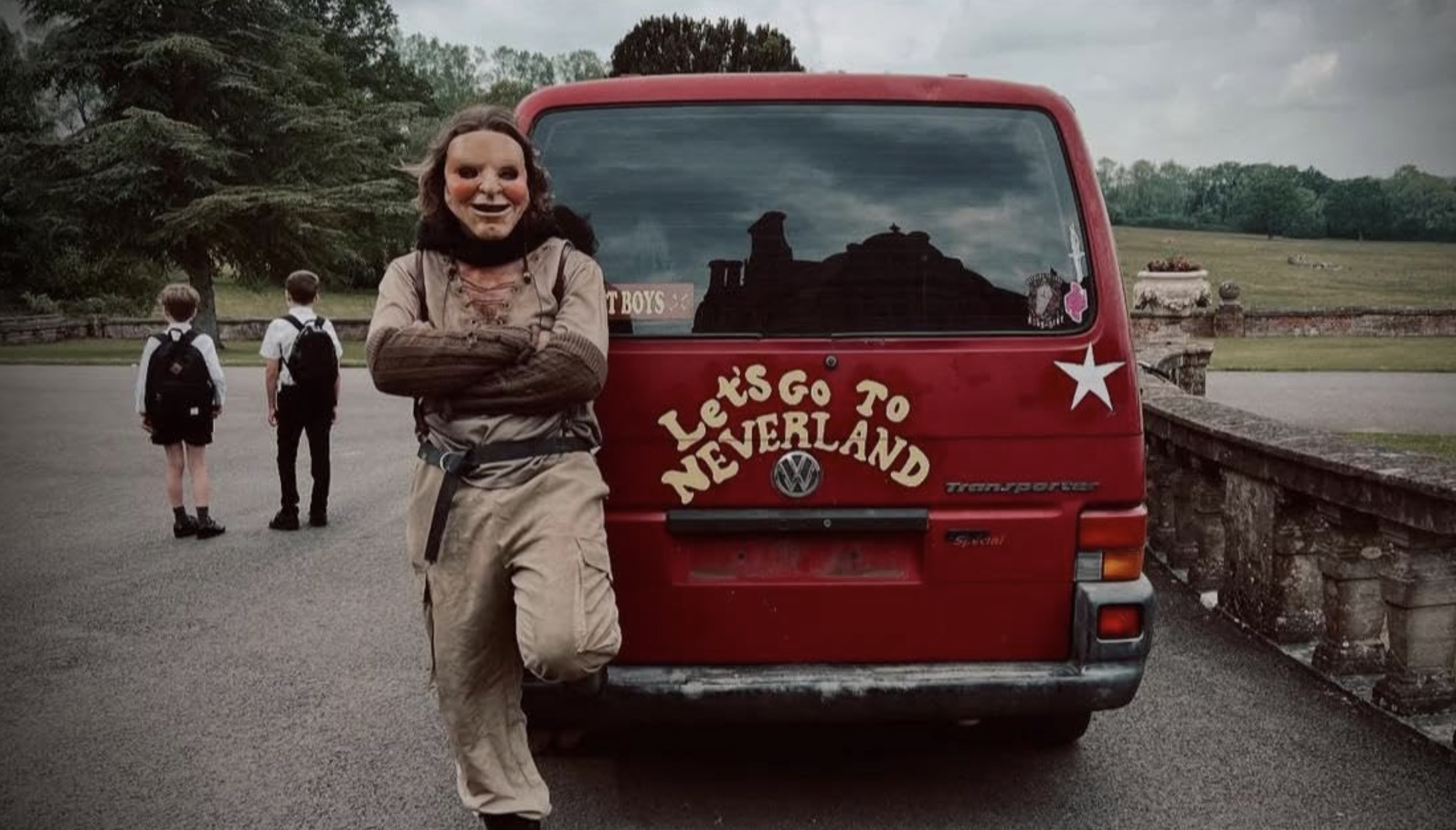
Throughout the decades, slasher film villains have had their fair share of bizarre motivations for committing violence. In Jamie Langlands’s The R.I.P Man, killer Alden Pick gathers the teeth of his victims to put in his own toothless mouth in deference to an obscure medieval Italian clan of misfits.