
Queer Victimization in ‘Peter Pan's Neverland Nightmare’
Second Star to the Right
As the “Twisted Childhood Universe” gathers steam, Scott Chambers looks to expand the franchise beyond the Hundred-Acre Wood for the first time in Peter Pan’s Neverland Nightmare. One can already see the team putting in place the connective tissue that will allow the monsters to assemble in the upcoming Poohniverse crossover event. Here, that connective tissue comes as Teresa Banham reprises her role as Mary Darling, Christopher Robin’s hypnotherapist from Winnie-the-Pooh: Blood and Honey 2. In Neverland Nightmare, Mary is (as might be expected) mother to Wendy (Megan Placito) and Michael (Peter DeSouza-Feighoney), who are caught in the sights of resurgent childkiller Peter Pan (Martin Portlock) in the town of Ashdown.
Peter, much like in J.M. Barrie’s story, hopes to whisk children away from their parents to live in Neverland, where no one has to grow up—though his methods differ pretty significantly. Peter’s sidekick, Tinker Bell, is also present (played by Kit Green); in this case, a heroin-addicted transwoman suffering from Stockholm Syndrome.

While viewers seem to be coming around to the idea that storybook characters are getting the twisted treatment, or at the very least, are accepting the fact that it’s happening, reactions to Neverland Nightmare have been less about the merits of carving new slashers out of childhood favorites than they have been about the film’s messaging and representation. While Pan’s targeting of queer children draws red flags, it’s the potential for Tinker Bell to be reduced to the harmful stereotype of a drug-addicted trans person kidnapping and harming kids that has drawn the most discomfort.
While valid, those criticisms, which come from a place of genuine concern, wildly miss the point. Though it’s never explicitly stated, the film strongly alludes to the idea that Peter’s targeting of queer children is sincere. He believes in his cause. He believes that these are children in need of saving, and the way to do it is to “preserve their innocence” before the world is given the chance to turn on them. That’s why he demands consent from his victims before “taking them to Neverland.” Peter understands what he’s doing, though he won’t admit it out loud, even to Tinker Bell, the closest he has to a confidant.
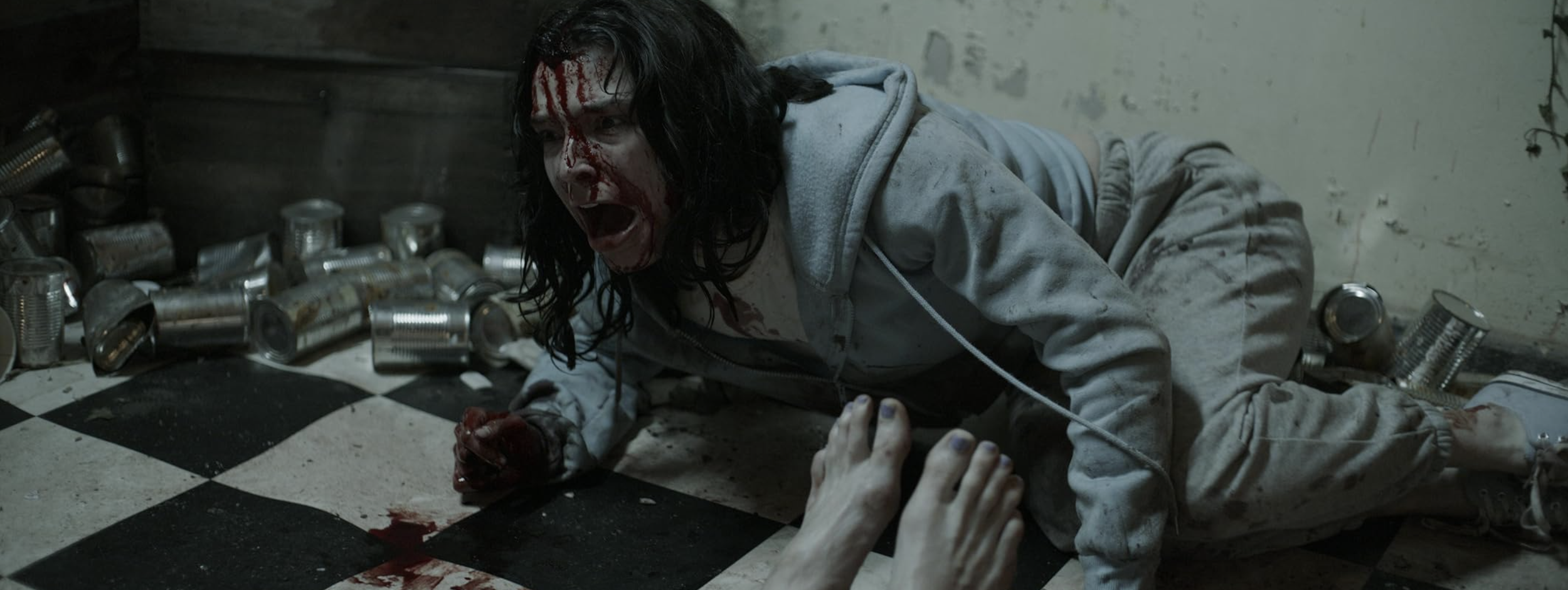
Megan Placito as Wendy Darling in Peter Pan’s Neverland Nightmare (2025)
Peter’s pathos is rooted in the deep, disfiguring abuse he suffered as a child himself, and the self-righteousness he feels for delivering for these children the escape which he withholds from himself is what makes him so frightening. Of course, it doesn’t hurt that Portlock plays the character with such conviction. The way Peter shifts from an uncanny lilting falsetto to gruff fury emphasizes the warring realities within himself. Eternally the “lost boy,” literally unable to reconcile with his cruel, self-ordained mission.
Then, of course, there’s Tinker Bell. While I understand the fears that Tinker Bell’s characterization might place her firmly in the realm of problematic queer stereotypes like Buffalo Bill and Norman Bates, at no point in the film is Tink portrayed as being a willing participant in Peter’s plan. Rather, she is only ever shown as shrinking in fear from him, eager to please, not out of complicity, but out of self-preservation. Peter keeps her obedient with physical—and chemical—manipulation.
Tinker Bell is one of the earliest of Peter’s victims we see on screen, having been living under his control ever since childhood, when Peter—using to his advantage what she had always insisted to her parents—decided that she could not go to Neverland as a Lost Boy, because she wasn’t a boy at all. Rather than affirming and caring for her though, he leverages her vulnerability to his own advantage, telling her she was something more, something better; destined to help him in his quest to save the children. It’s clear that Peter wasn’t very convincing, considering he needed to resort to hooking Tinker Bell on heroin to keep her properly motivated (and presumably quiet) while conditioning her to emotionally rely on him. And yet, after all of that, Tinker Bell is still able to briefly stand up to Peter, sacrificing herself and allowing Wendy to escape with Michael.
Peter Pan’s Neverland Nightmare is easily the best film in the Poohniverse so far. It embraces the idea that, in order to succeed at representing queer characters, it’s not enough to represent the saints. They can also be the monsters and the victims, not because they are queer, but because they are human. Where Neverland Nightmare excels is in writing its characters without centering the plot or their identities on their queerness. It’s an integral part of who they are, sure, but it’s almost peripheral to their characterization. It’s bold, it’s messy, and it’s unapologetic. And that alone makes this film worth watching.
Article by Ande Thomas
Ande loves the intersection of sci-fi and horror, where our understanding of the natural world clashes with our fear of the new and unknown. He is an independent member of the Society for Cinema and Media Studies and a supporting member of the Horror Writers Association. He writes about monsters and foreign horror and can also be found over on Letterboxd.
Other Articles You May Enjoy…
![[Movie Review] Avalon Fast’s “CAMP” is the Latest in the New Wave of Transgressive Filmmaking](https://images.squarespace-cdn.com/content/v1/5d3e481bc5a6e40001b215a8/1782401219629-WQRPE1S2P04BE4SNHMJ2/mPAUB3_Q.jpeg)
![[Movie Review] Izabel Pakzad’s “Find Your Friends” Debuts on Shudder](https://images.squarespace-cdn.com/content/v1/5d3e481bc5a6e40001b215a8/1781905520911-HKI5I64EQ6F19X0Q08A8/fyf-amber.jpeg)
![“Don’t Go in the Water”: Jennifer Van Gessel’s ‘Water Horse’ [Movie Review]](https://images.squarespace-cdn.com/content/v1/5d3e481bc5a6e40001b215a8/c8fc4742-1c98-46fc-bd57-db70f7556053/water-horse.jpg)


After a traumatic labor, Saga wakes to the cries of her newborn son in his bassinet on the other side of the room. While most watching will likely pick up on baby Kuura’s negative reaction to sunlight—I couldn’t stop thinking about the pain it would have caused Saga to get up and gather her son herself. The irony of thinking about her struggles is further amplified by the cries and almost animalistic moans and later-described hairy body that are all chalked up as “normal” and that the couple has a perfectly healthy babe. After all, everyone insists that every baby and every pregnancy… is different.