
‘LandLord’ (2025): Hard Crime or Horror? Why not both?
I was happy to have been asked to review this film for the What Sleeps Beneath folks and this coming right before the holidays is a lovely gift all on its own. Ande sent me the screener for this movie called LandLord and what an excellent way to close out the year for me. It’s a horror movie that is like a hard crime movie and that tone is never betrayed. Or sacrificed.
Not The Typical Caper
You will notice from the very beginning that LandLord isn’t going to color inside the lines. Sure, it’ll color inside some of the lines, but this coloring book wasn’t made by someone looking to retread all the cliches. It was made by someone who almost wants you to fall for some of the tropes. If you fall for the tropes, after all, you won’t be expecting the punch.
That someone in question is writer, producer, and director Remington Smith.
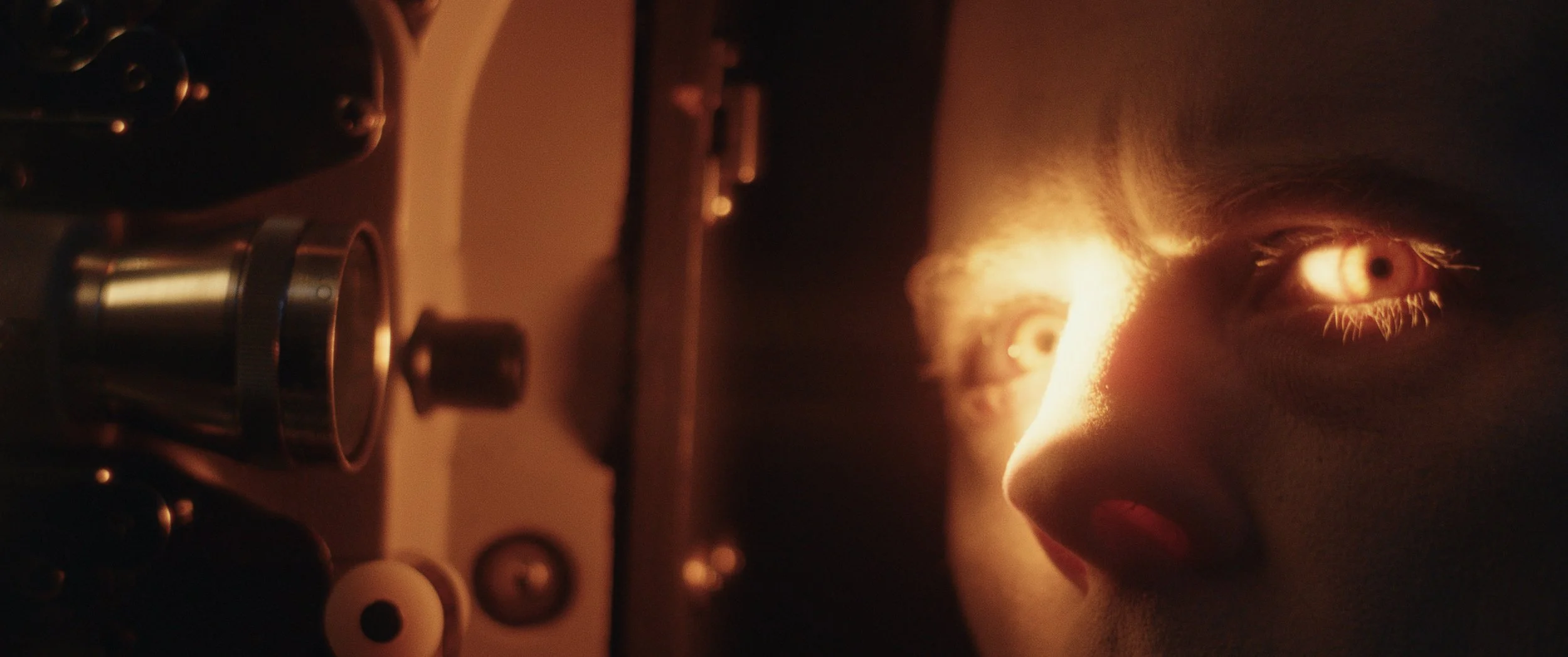
Image courtesy of K.O. PR.
If you run a search on this movie, you will get spoilers; I would have loved to have watched it without knowing the premise, but nothing pulled me out of the story. I’ll do my best to not give anything away in this review.
The movie’s first half plays very much like a multi-tiered hard crime story. A nameless bounty hunter (played by an intense Adama Abramson) checks into an apartment complex, in search of something which is neither established nor necessary, as other information eventually pushes this part to the side until nearly the end of the movie.
The main characters in this story are “the bounty hunter,” a boy living with his mom in the apartment complex named Alex (an impressive Cohen Cooper) and John Lawrence (an understated performance by William McKinney), the titular “LandLord” of the title.
There are of course other characters, most notably Lawrence’s assistant Christopher (played by a fantastic Lance Gerard) and the slimy and callous Sheriff (J. Barret Cooper).
Where this movie first succeeds is introducing the players in the twisty set up. Smith never rushes this part as we get a long look at the environment from multiple points of view from the bounty hunter and Alex. We see how the nameless bounty hunter searches out information using cunning (and a decent supply of cash). We see her watch Alex navigate being bullied by two kids and walk right past him, barely looking at him. The following day, he asks why she didn’t help him.
“Everyone needs to learn to fight for themselves,” she tells him, not even looking at him.
“Even if it’s not a fair fight? There were two of them!”
Her response is matter of fact and hard: “Fight harder.”
This kind of tense build (and the approach to get there) is not achieved easily in larger budgeted films. This movie doesn't exactly stop so you get to know the characters as much as you get to know the characters more often by what they're doing and not what they're saying. “Show don't tell” is used very deftly as part of Remington Smith's direction style. The film’s smaller moments do more to move the plot along than any drawn out scene could have ever done. Case in point, there is a beautiful and sad scene featuring our main antagonist Lawrence watching a color film projection of a sunrise; the delivery of this scene is simply devastating while introducing the only moment of sympathy for an otherwise ruthless character.
When Crime and Horror Merge
There is a two-point pivot of the film that changes everything in terms of tone when our Bounty Hunter comes back from a fact-finding mission involving Christopher getting rid of “wet items” in a rather simple, brutal way.
Abramson does an excellent job at being revolted by what she sees but never loses her character’s edge. Her cab drops her off at the complex and she hears Alex screaming in pain from his apartment. She breaks in, seeing Alex’s mother on the floor, dying and bleeding out. She hears Alex in the next room and sees Lawrence, wrenching Alex’s arm. In the ensuing fight, the hunter is injured, and the landlord slinks off.
The rest of the film is a tense study of confrontations, not of good and evil, but of complacency, the pull of apathy and really trying to do the right thing despite the outcome. It gets violent, bloody and in a very satisfying sequence, even ties up most of the loose ends.
But not all of them…
Smith has constructed a really refreshing noirish horror story that doesn’t dwell as much on the disbelief of any supernatural happenings as being something impossible but more of an obstacle that needs to be overcome. This applies to both natural and unnatural (or supernatural) occurrences. Violence is met with violence to be sure, but fear is met with defiance. The unlikely relationship of the reluctant protector and a kid just looking to live could have been made cliché and it would have worked. What we wind up with though, is somehow better. Pretty ambitious for a moderately budgeted thriller.
Summary
This is an unusual horror tale in that it almost doesn’t seem to think it is a horror tale. There are elements of horror to be sure, even something supernatural, but it’s not going to give it up to you easily.
And that’s exactly why it’s a horror movie. The same way The Silence of the Lambs is a horror movie, (I will die on that hill) so is LandLord—and a damn good one.
7.5 Pointy Sticks out of 10!

Article by Nelson Pyles
Nelson W. Pyles is an author, musician, podcast creator and voice actor living in Pittsburgh. He has written two novels and is currently working on his third. His second collection of short stories, essays and articles All These Steps Lead Down will be released in Summer 2024 from Cold War Radio Press. He is a member of the HWA. You can find Nelson at https://whatnelsonwrites.com/

Other Articles You May Enjoy…
![The Critics are Wrong: Long Live ‘The Bride!’ [Movie Review]](https://images.squarespace-cdn.com/content/v1/5d3e481bc5a6e40001b215a8/1773068326629-0WHV3NUESLFG23YV4800/Screenshot+2026-03-09+at+10.57.10%E2%80%AFAM.png)


Never graphically violent, [Cat People] is nonetheless shocking, especially in the stalking and pool scenes. Never graphic sexually—not the barest inch of customarily hidden skin is exposed—it’s nonetheless erotic. The heart of the film is the fear of female sexuality, the sense that, if women were to give in to their carefully repressed urges, they would throw society itself into chaos.