
Did I ask to be rescued from the darkness? Review of Guillermo del Toro’s ‘Frankenstein’
A few weeks ago, Guillermo del Toro's romantic horror film Frankenstein was released on Netflix. The well-known visionary has finally realized a long-held dream by creating one of the most lyrical, visually striking, and faithful adaptations of the classic novel.

Sailors from the Danish ship Horizon, heading toward the North Pole, become trapped among icebergs and have been trying to break free from their icy prison for days. After spotting a frozen traveller near the vessel, the crew carry him to a warm cabin where, barely conscious, the stranger introduces himself as Baron Victor von Frankenstein. He warns them that a creature is roaming nearby in search of him—and will not stop until it finds him. Soon after, a terrifying figure dressed in rags appears in the snowy wasteland and effortlessly kills several sailors. Meanwhile, Victor tells the captain the story of his extraordinary life, explaining who he is and why the creature is pursuing him. But when the sinister visitor boards the ship, he tells his own story—and the picture Frankenstein has drawn becomes far more complicated. For those looking for a break from Gothic horror, you could even unwind with something completely different—for example, using a Richard Casino promo code to explore exciting online games and bonuses.
A Long Road to Adaptation
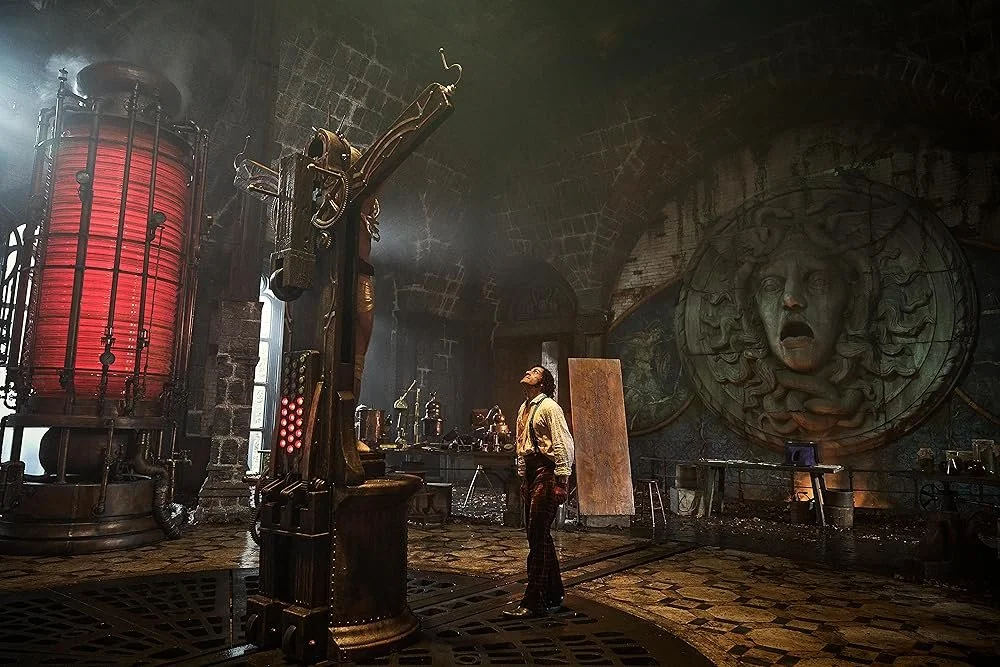
Frankenstein’s laboratory.
Guillermo del Toro's new film had been in development for almost a quarter of a century, and during that time saw several strong candidates for the role of the Monster (from Doug Jones, who played Abe Sapien in Hellboy, to Benedict Cumberbatch) as well as numerous script variations (at one stage, the adaptation was even expected to span three films). It only moved into production after Netflix agreed to finance the large-scale, long-term project. In the end, everything came together, and the film premiered at the Venice Film Festival—where it was nominated for the Golden Lion and received one of the secondary awards—before being released in limited distribution and earning a series of enthusiastic reviews.
The prevailing view among international critics, though not without some reservations, is largely one that can be agreed with. Del Toro, known for his lifelong fascination with monsters, horror and grotesque gothic imagery, has created a soulful and surprisingly faithful adaptation, at least in its essential elements, executed with impeccable style. However, to fully appreciate the ambition behind del Toro's project, it is necessary to outline the historical context that shaped perceptions of Mary Shelley's novel—a classic that many people know of, but few remember in detail.
Literary Context and Importance of the Original Novel
To begin with, it is important to recognize that although the book contains many images, plot twists and motifs that later became integral to horror—both literary and cinematic—its focus leans far more towards science fiction with elements of romantic drama, while the gruesome details remain secondary. It was not so much Shelley’s original text as its Hollywood adaptations, which freely reworked the plot, that exerted a colossal influence on the development of horror cinema.
Firstly, there is Frankenstein (1931), which established the archetype of the Monster—a figure still in demand today—and defined many conventions of the “mad scientist” narrative. Secondly, there is The Bride of Frankenstein (1935), which introduced one of the first significant female characters in the genre (almost every story about a man attempting to create the perfect woman, from Frankenstein to Weird Science, draws inspiration from this film in one way or another).
The success and cult status of these 1930s productions created a solid foundation for viewing Frankenstein primarily as a horror tale, and this tradition was later reinforced by British films of the 1950s and 1960s, which for decades overshadowed other aspects of the original novel.
Returning to the Spirit of the Source Material
In this sense, del Toro, while paying homage to the classic film adaptations, still refers primarily to the literary source material. Frankenstein is presented as a fast-paced Gothic drama with elements of fantasy, where horror remains a secondary component. This approach is much closer to the original book than most other screen versions, and del Toro, with his characteristic inventiveness as a dark fantasist, makes full use of the novel’s potential, skilfully combining vivid characters, lavish visuals and a dramatically rich story about a daring genius whose unrivalled creation ultimately turns against him.
Structurally, the film is divided into three parts: a short prologue (where the freezing Danes want to return to St. Petersburg), followed by Victor’s story, and finally the Monster’s account, each complementing the others. This structure broadly mirrors the novel and allows del Toro to shift the thematic focus several times within a single narrative. The prologue in the icy wastelands offers an intriguing introduction, briefly presenting the two central figures. Victor’s story becomes a chronicle of the rise and fall of a brilliant yet arrogant scientist, initially driven by ambition but later forced to face the bitter consequences of his obsession. The Monster’s story (or the Creature’s) unfolds as the tragic biography of a reluctant outcast struggling to find his place in a harsh world.
Shifts in Perspective and Pacing
The idea of different perspectives works, but not flawlessly. Despite del Toro (who also wrote the screenplay) trying to maintain a brisk pace, somewhere around the middle the film begins to sag noticeably, as the dynamics of Victor’s and the Creature’s stories differ greatly. While the first storyline is packed with events (covering literally every significant event in Frankenstein’s life, from childhood to the finale of the fateful experiment), the second is much less interesting. The unfortunate Monster hides on a farm, learns to read and write (through a hole in the wall—seasoned voyeur Norman Bates would approve!) and learns life lessons. These episodes are, of course, taken from the novel, but in the film they seem rather monotonous. However, the pace picks up later on, so it’s not all bad.
Visually, the film is magnificent. Del Toro spared no time, money or imagination to create a colorful world full of captivating details, whether it be elegant costumes (Mia Goth changes from one gorgeous outfit to another) or the design of the laboratory (in the middle of which a corpse with its insides turned out is very conveniently located). His long-time colleague, cinematographer Dan Laustsen (Oscar nominee for The Shape of Water and Nightmare Alley, who also worked on Silent Hill and Brotherhood of the Wolf) has fully revealed his talents here. He skillfully uses slightly distorted angles (to always keep the focus on the main characters), plays elegantly with light and shadow, and creates a strong sense of grandeur, whether it’s a ship frozen in ice, Frankenstein’s laboratory or his father’s library.
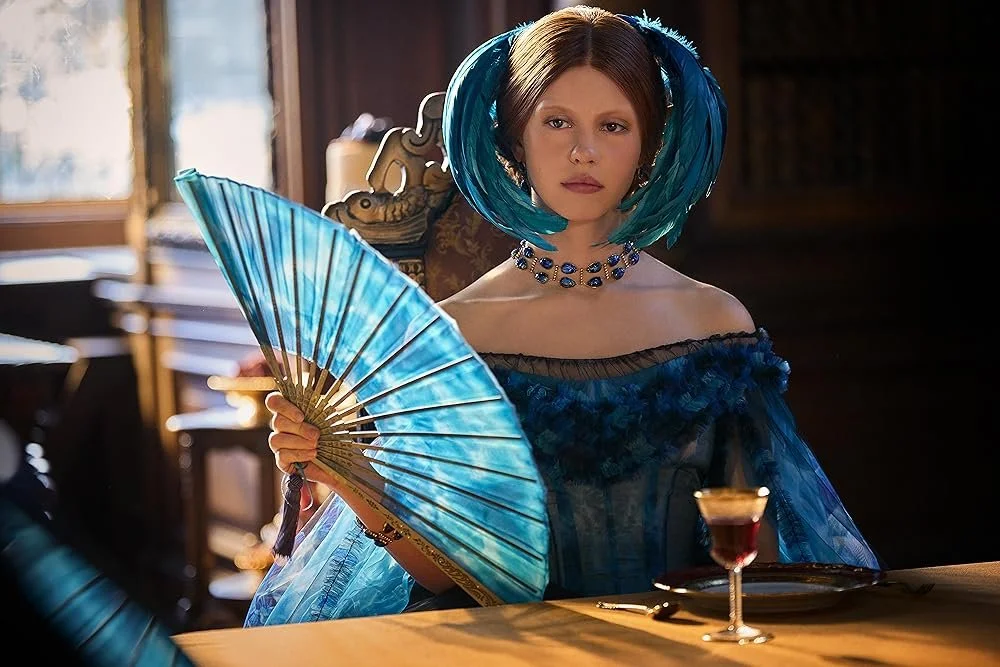
Mia Goth as Elizabeth in Frankenstein (2025).
Rich, sometimes even eye-catching colors complement the image, which is rich in small details. Each of the key characters has their own color palette (Elizabeth is dominated by green with a transition to turquoise, Victor by black and white, and the Monster by a yellowish “corpse” shade), and their combinations or contrasts partly build the atmosphere in specific scenes. The set design is also beyond praise, especially in Frankenstein’s citadel and the London scenes. Massive chairs and tables, huge halls with high ceilings, spiral staircases and stone walls saturated with a burning cold—all this diversity of locations quickly immerses you in the hedonistic lifestyle of the 19th-century European aristocracy, which Victor has fully assimilated, even if he does not always share it.
Character Development and Performances
The characters match the setting. All the key participants in the story (and there are three of them—besides Victor and the Creature, Elizabeth, his brother’s fiancée, plays an important role in their confrontation) are written in relief, even if at times schematically. Perhaps the most successful is Baron von Frankenstein, played with powerful dedication by Oscar Isaac. Del Toro is a rare author who has sensitively captured and brought to life on screen a long-forgotten but actually essential fact about the novel. In the book, Victor is not a madman detached from society (as he is in many film adaptations), but a young (in Mary Shelley’s novel, he is a student) romantic doctor, burning with passion. He is extremely self-confident and incredibly intelligent, and his desire to defeat death is not just the whim of a mad doctor, but a noble attempt to push the boundaries of knowledge as far as possible in the name of progress. And he is always stylish—just look at how deftly he makes his way through the slums in his casually unbuttoned frock coat!
However, there are some complaints about Mia Goth’s portrayal of Elizabeth. To be fair, they are not personal: The actress honestly delivers everything that is required of her. The issue is more that Goth does not quite fit the aristocratic type (delicate features, deathly pale skin, and so on) that her character is supposed to embody. While in Pearl she looked like the perfect farm girl from next door, and in MaXXXine or X her character was very much in keeping with the spirit of the times, here she often looks like a simpleton dressed in expensive dresses. But in terms of character development, there are no issues: Elizabeth acts as a force of compassion, a person who awakens the Monster’s interest in the world, and immediately sees in him a creature worthy of pity, more pitiful than terrifying.
The Monster’s Story and Its Portrayal
As for the Creature, played by Jacob Elordi, his performance is the most praised in foreign reviews. There are reasons for this, of course: Elordi was given the very difficult role of a creature who must be both menacing and haunted, cruel and gentle—in short, a powerful child who is not always able to control his own strength. The actor indeed makes a noticeable effort to adequately embody one of the most iconic characters in film history. However, despite this, the Monster is noticeably less developed than the people around him—he receives less attention than the love dynamics between Elizabeth and Victor, and there are disappointingly few memorable scenes featuring him.
Of course, such rough edges are not enough to fatally spoil the overall majestic picture painted by del Toro, who clearly loves the source material. This Mexican lover of European Gothic has always adored monsters and knew how to portray them as frightening, touching, and even tragic; one need only recall his early debut, Cronos, or the well-known Pan's Labyrinth. In this respect, Frankenstein marks a certain peak in del Toro's creative development, a point where his key passions—Gothic aesthetics, bizarre monsters, and scary tales—are woven together firmly and effectively. The main thing to remember is that this is a drama in which fantasy and horror remain abundant, yet serve primarily as decoration. It is an authorial, yet fairly accurate adaptation of a great book, perhaps the most faithful to the spirit and letter of Mary Shelley since the 1990s film, and it will interest not only del Toro fans but anyone who appreciates classic Gothic fiction and beautiful stories about monsters that reveal their humanity.
Other Articles You May Enjoy…
Filmmaker Bari Kang discusses Itch!, from its practical gore and zombie influences to filming in his own NYC store and directing his daughter.