
‘Jaws’ 50th Anniversary: There’s Still Blood in the Water
“You’re going to need a bigger boat,” Chief Martin Brody (Roy Scheider) trembles, having seen the great white shark Quint (Robert Shaw) and Matt Hooper (Richard Dreyfuss) have been collectively searching for—hunting for—for the first time since the people of Amity Island started being consumed by the eating machine. Prior to finally seeing the 25-foot, three-ton shark with their own disbelieving eyes on the open water, our characters, and viewers of the film, only caught glimpses—a side view, a fin, a tail. This, mixed with legendary composer John Williams’ soundtrack for the film, would be the two main components keeping us all on the edge of our seats. And now, 50 years later, the suspense, the shark’s unveiling, and the storyline all manage to hold up despite changing times, new film techniques, and decades of animal horror—but, how?

Less Is More
Created as an adaptation of Peter Benchley’s 1974 novel of the same name, Steven Spielberg was uncertain, yet unknowingly poised for greatness. At a time where folks were already afraid of sharks—Benchley’s book was inspired by a Long Island fisherman who killed a 4,500-pound great white just 10 years’ prior to the book’s release—it was not necessarily a hard task to convince people to be scared of sharks; unlike in monster movies, it was already inherited. Take for example, the slew of shark attacks along the New Jersey coast occurring nearly 50 years before the film’s release in 1975. Or, much more recently, a nine-year-old girl nearly lost her hand to a bull shark off the coast of Florida. Just about every summer, real stories like this and others along coastal towns and waterways make people think twice about where they go swimming, how far they’ll swim out into the ocean, and what’s lurking under the murky water.
With a fear of this oceanic predator already rooted within our brains, like the “lions and tigers and bears” Dorothy sang to us about in The Wizard of Oz, the real challenge for Spielberg would be to create a film that scared viewers—something new that took the concerns they chose to shove to the back of their minds while partaking in fun at the beach and bring them to the forefront. How would he take a common fear and make it a Blockbuster phenomenon? As noted by the numerous awards the film received, it would be an accumulation of aspects, from picture to dramatic score, to sound and editing. And boy, would it be timeless.
Picture & Editing
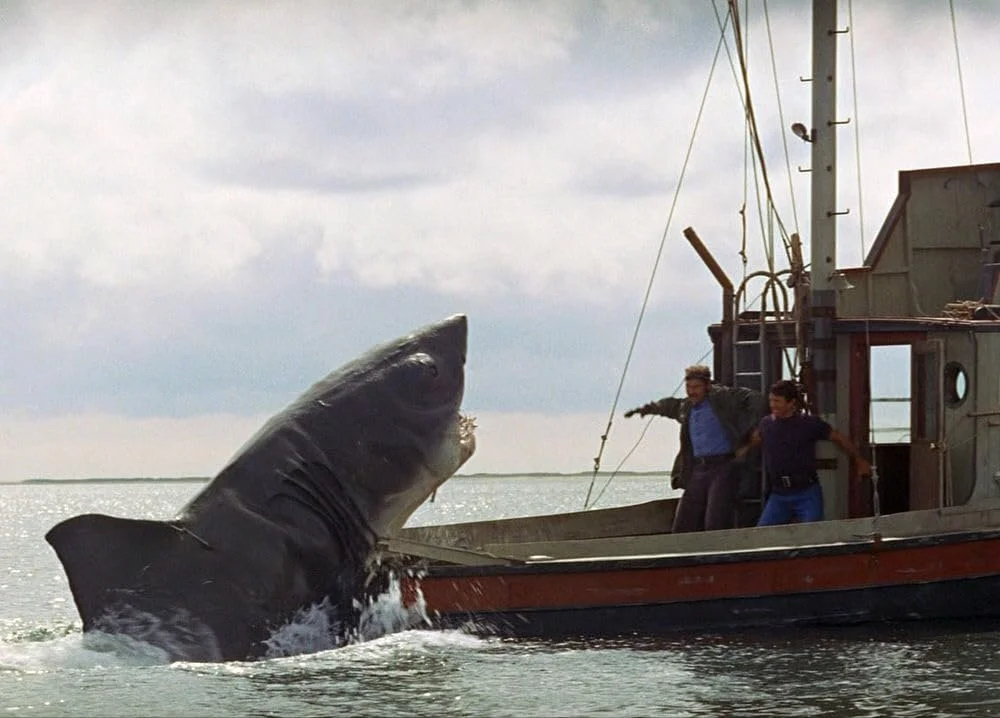
The infamous mechanical shark in Jaws. Image via IMDb.
Let’s start with the picture itself and editing. Biting off what was thought to be more than he could chew, Spielberg was determined to film on the open water. Incorporating a mechanical shark named Bruce, who often failed, certainly added its own complications and challenges. According to reports, Bruce’s inability to perform in every situation aided in the decision to not show him throughout the film as often and gave the characters the stage to show how they would fight one another about this threat, and how they would fight together. In an interview with The Guardian, phobia specialist Christopher Paul Jones makes a point about why this was so successful in the film, noting that most people have never encountered a shark in real life, despite suffering from galeophia, or a fear of sharks. Just as in real life, when the reveal of the shark is postponed, everyone realizes they can’t see the man-eating predator. “You can’t see below water, and the music creates a sense of fear,” Jones stated. “Movies are very good at hitting every sense—visual, sound—and can be very impactful on how we feel.”
But before we dive into the score and sounds featured throughout the film, let’s focus again on the picture and editing. Not only were some major practical effects brought onto the screen, but the blending of real underwater shots of folks swimming and even a real shark at one point brought another horror element into the mix. This third-person point of view has been idolized, not just in monster or animal attack films, but slashers and even found footage. It puts the viewer directly in the viewpoint of our villain in the story and doesn’t let go.
When it comes to sharks though, this is what puts our fears into perspective. Just as Jones noted, we cannot see what lurks below the water’s surface. Anything could be down there. It’s what makes you scream a little when you're swimming and a piece of seaweed or a fish (at least you hope it's a fish) brushes your leg. You don’t know what is touching you, or even what can see you from afar. You put trust in yourself and in nature that nothing bad is going to happen because truly, the likelihood of actually being attacked by a shark is roughly 1 in 11 million—pretty good odds. Yet, because of films like Jaws and the media’s obsession with these one-off attacks, our fear lingers. Even today, despite efforts made by marine biologists and specials each year during Shark Week or other documentary attempts to rewrite fiction with fact, the fear is seemingly everlasting, which again, can be somewhat attributed to the initial and continued success of Jaws 50 years since its original release.
Score & Sound
Although the picture and craftful editing gave viewers perspective and a view of what sharks might see below the surface, it was the soundtrack of Jaws that literally told our minds that there was blood in the water. With just two notes, John Williams created something so primal that it continues to live in all of us as a universal warning sign that danger is coming and you better run—or swim for shore.
I’m not sure if everyone has a “first time swimming after seeing Jaws” memory, but I do. I had to be around 11, maybe 12. We were vacationing in New Smyrna Beach, Florida, and had decided to rent some movies—my parents were going to have a date night and our sitters (my neighbor and family friend from back home) decided on a few horror movies: Leprechaun and Jaws. I don’t think I was supposed to stay up and watch these movies, but I did.
As a child, I loved sharks. I had been collecting books on them since the first grade, but I had never seen a movie quite like this. While it’s impossible to pinpoint how I felt after watching, I can remember clear-as-day the following afternoon when we packed up our stuff and headed for the beach. I was fine, or thought I was fine until we took our tubes and headed for the ocean. I remember my dad swimming me out with our sitters and as soon as my feet couldn’t touch the bottom, one of them started humming, “Dun-dun. Dun-dun. Dun-dun-dun-dun-dun-dun-dun-dun-dun-dun…” I freaked out, like a child would (or should) after seeing the movie and rushed to shore as if a shark was about to take me under.
My fear didn’t last forever, thankfully, but it truly made an impact on me that I’ll never forget. And I’m sure other children, adults, too, had this same uneasy feeling as they stepped into the ocean after watching the film. Even pools and bath tubs could be scary—I know for a time I looked all around those for a while, too, just to make sure a shark didn’t make its way into any body of water I was partaking in. At least in my case though, perhaps because I had such a love for sharks (and still do today), it was the music that instilled this fear, more so than the giant mechanical shark.
That very subtle, slow build of suspense created a score that invited you to always look behind you. Something that was so simple, just two keys, that you couldn’t forget so easily just played in the back of your mind. That was the backbone of what made Jaws so horrific and why the film and story has stuck with us, unwaveringly, for so long, because it is not just a score, it is a leitmotif, meaning that it represents the character just as much as its varying pace, or ostinato, intensifies the degrees of emotion and fear a viewer gets while watching.
Once paired with this giant shark, there was no stopping the lengths to which our fear would be stretched.
What Do The Next 50 Years Look Like?
Given the timeless elements of Jaws, I think we’ll look back and admire the film even when it’s 100 years old. Despite the slew of good (and bad) animal horror movies that followed its release, like Orca, Grizzly, Piranha, Prophecy, or even Jaws sequels—just to name a few—there is no denying that the film set a bar for the subgenre and it’s a bar I feel has rarely, if ever, been surpassed.
Article by Destiny King
Destiny writes about true crime and thrillers. She likes movies and stories that make you question the world around you, more so than what makes you jump.

Other Articles You May Enjoy…
![The Critics are Wrong: Long Live ‘The Bride!’ [Movie Review]](https://images.squarespace-cdn.com/content/v1/5d3e481bc5a6e40001b215a8/1773068326629-0WHV3NUESLFG23YV4800/Screenshot+2026-03-09+at+10.57.10%E2%80%AFAM.png)


![[Movie Review] Dead Mail (2024)](https://images.squarespace-cdn.com/content/v1/5d3e481bc5a6e40001b215a8/1745079293263-SFBEIPQXTRG91EFCVDA4/Screenshot+2025-04-19+at+12.14.27%E2%80%AFPM.png)



Never graphically violent, [Cat People] is nonetheless shocking, especially in the stalking and pool scenes. Never graphic sexually—not the barest inch of customarily hidden skin is exposed—it’s nonetheless erotic. The heart of the film is the fear of female sexuality, the sense that, if women were to give in to their carefully repressed urges, they would throw society itself into chaos.