
‘Sweet Relief’ Leans into its Mumblegore Influences
As a masked figure called the “Sweet Angel” goes viral in a social media challenge, three teens play the game as a joke, each nominating someone they’d like to see die. But when they are unexpectedly chosen by the Angel, they’re forced to follow through on their nominations, or risk death themselves. It’s a simple enough logline that promises to tackle themes of our chronically online culture, but filtered through director Nick Verdi’s (Cockazoid, 2021) mumblecore lens, and the zero-budget Sweet Relief, out now on VOD, sets itself up to be one of the most polarizing horror films of the year.
Starring Lucie Rosenfeld, Jocelyn Lopez, and Catie Dupont as Hannah, Lily, and Corey, respectively, Sweet Relief is a slow-build thriller that takes its time weaving its threads, unconcerned with the quick gratification that some horror tends to rely on. Even when the kills begin, the film doesn’t bother itself with picking up the pace, methodically drawing itself to its climax and conclusion on its own terms. This isn’t a criticism, though it’s something to be aware of if you’re hoping for a hack-em-up slasher. Other characters are caught in the orbit of this trio, but it’s Rosenfeld, as well as Alisa Leigh, who plays Jess, who get the greatest through lines.
Sweet Relief wears its mumblegore sensibilities proudly—its label declaring that it might have been the result had a young Richard Linklater made a slasher film. The influence is clear; its long takes and the matter-of-fact delivery of its improvisational dialogue put it right at home with films like some of Ti West’s early films like The House of the Devil (2009) or The Innkeepers (2011). Its economical use of the budget available, though, gives it much more in common with Patrick Brice and Mark Duplass’s Creep franchise, whose mumblegore aesthetic came out of necessity as much as it did from Duplass’s experience in such films and roles. Its willingness to let its characters wax poetic as they gaze inward, meanwhile, give it as much in common with the more recent, but still vastly underrated Soft Liquid Center from Perry Home Video.
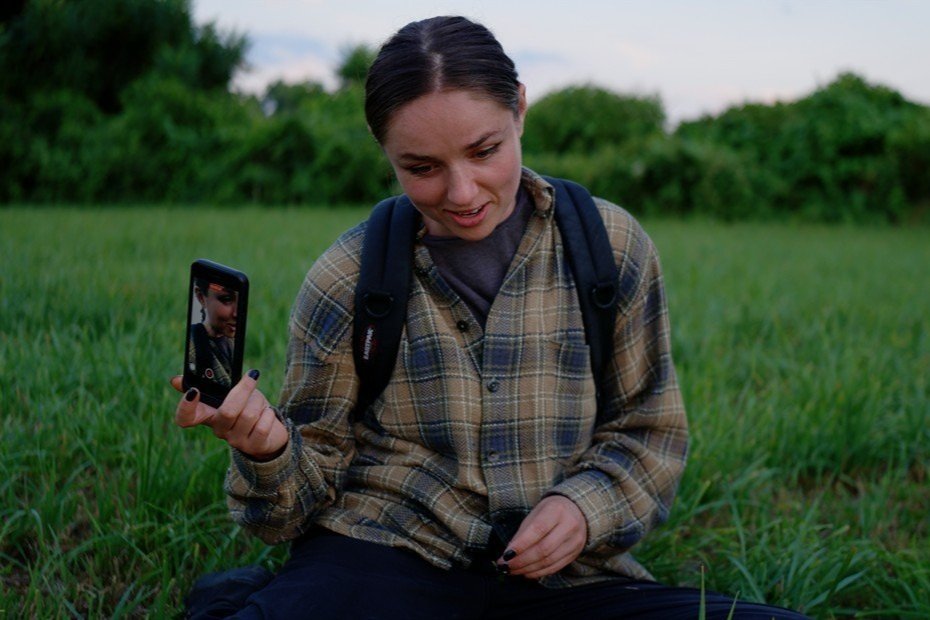
Lucie Rosenfeld in Sweet Relief (2025).
Rosenfeld and Leigh, in particular, adapt well to the film’s approach, making the casual, almost slurring speech patterns seem effortless, if not a little lazy—which is precisely the goal in these films. These are teens and young adults living in a dead-end small town, a reality that bears down on them each, as well as their parents and other adults in the community, differently. Take Gerald (B.R. Yeager), for instance, who so desperately wants to be viewed as an authority figure, he’s willing to go to any lengths to be recognized, respected—and feared. Or local science teacher, Mr. McDaniel (Paul Lazar), who has convinced himself of his own good intentions, but who is doing far more harm than good.
The laid-back, go-at-your-own-pace style doesn’t always land, though. Yeager has a habit of filling in gaps with F-bombs, which in and of itself isn’t an issue for me (it’s a beautiful and versatile word), but there’s a point where it extends even beyond comical and ends up more distracting than anything. Adam Michael Kozak, who plays Hannah’s concerned older brother Nathan, tends to punctuate each line with a sigh, pulling away from an otherwise believable and touching role of a man trying to stay in touch with his younger, more rebellious sister.
On its face, Sweet Relief makes a fairly good approximation of the real life concerns many parents have about their kids and the never-ending array of online challenges and memes that threaten to bleed into too-real tragedies. This isn’t a film looking to capitalize on those fears without giving something in return, though. Peppered throughout the film’s various monologues, Sweet Relief aims to acknowledge the epidemic of loneliness and low self-esteem infecting our world, diagnosing it as an effect of our chronically online culture. “We’re talking about corroding people’s minds,” Mr. McDaniel says when confronted with accusations of fear-mongering (itself a relevant issue of our times), “I mean, an act of violence can only be joked about for so long before something happens.” As his prediction spirals toward fulfillment, Sweet Relief shapes itself into an oddly relaxing, but paradoxically intense thriller with a fittingly sharp conclusion. This one is certain to divide audiences, but those that resonate with it will be chasing its vibes all summer long.
Article by Ande Thomas
Ande loves the intersection of sci-fi and horror, where our understanding of the natural world clashes with our fear of the new and unknown. He is an independent member of the Society for Cinema and Media Studies and a supporting member of the Horror Writers Association. He writes about monsters and foreign horror and can also be found over on Letterboxd.

Other Articles You May Enjoy…

![[Movie Review] Avalon Fast’s “CAMP” is the Latest in the New Wave of Transgressive Filmmaking](https://images.squarespace-cdn.com/content/v1/5d3e481bc5a6e40001b215a8/1782401219629-WQRPE1S2P04BE4SNHMJ2/mPAUB3_Q.jpeg)
![[Movie Review] Izabel Pakzad’s “Find Your Friends” Debuts on Shudder](https://images.squarespace-cdn.com/content/v1/5d3e481bc5a6e40001b215a8/1781905520911-HKI5I64EQ6F19X0Q08A8/fyf-amber.jpeg)

![“Don’t Go in the Water”: Jennifer Van Gessel’s ‘Water Horse’ [Movie Review]](https://images.squarespace-cdn.com/content/v1/5d3e481bc5a6e40001b215a8/c8fc4742-1c98-46fc-bd57-db70f7556053/water-horse.jpg)


After a traumatic labor, Saga wakes to the cries of her newborn son in his bassinet on the other side of the room. While most watching will likely pick up on baby Kuura’s negative reaction to sunlight—I couldn’t stop thinking about the pain it would have caused Saga to get up and gather her son herself. The irony of thinking about her struggles is further amplified by the cries and almost animalistic moans and later-described hairy body that are all chalked up as “normal” and that the couple has a perfectly healthy babe. After all, everyone insists that every baby and every pregnancy… is different.