
Dissecting a Serial Killer: The ‘Creep’ Franchise
There will always be a soft spot in my heart for found footage. Whether it’s revisiting a timeless horror classic like The Blair Witch Project (1999) or rewatching later takes involving the videographic style of the Paranormal Activity franchise or Lake Mungo (2008), the question they all evoke is, “Is this real?” Something about having to ask yourself that just seems to make a film that much more scary––you fear that the stories being told could cross over into the true crime and nonfiction realms. The fact that a horrific retelling could have involved real people and a physical place just awakens a strange curiosity within us all, I think. That curiosity easily pairs with other underlying concerns, most notably, “How likely could this happen to me?” We want answers to questions that, more often than not, can no longer be answered, or could never have actually been known for sure.
Given my love for the film style, real-life stories, and the unknown, I recently revisited the largely underrated Creep franchise, which follows self-proclaimed serial killer Josef (later known as Aaron) as he both sets the stage for his victims, and in the second installation, undergoes a midlife crisis. In examining this film duo, I’ll discuss what makes the viewer question Josef/Aaron’s intentions, his awkward behavior, and how the carefully crafted combination makes for a micro-budget psychological slasher we didn’t know we needed, but are so grateful to have.
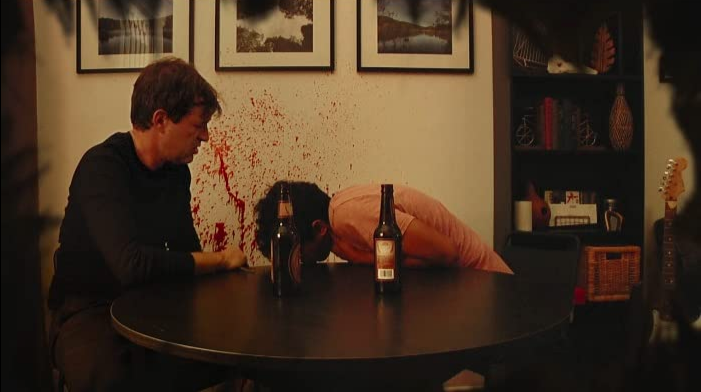
Director: Patrick Brice
Story, Production & Main Character: Mark Duplass
We are first introduced to Josef (Mark Duplass) just as Aaron (Patrick Brice) meets him for the first time, having responded to a Craigslist ad offering $1,000 a day to film this guy in a remote mountain town. Although Josef seems a little off at first, having appeared out of nowhere in a jumpscare-like fashion and attempting to quickly develop a friendship through compliments and hugs, he soon explains to Aaron that he has inoperable brain cancer and wishes to make a video for his unborn child, who he will likely never get to meet––like the Michael Keaton film, My Life (1993). While the reason behind the ad could explain some of Josef’s introductory awkward kindness, his behavior only grows more erratic as the film presses on: first, by jumping right into a tubby scene. Just as you’d suspect what a tubby scene means, Josef strips down and pretends to have a bath with his unborn child. While a little strange, the scene could have been a touching moment, but doesn’t last long before Josef takes a dark turn.
Watching the film for the first time, the viewer only sees a strange form of relationship building, which leaves viewers to decide if Josef’s illness is what makes him so strange and open, or if he’s somehow dangerous. Having watched both films back-to-back for the purpose of this article, however, I found myself questioning why exactly would a serial killer want to be fully exposed, vulnerable even, to a victim he intends to kill? Is it to throw Aaron off? Is it to test his boundaries? Or could it be that in order for Josef to carry out his own plans, he, too, must be vulnerable? The more I wonder, the more I believe that Josef’s actions are chosen to gauge Aaron’s reaction. What is going to make Aaron repulsed? What is going to make him tick or make him scared? Like a predator stalking his prey, Josef is learning everything he needs to know about Aaron.
The only way to find out who Josef really is, though, is to keep watching. With Josef’s one bad suicide joke and multiple opportunties he has planned to scare Aaron (for fun), Aaron struggles, much like the viewer, to decide whether Josef is a total psychopath or just has really terrible people skills in the wake of his diagnosed terminal illness, allowing for this questioning cycle to continue through most of the film. The uncertainty regarding such a high-stakes chance is terrifying enough, but surely, all of us can recall a friend that while you see the “good” in them, others could process their behavior as offensive or off-putting.
Aaron manages to press through every abnormal scenario until he picks up a phone call from who is believed to be Josef’s wife, Angela. Upon answering, every gut feeling that was telling Aaron to go home is brought to light: Josef is not married; Josef does not have terminal cancer; and most importantly, Josef has “issues” so severe that Aaron should leave as soon as possible. In attempting to sneak out while Josef is still passed out, Aaron fails and is forced to fight his way past Josef, who is now sporting his “Peach Fuzz” werewolf mask in some final attempt to keep scaring him. Although, in a surprising turn of events, Aaron survives and makes it back home, only to be continuously stalked by none other than Josef.
“identifying an actual monster is much harder in real life than on screen”
In the final scenes of the film, Josef offers Aaron an otherwise cumbersome gift to make amends (a stuffed wolf and a knife), almost like a final test to see if Aaron has genuinely fallen for Josef’s troubled behavior, or if he can still see the good within his dangerous-animal analogy to explain himself. For his ignorance, Aaron ends up paying the ultimate price, and the viewer learns from Josef himself that there were many other victims. In conclusion, the film becomes that much more frightening in that, like Aaron, we also questioned Josef’s behavior, and wanted to sympathize with his condition(s), only to realize that identifying an actual monster is much harder in real life than when shown to us on a screen.
Creep, a slow-burn slasher specifically appropriate for a time when meeting people over the internet was becoming more popular, has viewers hearing their parents’ and friends’ concerned warnings about never going to meet people you encounter over the internet––enter the Craigslist Killer, the Internet Slave Master, or any of the vile murders resulting from meeting up with a stranger from some random chat room.
Jumping right from Creep to Creep 2 in this double feature, we learn that Josef (now going by Aaron as some kind of sick tribute or souvenir kept from his favorite victim) is still getting by in his profession. However, now approaching forty, he appears bored and as though he’s losing interest in his craft, admitting his disinterest and loss of passion to his victim, Dave, in the prologue of the movie before slashing his throat anyways. Could it be that because the chase or the thrill of being caught has lost its value? Or is killing people, who he’s clearly tricked into believing that he is just some strange, harmless dude, failing to satisfy his traditional process of luring his victims all together?
In a decision to retire from his profession and confess his crimes, Aaron posts yet another Craigslist ad, this time luring videographer and creator of the web series Encounters, Sara (Desiree Akhavan). In her series, Sara answers Craigslist ads, hoping to find someone with a good story; however, most encounters are rather depressing and lack any kind of excitement. That is, until she answers Aaron’s ad.
When Sara arrives at Aaron’s place, he flips the script from what we witnessed in the first go around, immediately admitting to Sara that while he doesn’t like being called a serial killer and prefers the title “murderer,” his numbers (now 39) qualifying him as such. However, something about Aaron doesn’t have Sara convinced, and even his murderous recordings can’t persuade her. Maybe it’s because serial killers are supposed to be so secretive, or maybe again, it’s just his awkward kindness that instead has Sara believing the whole thing is a hoax. Regardless, she continues to stay in case she’s later proven wrong and has potentially landed the best story of her career.
Within the first ten minutes of breaking the ice and working through introductions, Aaron again presents a version of a naked and vulnerable scene, which he describes this time as breaking some kind of barrier regarding ever possibly wanting to have sex with Sara. For the exercise, Aaron also requires that she get naked so he doesn’t have to try and picture her in his head. In giving him the camera while she fulfills his requests, Aaron zooms in on her face, gauging her reaction. Much like his encounter with the real Aaron in the first film, I believe Aaron (Josef) is looking to see what effects he’s having on his possible victim. Does she have murder in her eyes? Baby murder? Is she annoyed? To most, it would appear that she’s just giving him a blank stare and hoping that his concerns have been diminished. While she later acknowledges in private that the entire thing is crazy and that red flags have obviously been raised, the opportunity for such a unique story cannot be passed up.
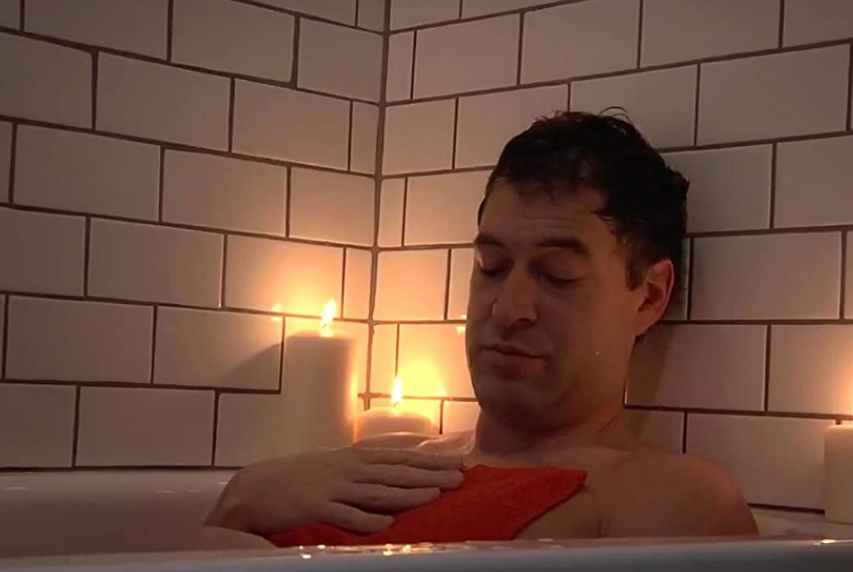
Image via IMDb
What happens throughout the rest of the movie is actually what I think makes the sequel better than the first. In profiling Aaron as this serial killer, we learn more about what actually makes him tick, vs. Sara. Unlike the first movie, where Josef (Aaron) is able to act as some kind of director in telling his story to his unborn child, Sara takes the lead: She asks questions; she’s un-phased by jump scares; and, honestly, seems completely unbothered by Aaron’s erratic behavior and awkward charm. In fact, one might even observe their relationship building and chemistry as some kind of weird flirting. From hand-holding to hot tub massages and even scaring Aaron herself, Sara is a “tough cookie to crack” and only inspires concern over what he might do next to level up the playing field. While he did promise that she’d be safe for the first twenty-four hours, that time is running out.
It is because of these stakes in the game of cat and mouse that the film effectively mimics what we loved about the first, but under more challenging circumstances that we are still unable to dissect our characters fully that ultimately makes it successful. We know Aaron is a killer, but will he kill a victim who challenges him so frequently? Is the new style of back and forth enough to reawaken his destiny? Littered with dark humor along the way, the film eventually reaches the moment of fight or flight. Will Aaron kill Sara, or will the roles be reversed? In the event of an apparent getaway, the viewer knows that Sara has, in fact, made it out alive. But, as per all his meant-to-be victims, Aaron takes to stalking her as the screen goes black.
As viewers, we are still not being able to pin down everything about Aaron (Josef) that makes him so dangerous––this serial killer he’s admitted to being, even shown us and tried relentlessly to convince us and Sara that he is. While famed killers like Ted Bundy, Jeffrey Dahmer, or Richard Ramirez were all reported to have some kind of charisma about them, a tool used to lure their victims, Josef is different: He’s kind but cynical and strange, open but reserved behind our inability to really read him. Like a genuine psychopath, he plays with our mind as we cross over a fine, and hard-to-define line of sane or insane. Are all the stories true, or is Josef just troubled like his sister said in the first movie?
Article written by Destiny Johnson
Destiny writes about true crime and thrillers. She likes movies and stories that make you question the world around you, more so than what makes you jump.


Filmmaker Bari Kang discusses Itch!, from its practical gore and zombie influences to filming in his own NYC store and directing his daughter.