
Interview with ‘Soft Liquid Center’ Writer and Star, Steph Holmbo
Heading into the 2023 Chattanooga Film Festival, there were a few films that I had my eye on. One that managed to sneak in under my radar, however, was a quiet, unassuming title directed by first-time feature film directing duo Perry Home Video called Soft Liquid Center, which centers around a character trying to extricate herself from an ex-boyfriend who refuses to move on. It’s a deeply unsettling film dripping with style, so unlike any other film you may have seen and yet seems so effortlessly familiar.
Needless to say—I fell in love with the film. So I was thrilled to get the chance to speak with the film’s writer and star, Steph Holmbo, about the movie, its influences, how to approach content warnings, and just what the hell “mumblegore” actually means.
Ande Thomas: Going in, I thought the premise looked really cool, but I wasn’t quite sure what to expect. I have to say though, this is right up my alley. It’s not heavily reliant on dialogue or any specific effect or monster or anything like that. It’s thoughtful, it’s psychological, I loved it.
Steph Holmbo: Thank you!
AT: Right off the bat, this feels like a very personal story, so as much as you’re willing to share—I don’t want you to feel like I’m prying anything out of you, but I’d love to hear a little bit about what the film means to you and what led you to this story in particular?
SH: So the main relationship isn’t even seen for most of the film, but what things hang on is an amalgamation of several relationships I’ve had in my life that were deeply toxic and unhealthy, often especially in unexplainable ways. And so, Perry Home Video—which is my husband Joseph Kolean and Zachary Gutierrez—directed it.
And so, we sat down one day and decided to write something and we talked about this idea of taking real life experiences of relationships, especially with the power dynamic of men and women, and heightening it to include a supernatural element. Then people believe it more which is like an insane thing to say—that people might believe it more if it’s less believable—but I find when having conversations about real life abuse or real life toxicity, people question it much more than if you say, “there’s a monster in the house.”

AT: Well, I think there’s sort of a level of distancing that makes it a little bit more ambiguous so people can relate to it more, so it’s not, you know, exactly what’s written on the screen but that someone can say “oh you know what? I’ve had experiences like that,” so it’s similar but it’s not dead on. It’s easier for people to insert their own experiences through that lens and make the connection themselves. Before we get too deep, let me start this way—could you describe your relationship with horror, or more broadly, how you come to horror as a fan?
SH: Yeah, especially in the past, my husband—we’ve been married for six years but have been together for nine—and I lived alone for a lot of my life, and I loved living alone, but it meant, I couldn’t like, watch scary things because then, you know, you turn off the lights and imagine everybody and everything was crawling through the windows. But when you live with other people, it’s a lot easier to like, watch a spooky thing and then you hear a tree outside, be like, “That’s a tree, right?” So now I think horror is such a brilliant genre to comment on the present day on social norms, on things that are really in jest, and it also feels like the fans of horror really come out for things and really love them, really nerd out on things, and I’m also a theater actor which is another really nerdy avenue so it felt like a nice transition into being like, “Oh this is also kind of dangerous but still nerdy.” It’s cool.
AT: Yeah, I think not even just commenting on but processing the things that are going on in the world. You know, at this point, so much has been said about the pandemic already but these studies kept coming out saying how, you know, horror fans, in particular, were more emotionally equipped for these months of isolation that we all had to go through just because we kind of gear ourselves up every night watching a scary movie anyway.

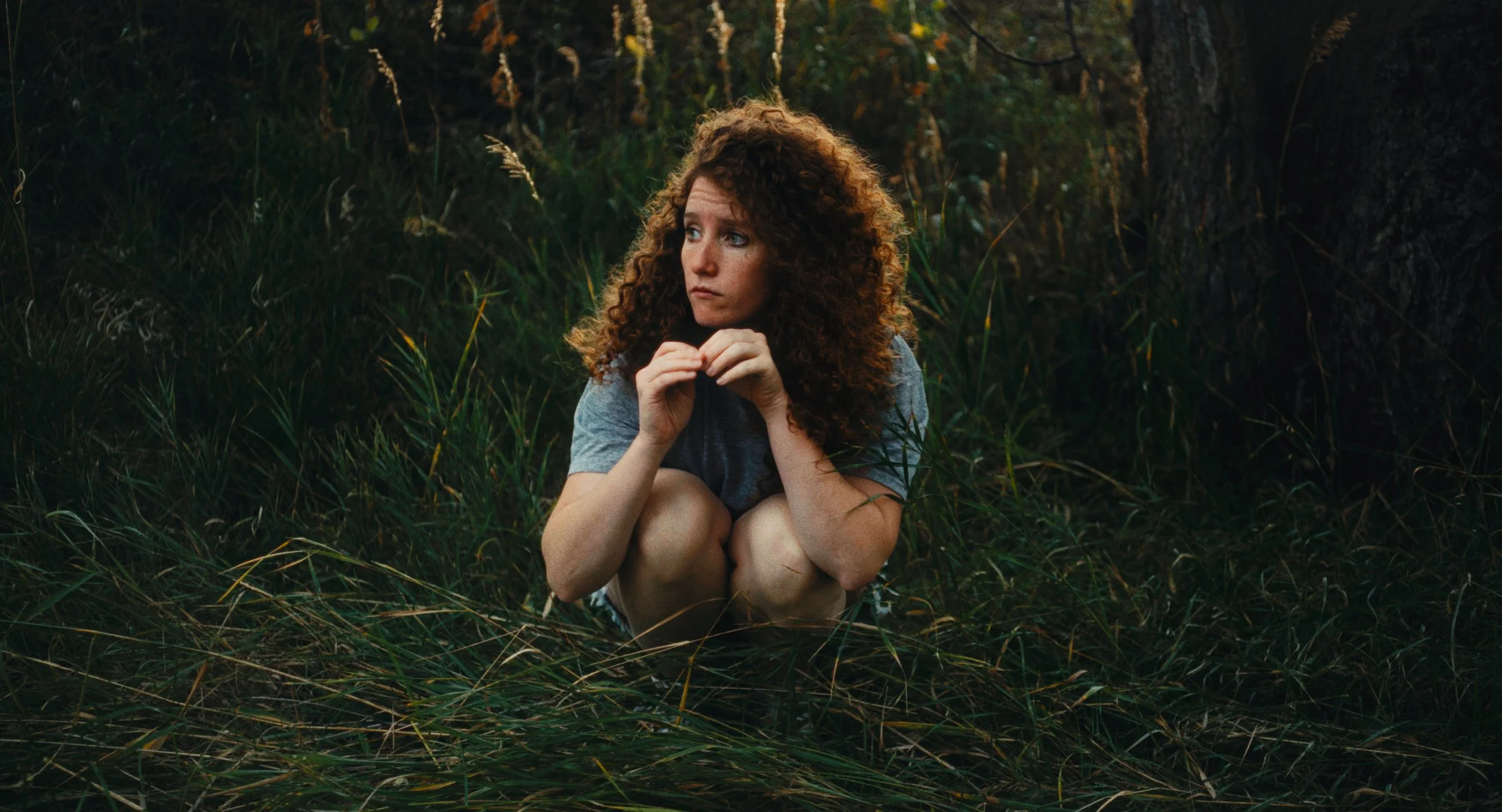
Steph and Paul in Soft Liquid Center, directed by Perry Home Video.
One thing in particular I was curious about Soft Liquid Center, and this might be more for, you know, your husband or Zach, from a cinematographic perspective, but I saw a lot of influence stylistically from a movie called Images by Robert Altman, if you’ve seen that?
SH: I haven’t! I have heard the name, I’ve heard Robert Altman, but I haven’t seen it.
AT: Okay, yeah, different story, but it does follow a woman who kind of undergoes a bit of a break from reality and things start happening around her house, she starts seeing things like her husband morphs into an ex from a previous life and, you know, objects go missing, she starts seeing her own doppelganger, and so on. But then, stylistically speaking, there’s a bit of a cool resemblance. And then another more recent one that maybe you’ve seen is David Lowery’s A Ghost Story.
SH: I loved A Ghost Story! We saw that before we ever started making this but there’s, I mean, the famous pie shot where she’s like, eating for however long and we talked about how we didn’t need 20 or 25 minute shots, but that to really build the suspense of something that is more unexplainable, we wanted the beginning to languish in some moments, to feel—we did a work-in-progress screening about a year ago and people were really on the fence of like, “It’s too slow in the beginning,” or like, “It’s just the right length,” and we actually loved that people were slightly uncomfortable with some of the shots, some of the atmospheric moments, and some of the walking where you’re just like, “what is the point?” and so if I’m describing the movie, I will often put A Ghost Story in the stew of what it feels like to me.
AT: At the festival, a lot of the chatter was about the watermelon and relating it to that pie scene in A Ghost Story, which is true and that’s fair, but I think the comparisons are really more atmospheric, like you said, and the contemplation that you get from each scene as its own entity and then also in relation to the story as a whole—I thought that this story in particular benefits from that kind of pacing and pulling it all together without dragging us along, I guess, you know, there’s a lot of things in the story that people might want to know but don’t get to know—what happened between the couple, that caused the breakup, for instance, but it’s not really that important is it? The fact is that it happened. Full stop. And we follow Steph through her journey and her lived reality with the trauma that she is recovering from.
SH: Yeah.
AT: So is that something that you’d agree with, that whatever happened, whatever it is that this ex won’t let go of doesn't really matter? Specifically with regard to Steph because we’re looking at it from her point of view—she’s the one traumatized and she’s letting go. He won’t let go and much of the movie is centered around him refusing to give up this relationship.
SH: Yeah, I think it’s two sides of the same coin. There’s a great quote about how a memory is the kindest editor and how it often smooths edges and makes you second guess whether or not it was really that bad and what trauma does and what abuse does is signal to the body to remember how bad this was. And the first time I watched it, the scene I was most affected by was when he comes into her house. He has found out where she lives, comes into her house and she’s still. Like she’s underneath the skylight (which wasn’t on purpose) but can’t move. And that is the body saying, this is so dangerous. It’s so dangerous that he’s here, even though he’s not doing anything dangerous. It is such a gift that the body gives us to say, “don’t forget—even if you’ve allowed yourself to forgive or you’re in a new phase of life.” Especially in intimate relationships, whether romantic or not, those endings can be really frayed and when people won’t own up to their hurt or have done things that really intertwine their life with someone and won’t allow the release of that, it gets really messy and part of the reason we started the movie with her moving out is to say this is new. The point of this story is to tell what has happened from now—from this point forward, like you said—and yet, our bodies don’t get as clean of a break and especially if the villain or the pursuer doesn’t allow somebody to let go, then it becomes even more challenging to sever the ties.
AT: Yeah, backing up quickly to the scene when he comes into her house—it’s such a powerful scene because you can see the deer-in-the-headlights reaction from her, and you can feel her body not being able to process what’s happening, first because he knows where she is, but second, that he’s just kind of going along as if he came home from work and it’s just another day, refusing to acknowledge the separation at all. And it is such a powerful performance but it also gets much more to the heart of the film than anything supernatural, you know? That was the scene that kind of hit the hardest because looking from the outside, you can see both of them kind of going through their emotions.
I think it’s really easy to watch this movie once and kind of take away how Steph is feeling and how she’s kind of dealing with this trauma. But I think it’s equally as important to see it from his perspective as well because he’s so oblivious to her pain. I can see that he just wants to understand. I can see that he doesn’t really know or comprehend what happened or what went wrong but in trying to figure that out, he’s not letting her heal. And his pursuit is reopening those wounds over and over and over again. I think we can all find ourselves in that place at times where we forget to account for other people’s perspectives in conflict with our own. So for me, it’s important to recognize that you need to have this empathy for your partner and that your desire to understand what you did doesn't supersede their healing process.
SH: Yeah, and I think he is such a buffoon in the movie—like he’s scary but he really fucks things up constantly—again, he is an amalgamation. So there is that side of giving somebody the benefit of the doubt and saying like, “Hey, even if you don’t understand, give them some space.” I think one of the scariest crimes you can commit or be charged with is stalking because you’re not doing the thing that somebody is afraid of, you’re just putting it in their purview constantly and you can’t really charge somebody with that crime. You have to have physical proof and it’s very difficult to get that. And so I had a relationship where I said I just don't want to have contact for six months, and after that, we can reevaluate. There were tiny moments where he would contact me where he would send a text message or he’d give a letter to me through someone else and it becomes this issue where if you can't even handle this hard boundary, then what else will you do? How far will you go if this boundary isn’t clear enough for you? So I think yes, if we’re giving Paul the benefit of the doubt and saying, okay, maybe you don't understand—really give this person some space but then I think there’s a more malicious aspect too. In lighter terms, I got in a car accident once that wasn’t terrible, and it was the other person’s fault, but when we pulled over to the side of the road, the other person went, “What happened, I was on the phone with my girlfriend?” And I was like, “Uh, you hit me!” You’re not admitting fault because you don’t want to, but you hit me, that’s what happened. And so I think sometimes what people do is to think maybe it wasn’t my fault and maybe if I go to them and I’m nice to them after the fact, or I can convince them or just prove I’m really nice after this terrible thing I did then it makes up for it and I don’t have to be so terrible and people don't have to see me as so terrible.
AT: Yeah, thinking on that malicious aspect, some other recent movies that I would point to are Alex Garland’s Men and then Watcher by Chloe Okuno.
SH: Yeah, exactly!
AT: And in both of those instances, there are these stalkers and that’s intense and emotional and traumatic. But the malintent is very clear in those movies whereas in this one, at least the way I read it, is that Paul doesn’t necessarily see the malintent from his point of view and so my takeaway for Paul, or you know, prospective Pauls that might see themselves in that role, is that you need to think to yourself, okay, let me step back from myself and recognize what I’m doing to this other person. I think it may be less about giving him the benefit of the doubt than it is shining a light on the effects his actions have and how far he’s pushing those boundaries.
SH: And like (here’s a spoiler alert) but the moment when he’s like bleeding himself to make his witchcraft/ritual thing that Alex accidentally gets looped into, I think by that point, either you would have turned around and been like “Gosh, she just won’t answer my calls, whatever,” or you push on to be like “She’s going to answer me. I will get her to talk to me.” So that scene to me and the photo scene where he’s like muttering to himself and looking at all these slides, to the point where you’re like, okay—that’s enough. A person who wasn’t trying to hurt someone else would have, maybe bitterly moved on, but moved on.
AT: Yeah, that’s a great point, he does take it to an extreme level. Once you start bringing dark spells and rituals into it, you’re not the good guy!
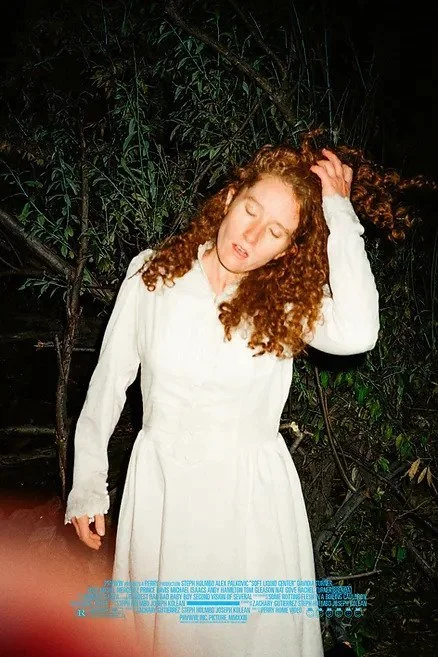
Soft Liquid Center poster at Chattanooga Film Festival.
I’d like to hear your thoughts on content warnings, because there are definitely a few that would apply to this movie, for sure, but I’m curious to know how the filmmakers themselves feel about that because—and this kind of speaks to the theme of the movie—I understand not wanting to open up these wounds that people might have, but at the same time, personally, I find that there’s an importance to (consensually) processing those things, particularly if you’ve experienced them. So I’m always on the fence about how I want to handle content warnings for myself, but then I obviously wouldn’t want to recommend a movie to somebody with or without disclosing content warnings and then either, on one hand, make the movie less impactful for them because they know exactly what to expect, or on the other, open up these traumas that they didn’t want to or weren’t prepared to reopen. As a filmmaker, how do you like to handle that dance?
SH: I think, especially when talking to press or submitting to festivals, using some kinds of buzzwords to be like, you don’t have a lot of time so this captures “a thing,” like, “#metoo” or “an abusive relationship” or “a toxic relationship” and then there is one gory scene. Other than that, I think, like you said, there is a vagueness that I really appreciate about the movie. Having some things in my history that I really feel like I could watch this movie and either use it as a processing tool and think, “Whoa, I’m not alone. This person experienced this thing.” This was on a whole other supernatural level or if I wasn’t in that place, then I could have some separation because we’re not explicitly showing or saying things, since it takes place after the relationship, rather than flashbacks about the relationship or graphic details about the relationship. So, I don’t know what to do with trigger warnings. I want people to be able to go on the journey of the movie without them being in danger of unearthing some things they didn’t expect. I think we tried to do a good job to take care where people can either get a little bit deeper into the soil if they choose or have some separation because it’s not graphic or descriptive or super involved in what might unearth those things.
AT: I like that, I think those are some good guidelines that I can use.
How do you feel about the term “mumblegore,” and would you put Soft Liquid Center in that category?
SH: Oh, gosh, I have heard it, but I don’t feel like I know enough to categorize our movie there. I do think we, speaking of the watermelon scene, we’re using things other than bodies being gory to introduce grotesque and visceral pain or like messiness. But I don’t know, would you categorize it as mumblegore?
AT: Ha! Um, this was another conversation that was happening at Chattanooga and I was just thinking that I’m a little unclear on the definition too—I’ve noticed people usually focus on the way the dialogue plays and a bit of a lo-fi aesthetic, so if we’re using those incredibly vague criteria, then yeah, I think so? I’m just always curious to see what genre, if any, the filmmakers put their own film in.
SH: Yeah, especially before submitting to festivals, we talked a lot about what genre it’s in. Joe and I have actually had conversations where he’s like I don’t know if horror fans will like it and I’m like, oh, I think they will because it’s this and that and all these things. So, I think one of the beautiful things I find about it is I really feel like people can watch it if they get scared by scary movies and people can enjoy it if they like scary movies and I have told some of my dear, close friends who say they can’t watch a scary movie that, “okay, when the red scene comes up, you just watch through your fingers and everything else you’re gonna get through just fine.”
AT: You know, I almost forgot about the red scene, thank you! I came out of my screening, and immediately told my fiancée—I just watched one of the best ghost scenes I’ve seen in years.
SH: Thank you! So we thought we would finish this movie in like three to four months, and we started it in the winter before the pandemic. Then as we went on, we thought okay, we won’t get it done in three months, but we’ll be okay. That was around January of 2019. So like a full year, then the pandemic happened. And so it took us almost three years to finish filming and we had written an outline, and then we were piecing things together. Finally, we got closer to the end and all three of us, the two directors and I sat there thinking, like, it has to be scarier. How do we make it scarier? And we don’t want to use a cheap scare and we don’t want to have a jump scare—we just want it to feel scary. And so we all wrote that scene together and we actually filmed in our house and so that shoot took two days. We covered all of the windows, including the skylights, in red gel, and I would have to, like, I feel like I just need five minutes to breathe the sunlight because I’m losing it
AT: So you kept the gels up for the whole two days?
SH: Yes! I was like, I’m in Hell, this is my house. This is where I live now. Yeah.
AT: God, so you lived in that scene. At least you can take comfort now knowing that it worked! What do you have going on next for the movie?
SH: We’ve submitted to some other festivals and we’ve been in conversations with some distributors and figuring out what’s next. Our main goal was to make this. It was Perry Home Video’s first feature, it was my first time acting in a feature and writing one and we wanted to make a movie that we really liked and all three of us are extremely opinionated and particular. So we got to the end of watching it and really felt like we had done that, so that was the gift. So then we were like, okay well, we’ll see if other people like it and we’ll submit to some festivals, we’ll talk to some distributors and we’ll see where this goes. I still work in the theater circuit in Denver. I’ve written a couple of one-woman shows. Joe and Zach are doing some directing projects together, and Joe is writing his first feature alone right now. So it’s just like a hundred irons in the fire for all three of us. And we really believe in this. It takes so much more time and so much more blood, sweat, and tears than you expect and we finished it so sitting in the movie theater, watching it, thinking like this is good! And we did it with no money and no time at all. We did the whole thing in three years for under $6,000.
AT: That’s incredible. For what shows on screen? It looks so polished and you shot on film!
SH: Yeah, one of the factors, too, is our friend and musician Rob Garza wrote all of the music and just loves writing music and so he did it for gifts and meals, and that was a part of the process that I wasn’t involved in. I just got to see it in the movie and I was blown away. I was like, this music is incredible. You should write music for a hundred movies.
AT: Where can we find you or Perry Home Video online if we want to stay up to date on Soft Liquid Center?
SH: Well Soft Liquid Center has an instagram, @softliquidcenter, and a website and that is where we put all the information about where it can be seen and how it can be seen, especially gearing up to November, we’re gonna start dropping a lot of behind the scenes stuff and also because of all three of our separate artistic projects, the site will also start to become a hub for our work. It won’t become flooded with that, but that’s kind of the easiest place to get in touch with the three of us and see clear updates about the movie.
AT: Great. Like I said earlier, this is the kind of film that is right in my wheelhouse and I can’t wait for people to see it. So truly, congratulations on making it happen, I appreciate being able to see it and speaking with you! And if there’s anything else you want to add, the floor is yours, you can sign us off.
SH: Just thank you for watching it and for the kind words! We really believe in it, we love it, and we are excited to share it with everyone, and I’m going to go ask Joe if he thinks it’s mumblegore.
AT: Yes, let me know what he thinks!
SH: I will!
Update: Joe’s response to the mumblegore question is brilliant and requires no notes:
“The mumblegore descriptor makes sense, but that wasn’t an influence or aspiration. The film’s in conversation with more esoteric stuff like landscape painting and the films of Carlos Reygadas, as well as atmospheric horror like [Nicolas] Roeg’s Don’t Look Now. Reygadas talks about cinema as presence or a tool that can utilize presence, at least that’s how I understand his philosophy, and that’s been instructive. And then there’s the fact that we have a very DIY, stripped down, punk rock manner of working, but it’s also precision-oriented. I don’t see this process, nor its end result, connecting much with the looseness of mumblegore. What we’re trying to do is make films that leave room for surprise and wonder, but are uncompromising, obsessive, and precise. That being said, the only thing I really know is that making films is incredibly challenging and we’re lucky if we get a single moment that rings true, so if mumblegore is a positive association, I’ll take it!”
—Joseph Kolean
Article written by Ande Thomas
Ande loves the intersection of sci-fi and horror, where our understanding of the natural world clashes with our fear of the new and unknown. He writes about monsters and foreign horror and can also be found over on Letterboxd.

Other articles you may enjoy...
Filmmaker Bari Kang discusses Itch!, from its practical gore and zombie influences to filming in his own NYC store and directing his daughter.