
Bad Dog: ‘Cujo’ Still Scares 40 Years Later
Adapted from Stephen King’s 1981 horror novel, Lewis Teague’s rendition of Cujo hasn’t lost its ability to scare viewers in four decades. Maintaining a close similarity to the book, the film follows the Trentons, a middle-class family who recently moved to Castle Rock, Maine, from New York City. As four-year-old son Tad battles his fears of the monster with red eyes in his closet nightly, parents Donna and Vic try to address their own monsters: marital troubles and Donna’s recently confessed affair.
Timing for all of these changes and hardships couldn’t be worse, as Vic’s company is simultaneously dealing with a scandal that requires him to leave town, leaving Donna to contemplate their potentially nonexistent future and get their failing Ford Pinto fixed. Unknown to Donna, however, the shop she intends to get her car fixed at is fairly remote and home to a 200-pound St. Bernard. But this isn’t your fun and lovable Beethoven, no, Cujo is infected with a disease that’s turned him from man’s best friend into the symbol of a primordial predator––and he intends to kill.
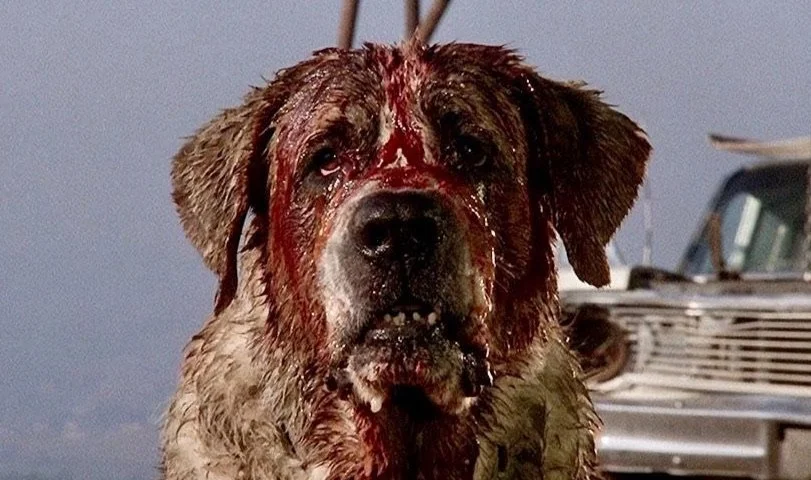
On the day that Donna and Tad are scheduled to bring the Pinto over, mechanic Joe Chamber has been persuaded to let his wife Charity and son Brett go visit her sister in Connecticut. While this detail wouldn’t be worth mentioning in any other story, it intensifies Donna and Tad’s future dilemma. While dragging along rural roads, unsure if they’ll ever get the car to the Chamber’s shop successfully, Cujo’s transformation has entered its final stages. By this point in the film, I am already sick to my stomach over the building tension. As a dog mom of two, any time I sense something wrong with my furkids, we are calling the vet. I might be overdramatic at times, but you can never be too careful. Regardless, even if Cujo’s changing demeanor wasn’t immediately apparent, a trip to get him checked after a flash of anger Brett witnessed prior to departing could have been enough to prevent the wicked turn of events.

Before the Trentons arrive, Cujo has attacked and murdered Gary, the Chamber’s neighbor, and his owner, Joe himself. After all of this unknowingly occurs, Donna pulls the Pinto up to the Chambers’ house, where it inevitably dies, having used all its power to make the trip. As Donna gets out of the car to try and find Joe, Cujo makes his first attempt to kill, scaring her back into the car with Tad. Saved by metal doors and glass windows, Cujo puts up enough of a fight that the car almost looks like it's been in an accident. Coated in puss, blood, and drool, visibility from inside the Pinto is like trying to see when you’re in the middle of getting your car washed. After several hours go by, Donna comes to the realization that they’re essentially stranded on this remote property with no one to realize that they never went back home and no way to call for help.
Trapped in a car that is only getting warmer in the summer sun, the nightmare ensues. While heat exhaustion and dehydration are some of the most talked about accidents in the hotter months, they rarely make a good horror movie. What sets Cujo apart though, is not just the rabid dog, but the underlying possibility that it all could happen. Despite when this story was told, in book or film versions, there is still the possibility of not having a cell phone, or more likely, not having service or GPS, etc. This perfect storm could still happen in today’s time—turn on the news and somewhere someone has died sitting in a hot car or more recently, from the high temperatures alone. If nothing else, a remake of Cujo could be even scarier than its predecessor (Any takers?).
Despite several changes made by screenwriters King, Don Carlos Dunaway, Lauren Currier, and Barbara Turner, and having read the book as an adolescent, I think the changes were wise for melodrama, but served to be more impactful in the original telling, because it tells the truth. In the movie, apart from Gary, Joe, and a local police officer, no one else’s life is lost as a result of Cujo’s terrorization. Tad lives and viewers can sympathize and fear what nearly happened to the innocent child. But the swirling of possibilities and knowing that the end could arrive at any moment is captured so uniquely and accurately when the camera swirls from a bloodied Donna, having just retreated and tittering unconsciousness from a failed attempt at getting past Cujo to the house, and Tad screaming and crying, faster and faster until viewers become almost nauseous.
By no means am I advocating that we kill kids in movies. Again, we hear and watch much less dramatic stories take place all over the world where a child has lost their life to negligence or a dog has attacked someone, etc. The staple in King’s stories and movies, Cujo especially, is that we don’t stop thinking about the possibilities. We fear our own ability to accurately pay attention to what’s happening around us and that sticks with us, because if you’re not too careful, it could cost you. We are here to not only live, but survive this world. And, that’s not always an easy thing to do once you realize how fragile you really are.
Article written by Destiny King
Destiny writes about true crime and thrillers. She likes movies and stories that make you question the world around you, more so than what makes you jump.
Other Articles You May Enjoy…


Filmmaker Bari Kang discusses Itch!, from its practical gore and zombie influences to filming in his own NYC store and directing his daughter.