[Book Review] ‘Weird Sisters; Tales From The Queens of the Pulp Era’
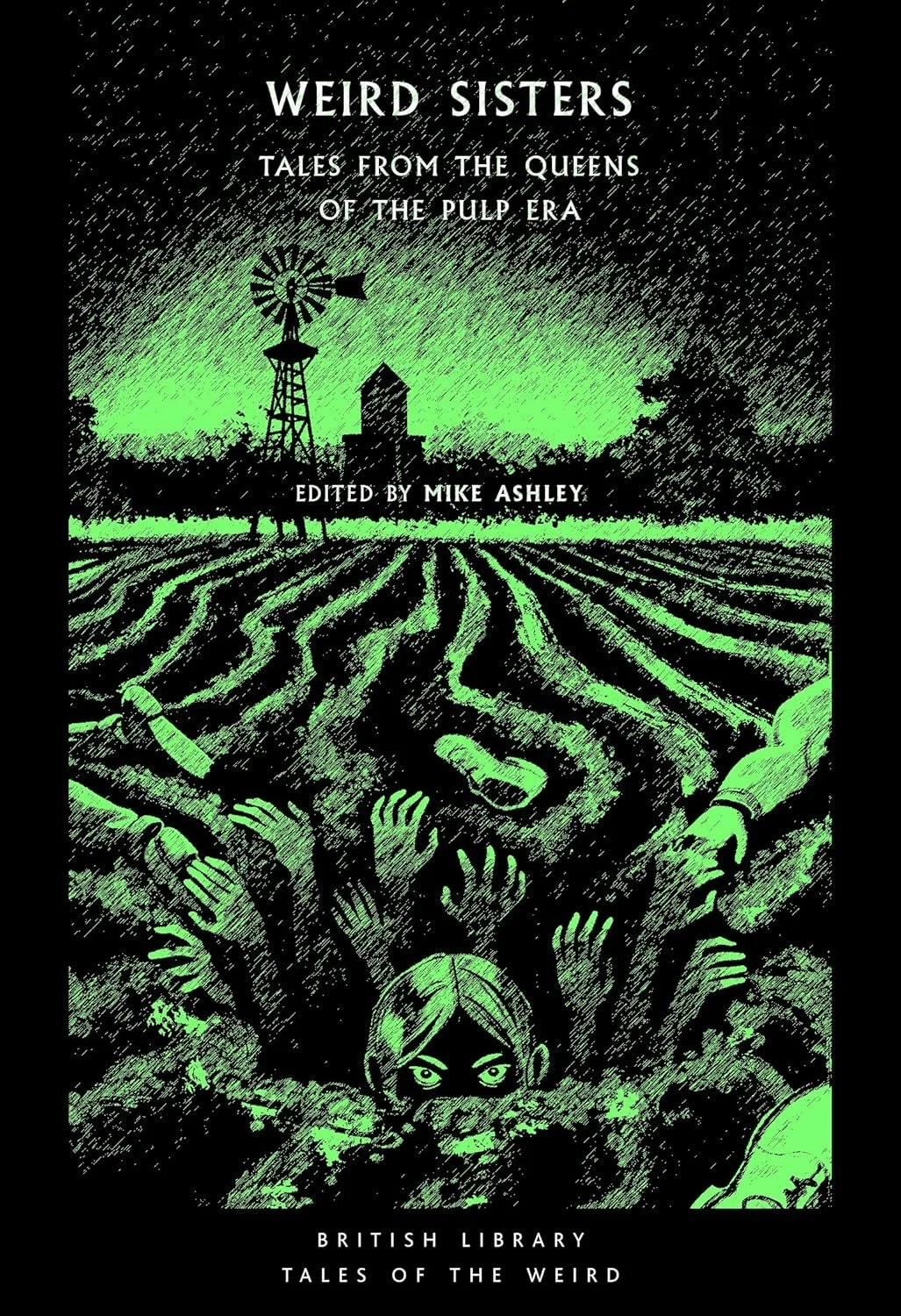
Even after dozens of other entries into the series (including even, I freely admit, my own offering) Mike Ashley’s Queens of the Abyss is still one of my absolute favorite Tales of the Weird anthologies. Not only is it a collection of excellent strange stories but it subtly charts the impact that female authors have had on the genre, developing from relatively mundane mysteries to genuinely surreal scares. Accordingly, you can imagine my excitement when I saw that, with Weird Sisters, Ashley once again delves into that class of weird tale which, despite their narrative power, have often been unfairly overlooked purely because their authors happened to be women. Overlooked, it has to be clarified, especially in the sense of being writers of weird fiction. Many of the authors included here were celebrated—LM Montgomery, who we’ll hear more of later, wrote the much-loved Anne of Green Gables—and supported; as Ashley explains in his introduction, the legendary pulp magazine Weird Tales, which informs the anthology’s title, “welcomed women writers as much as men.” Yet, in the years since that initial celebration and support, many of these writers have found themselves relegated to footnotes, if that.
Featuring stories that range from the mid-1920s to the cusp of the twenty-first century, Weird Sisters tries, with admirable success, to crack the sadly still-pervasive narrative that a woman writer’s place is solely in romance or children’s fiction. The most obvious indicator of this is that a good number of the stories in Weird Sisters are straight up bleak. Surprisingly bleak, in fact. “The Underbody” by Allison V. Harding—which features an enigmatic figure with “earth coming from his nostrils and his ears and at the corner of his mouth” who perhaps emerges from the soil or is in some way made from it— is genuinely distressing, with its vivid and unblinking descriptions of grief and loss. Rational human beings become “squealing, screaming, crying creature[s]” as they are faced with the inscrutable, sneering actions of the subterranean thing. Perhaps surprisingly, this unflinching style found a home in the pulp magazine’s pages. Harding, according to Ashley’s short biography of her, “was the most prolific female contributor of short fiction to Weird Tales” with 36 pieces to her name. Equally dark, Everil Worrell’s “Leonora” uses a piece of fairy tale framing to build the skeleton of a tale—one perhaps inspired by Emily Dickinson’s poem “Because I Could Not Stop For Death” as much as it is by the eponymous legend of German background—that could be interpreted as something genuinely supernatural or as a young girl’s confused attempt to explore her own mental distress. “I am only seventeen,” she tells us. “And they say I have been mad more than a year.” Even these two stories pale slightly next to “Brenda,” Margaret St. Clair’s story about a young woman who finds something with skin of “an inky greyness,” whose body “was blobbish and irregular” and a “rotten smell was welling out from him.” Brenda’s initial fear of this shambling figure is more than understandable but the glee and, eventually, power she derives from her discovery, not unlike that of the equally young women in Yellowjackets, is confrontational even today. How it came across in 1954 is anyone’s guess but it is undoubtedly a fine example of a particularly striking kind of weird fiction; one that doesn’t turn away, cowering, but which holds the gaze of the horrors arrayed in front of it, and even comes to love them…
As is the case with most anthologies, not every story collected here landed as well with me. “Ode To Pegasus” is florid in its writing style but narratively obvious in its quasi-retelling of the myth of Icarus. The biography of Maria Moravsky—a Polish émigré to the United States who wrote the story after teaching herself English—hints at a far more interesting real-life story than that of flying horses and falling boys. Equally, Frances Garfield’s “Forbidden Cupboard” is written well enough but its Jamesian narrative of a vile horror—a thing of dust and cobwebs, with a “torn, musty head” and whose “hands had no fingers - they flapped like dusty mittens”—ends far too abruptly (and neatly) for it to be truly terrifying. I find it hard to call either of these stories bad but they didn’t suit my tastes, especially when we consider some of the excellent writing otherwise included.
Writing like LM Montgomery’s chilling “The House Party on Smoky Island,” a piece I’ve read many times but which never fails to unnerve me and is, in my opinion, the pinnacle of Weird Sisters. Often described, even when first published in Weird Tales, as “quaint,” this seems to be due more to a focus on the tale’s Wodehouse-esque set-up; a mismatched group of guests spend a drab holiday on the eponymous island, with troubled relationships bubbling just under the surface. Yet the sudden, grinding gear change of the finale—a deft piece of weird wrongness that the reader is probably a few sentences past before they realize what’s happening—is up there with Nineteen Eighty-Four’s “We are the dead / You are the dead” exchange for its capacity to make the hairs on my neck stand up. It’s a quiet, even gentle terror. Sad and strangely pitiful; “I loved him enough for that,” we are told by… someone. But it’s terror nonetheless and one that is shown not in gory details but in the effect on the holiday-makers we’ve been watching; “I felt sick,” admits the narrator and we can hear his voice choke as he continues “Very, very sick.” It’s a startling story and one of my absolute favorites, although I freely admit it’s one that many other readers genuinely will find “quaint”or even outright disappointing. Hopefully, though, at least some will find something to love in its chills.
I’ve not even touched on CL Moore’s “Daemon” and its portrayal of a world where human action and intent is as evident as their clothes, at least for those who can see clearly enough. Nor the paranoid, claustrophobic dread of “They That Have Wings.” As Ashley tells us in his introduction, Evangeline Walton’s piece of what I can’t stop myself from calling eyrie fiction was “too gory” for Weird Tales to consider. Quite an accolade. Although Ashley states, not incorrectly, that “there is an emphasis on personal stories and especially children” in this collection, how those stories are set and told varies wildly from writer to writer, making Weird Sisters a tantalizing peek into the vast array of female writers who haven’t yet had their chance at re-emerging and hopefully inspiring yet more ranks of weird sisters.
We often talk about writers being “lost” or “forgotten,” when “ignored” and “neglected” are far nearer the mark, especially when attributes like life, race, or gender come into play. Correcting this neglect is, I think, where the Tales of the Weird series has consistently excelled, by bringing these ignored authors back into the public eye. Long may it continue.
Article written by Dan Pietersen

Daniel Pietersen is the editor of I Am Stone: The Gothic Weird Tales of R. Murray Gilchrist, part of the British Library’s Tales of the Weird series. He is a recurring guest lecturer for “The Last Tuesday Society” and the “Romancing the Gothic” project, where he produces an ongoing series on Haunted Houses and related topics. He has also contributed criticism and reviews to publications like Dead Reckonings, Revenant and Horror Homeroom. Daniel lives in a very old house in a very old town and is slowly becoming very old himself. He occasionally appears on social media as @pietersender.
Other articles you may enjoy...
In The Buffalo Hunter Hunter, blood carries the violence of colonialism, while a settler’s journal controls whose story survives. This essay examines how Stephen Graham Jones uses vampirism and layered testimony to confront historical erasure.