
30 Weeks And Counting: A Continuation of Pregnancy Horror
When I started writing this, I was just two months away from Gage’s due date—now I’m just two weeks. How the fuck did we get here this fast? While I've been busy with last-minute travels, nursery prep, baby appointments, birthing classes, and the Trailer Bash / Raging Pages Film Festival, I somehow found the time to squeeze in a few more pregnancy horror films that push the boundaries on pregnancy and childbirth.
If you haven’t already, be sure to read Part One of this series as I continue to explore how much more uncomfortable I can get as my body continues to change and this tiny human grows inside me. A kick, a push, a hiccup—all strange and new and wild—and admittedly pretty freaky. But what I’m finding in pregnancy horror is that directors rarely explore those natural phenomena. No, there always has to be a sinister monster baby to test our faith and sanity. If only they knew…
Delivery: The Beast Within (2013) | Dir. Brian Netto

I’ll admit, when I stumbled upon this film, I was eager to press play. I mean, how fun: a found-footage-style demonic baby horror movie? The concept was wildly unique and something I knew I had to explore while on this pregnancy journey. Trying to place myself in the mindset of the film’s release, I recognized that this was a period where found footage was just beginning to break through to the mainstream with big releases coming out just a few years prior, such as Lake Mungo, Paranormal Activity, and Cloverfield. The subgenre was building a name for itself and with Delivery specifically, we were also witnessing a combination of subgenres.
Intentionally, the film opens up like a reality series you’d see on HGTV, complete with generic soundtracks during its opening credits and scenes where each character(s) can have one of those MTV-style confessionals to share how they’re feeling at any particular moment. It’s kind of comical at first, given the awkwardness of the actors and how at the same time, it makes the storyline feel more real—these are not actors, they’re real people.
The build-up of the story is fairly well-paced, but it’s only after we think that Rachel (Laurel Vail) and Kyle (Danny Barclay) have a miscarriage that the storyline becomes more predictable and shaky. While I want to appreciate the blending of found footage and demonic possession or supernatural like we’ve seen in predecessors, the new element to the story no longer feels believable. Could this be the repeated denial, like we see in survival house haunting stories? Or the over-the-top changes in our characters that detach us from them before we make it to the film’s end? I can’t quite pinpoint it, but it left the film feeling like we went nowhere fast.
Alien Romulus (2024) | Dir. Fede Álvarez
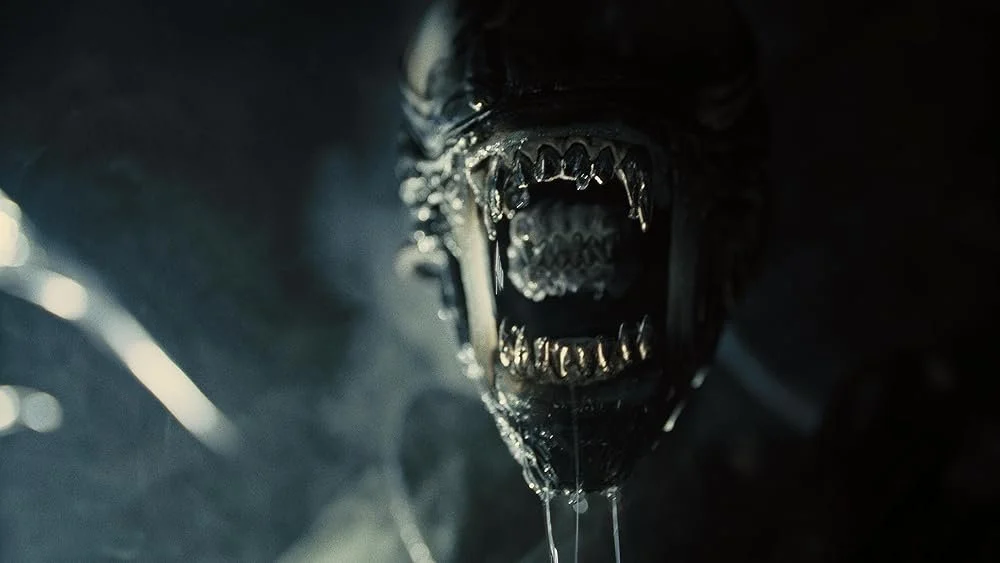
Alien: Romulus. Image via IMDb.
While I haven’t watched this film since its release back in August 2024, every time my son was pushing up against my belly throughout my pregnancy with force, my mind repeatedly went back to that scene with Kay (Isabela Merced). The only pregnant crew member on this mission to escape their mining colony, I was drawn to Kay’s character then, worried as a woman for her safety and what hardships she might have to endure in her condition. The group’s mission would not be an easy one, and given our views of pregnant women being a disadvantage for health and safety reasons, I was concerned. In my new mindset, those fears in thinking back on the film only became more intense, and much of the reason I couldn’t bring myself to rewatch it in this sensitive state.
Do I think I could have actually watched it? Probably. But I wasn’t feeling how I thought I might before pregnancy. For example, when presented with the hybrid Xenomorph, I thought prior to becoming pregnant that maybe I would have a greater attachment, as in the creature was still created by Kay—to a degree. Instead, I felt discomfort and sickness in my stomach. My mind swarmed with anxious thoughts, questioning every vaccination throughout pregnancy and those that would be scheduled after his birth. There is so much we don’t know regarding the side effects or longterm effects of these injections.
Although completely science-fiction, it puts reality into a perspective I wasn’t expecting. And an unrealistic fear about if babies could, well, you’ll just have to watch the film.
Inside (2016) | Dir. Miguel Ángel Vivas
Only when I realized after the fact that I watched the wrong Inside, did I actually feel some relief. Although I was not impressed with the remake, hearing about the gore and bloodbath its French origin hails from, I was curious if life had just given me some grace from what I could have witnessed. What drew me to the film was its plot: Sarah, played by Rachel Nichols, is being stalked while in her third trimester. On Christmas Eve, the wicked woman stalking her during this crucial time in her pregnancy tries to steal her unborn baby.
Talk about a crazy true-crime type scenario. Like Delivery, the film started off strong. I was thoroughly freaked out by the factoids regarding childbirth and knew immediately that Sarah would be facing yet another heartache or challenge of sorts, even after the accidental death of her husband. A bit of a roller coaster for sure, the movie is one of those that doesn’t put you on the edge of your seat, but makes sure you’re never comfortable and never trusting of what could happen next. This is a horror movie after all, and no one should expect a happy ending.
After the pace picks up and Sarah must fight for her and her baby’s life, things again feel unrealistic and a bit forced. I don’t want to pick apart these instances, but can confirm that as a woman who was approaching her third trimester while watching this film, I had no issues making it to the credits. Perhaps after I give birth I will go back and try the original from 2007. Wish me luck!
Mother! (2017) | Dir. Darren Aronofsky
Of all the films in part two of this series, this one actually scared me the most. While it doesn’t go into the horrors of pregnancy or labor specifically, it very much covers a loss of control and the psychological aspects of motherhood, which honestly, felt much more terrifying. In Aronofsky’s film, we see a couple played by Jennifer Lawrence and Javier Bardem living in a remote, completely remodeled home that they quite literally restored from the ashes. As “Mother” struggles with navigating the next steps in life together (assuming this would be children and building a life), her husband “Him” is more focused on his delicate ego as a poet who has been unable to write in some time. Our characters are never given names in this film, but seem to serve as entities.
Things start to get weird when Him allows for a complete stranger to stay with them in their home. Some kind of drifter, the man is clearly going through something, but ends up actually being a huge fan of Him’s work. Ego stroked, despite Mother’s insistence that the occurrences are beyond strange and this man should leave, Him compels her to remain kind to their guests. The problem is, however, it doesn’t end there. Eventually more and more people come, slowly destroying their home and completely uprooting this tranquil lifestyle they’ve created together.
Amidst the chaos, Mother gets pregnant and has her baby quickly—almost like in a dream. Where this would be exactly what she wanted, the entire state of their home is uncontrollable and her own child is taken from her… sacrificed. Even though I was confused in parts throughout the film, I couldn’t help but feel an intense amount of anxiety about the transition period of becoming a mother. Everything in the movie felt like a metaphor for this journey and the uneasiness and fear it bestowed upon its viewers was deeply unsettling. I’m curious to know if others, who are not pregnant or thinking of children had the same reaction, or if as a pregnant woman with versions of these thoughts already swarming around on a daily basis, were just immensely intensified.
Article by Destiny King
Destiny writes about true crime and thrillers. She likes movies and stories that make you question the world around you, more so than what makes you jump.
Other Articles You May Enjoy…

![[Movie Review] Avalon Fast’s ‘CAMP’ is the Latest in the New Wave of Transgressive Filmmaking](https://images.squarespace-cdn.com/content/v1/5d3e481bc5a6e40001b215a8/1782401219629-WQRPE1S2P04BE4SNHMJ2/mPAUB3_Q.jpeg)

Thomas Ligotti wrote that “the highest aim of the realistic horror writer is to prove, in realistic terms, that the unreal is real”. Nowhere is this sentiment embodied so well as in internet horror fiction, colloquially known as creepypasta (a name riffing on the act of copy and pasting stories across multiple forums i.e. copypasta, and homage to the genre’s collaborative storytelling roots).