
True Nature Contained: A Bear’s Primal Terror In Animal Horror Cinema
This summer I’ve been contemplating the fear of nature, particularly as it manifests in our cultural representations of animals. Prior to reading Mauled, I had devoured the pages of Erica Berry’s Wolfish: Wolf, Self, and the Stories We Tell About Fear. While I didn’t know that bears would become my focal point when I began exploring animal attacks in cinema, Berry’s content felt very relevant to my journey in that it was able to pinpoint where our fears around predators had originated and developed over time—across cultures and even through Berry’s own personal experiences.
Like wolves, bears have long been cast as symbols of danger. When observed from a safe distance in their natural habitats, bears typically pose no immediate threat. As long as we stay outside their sphere of interest, peaceful coexistence is possible. However, not everyone perceives these encounters in the same way. As I noted in the first installment of this series, no two encounters are alike, and safety is never guaranteed. As Berry aptly states in Wolfish, “There is always the creature in front of you and the creature in your mind.”
While the bear before us remains unchanged in a biological sense, the bear we imagine is shaped by centuries of myths and decades of media. Each individual's perception is a unique blend of fictional and real-life experiences, creating the mental image that comes to mind when we picture a bear in the woods. In Psychology Today, Marc Bekoff Ph.D., Animal Emotions, writes:
In the case of wildlife conservation, nowhere is the lack of compassion more apparent than in the ways we treat carnivores. We have demonized and persecuted wolves and bears for centuries. They have been labeled as unpredictable, dangerous, ferocious, and untrustworthy. None of these is true, but the labels persist. Partially, this is because we fail to distinguish between a minuscule real risk and an inflated perceived risk.
While these historical myths and perceptions of bears have shaped public attitudes, modern cinema continues to reinforce and, at times, distort these ideas even further. As I delve deeper into this niche subgenre, I’ll examine how bears have become a symbol of nature’s raw, untamed power, challenging humanity's dominance.
Amidst the surge of animal horror cinema in the 1970s, following Steven Spielberg’s historic blockbuster Jaws (1975), was William Girdler and David Sheldon’s Grizzly (1976). In an almost play-by-play rendition of its shark predecessor, Grizzly follows a ravenous brown bear as it terrorizes a national park. Following a series of gruesome attacks on campers, park ranger Michael Kelly teams up with a naturalist and a helicopter pilot to track down and stop the bear. Standing 18 feet tall and weighing over 2,000 pounds, the grizzly proves to be a nearly unstoppable predator. As the body count rises, the trio faces mounting pressure to kill the creature before it causes more devastation. Nearly 20 years later, The Edge (1997) was released, directed by Lee Tamahori, portraying another relentless grizzly bear in the Alaskan wilderness, seemingly hunting three men stranded by a plane crash. In this film and Grizzly, the bear is depicted as a bloodthirsty predator determined to kill humans. Despite real brown bears being used in both films and their reputation as instinctual killers, both directors took the opportunity to nearly double the average size of the common forest dweller—further emphasized by camera angles and props. According to reports, the North American male grizzly bear averages a standing height of nine feet and can weigh upwards of 860 pounds (Live Science).

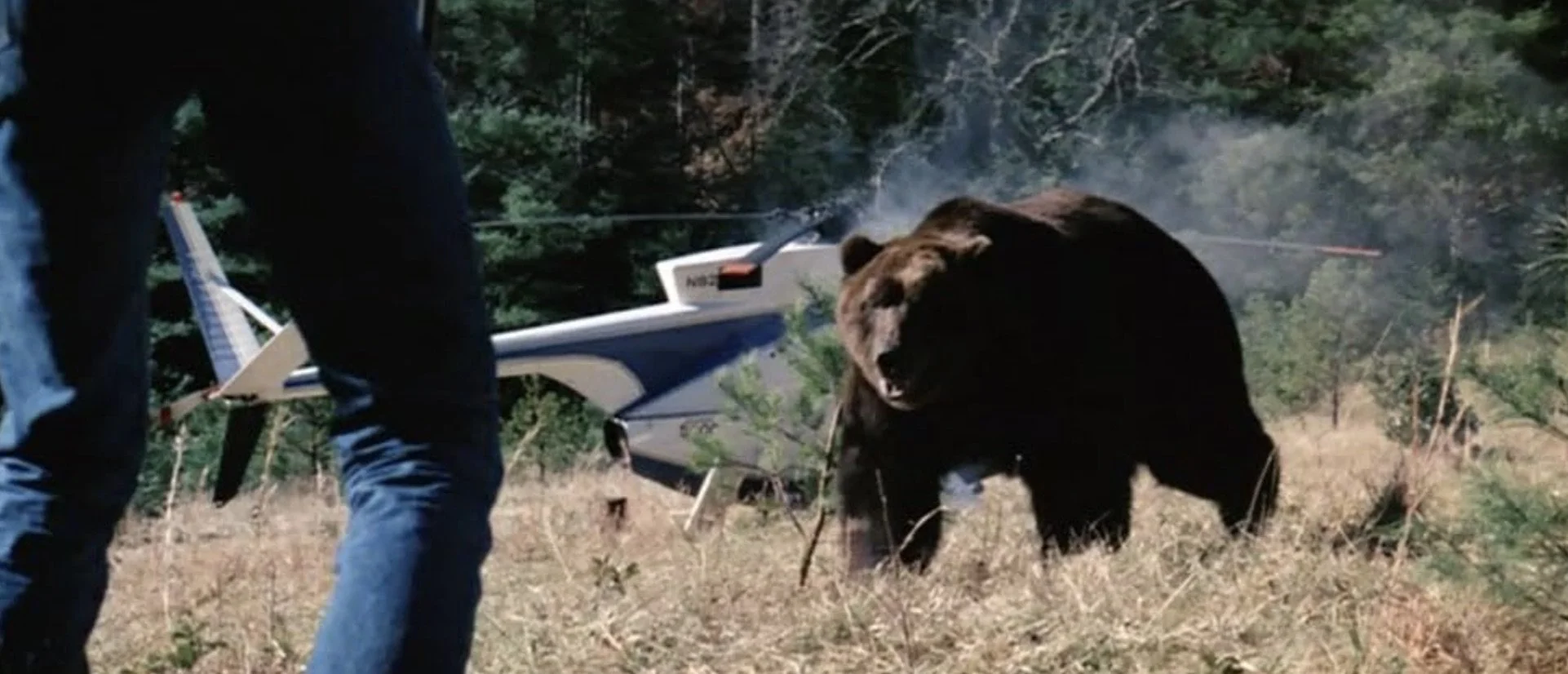
Andrew Prine in Grizzly (1976), image via IMDb.
The portrayal of brown bear behavior in these films was also far from accurate. The closest real-life parallel to these events might be the tragic occurrences of August 1967, when two women were killed by grizzlies on the same night in Glacier National Park—an event often referred to as "the night of the grizzlies" (NPAD 17 & 18). This incident marked a first for the park, which had been established for nearly 60 years without recording a single bear-related death (Outside). However, these bears weren’t rampage-engaged bears determined to kill every human in sight. The bears who consumed Julie Helgeson and Michele Koons had become accustomed to feeding on human food and trash. Before that fatal night, the Granite Park Chalet had been reportedly encouraging campers to watch bears feed from the dumpsters—and in Yellowstone National Park, rangers had been known to erect bleachers around dumpsites for tourists to observe bears scavenging (Outside).
While real-life bear attacks often result from human negligence rather than territorial aggression, these incidents sharply contrast with cinema's portrayal of bears as bloodthirsty predators. Films like Grizzly and The Edge capitalize on primal fears of being hunted—fears that are more cultural than reflective of typical bear behavior. In these cinematic narratives, bears often symbolize dominance and territorial power, embodying the raw struggle for survival and supremacy in the wilderness. These films position the bear as more than just a physical threat; it becomes a symbol of nature's untamed power, challenging humanity’s illusion of control over the natural world. The bear represents the wild’s resistance to human intrusion, a reminder of the delicate balance between species. The conflict between man and bear transcends survival, delving into questions of identity and dominance.
Dawn Keetley’s observation about wolves in Frozen (2010) applies equally well to the bears in these films: they are portrayed less as authentic wild animals and more as reflections of human savagery and ruthlessness (Keetley 199). The uncharacteristic behavior of the cinematic bear mirrors human qualities, suggesting that the creature is becoming a distorted reflection of ourselves. In both Grizzly and The Edge, the protagonists are not simply trying to survive; they are attempting to reclaim control, escape nature's chaos, and return to the order of civilization.
Ultimately, the bear in these films represents more than a threat to life. It challenges the idea of human superiority, positioning itself as the "alpha" in a metaphorical struggle for dominance. This primal conflict is not just about survival but also about ego, revealing humanity’s vulnerability in a world where we are not always the dominant force. By heightening this tension, the films explore deeper themes of survival, identity, and the fragile relationship between civilization and the wild.
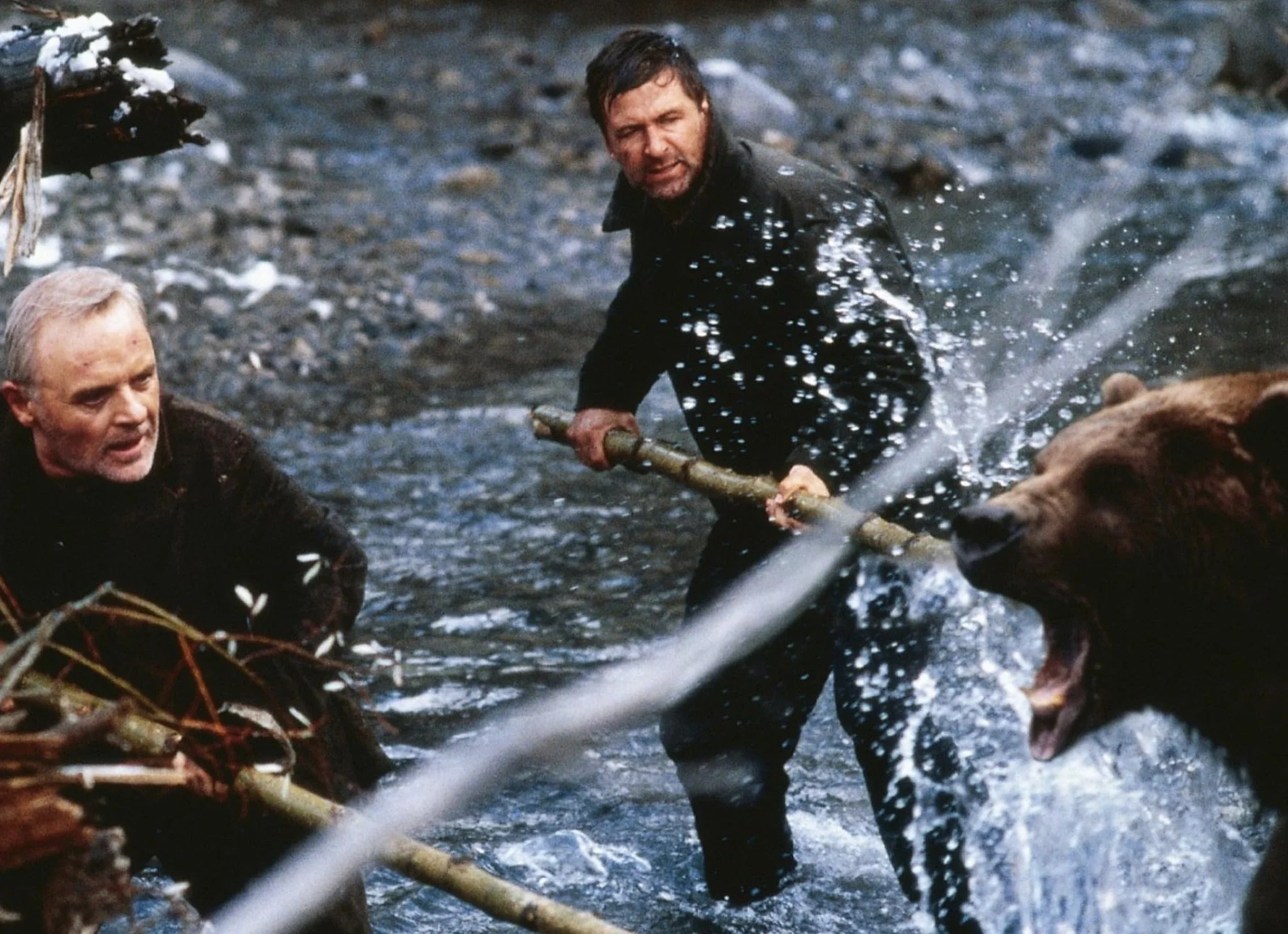
Anthony Hopkins and Alec Baldwin in The Edge (1997), image via IMDB.
In making this observation, another bear attack film fitting perfectly here and further supporting these notions is Alejandro González Iñárritu’s The Revenant (2015). Where in Grizzly, the bear is a more straightforward antagonist, symbolizing nature’s wrath, the bear attack scene in The Revenant is a pivotal moment that highlights the fragility of human life in the face of nature’s indifference. In the iconic scene, Leonardo DiCaprio is nearly killed by the grizzly in what viewers can assume is to protect her nearby cubs. Although crafted in fast-paced CGI, the animal behavior is on-point—textbook, even—and successfully portrays nature as a dangerous force. Furthermore, if you were to examine the cultural happenings surrounding these two films, you would learn that the 1970s was when environmental awareness was rising. In 2015, when The Revenant was released, things had modernized, reflecting more contemporary anxieties about humanity’s relationship with the environment.
The cinematic portrayal of bears taps into a primal fear—the fear of being vulnerable in a world where human control is an illusion. Whether through Grizzly, The Edge, or The Revenant, bears become avatars of nature’s power, reminding us that, despite our attempts to dominate the wilderness, we remain at its mercy.
Ultimately, films like Grizzly, The Edge, and The Revenant do more than dramatize the fear of animal attacks. They delve into deeper, more primal concerns about humanity's place in the natural world, forcing us to confront the fragile balance of power between us and the wilderness. As these films suggest, nature is not just a force to be feared, but one that holds up a mirror to our savage tendencies, too. With so much to consider, is it only natural that in trying to dominate these forces, civilization seems to put itself in even a greater predicament when it tries to control it?
In the third and final installation of this bear attack series, I will continue to observe and explore how humans have tried to impact nature in its desire to overcome it, and the horrors to rise from that as a result.
Works Cited
Bekoff, Marc. “Why We Misjudge Wolves, Bears, and Other Large Carnivores.” Psychology Today, Sussex Publishers, 26 Jan. 2024, www.psychologytoday.com/us/blog/animal-emotions/202401/why-we-misjudge-wolves-bears-and-other-large-carnivores.
Berry, Erica. Wolfish: Wolf, Self, and the Stories We Tell About Fear. Flatiron Books, 2023. Accessed June 2024.
Goldfarb, Ben. “The 50-Year Legacy of Glacier’s Night of the Grizzlies.” Outside Online, 12 May 2022, www.outsideonline.com/outdoor-adventure/hiking-and-backpacking/50-year-legacy-glaciers-night-grizzlies/.
Keetley, Dawn. “Frozen, The Grey, and the Possibilities of Posthumanist Horror.” Animal Horror Cinema: Genre, History and Criticism, Palgrave Macmillan, London, 2015, p. 199.
King, Destiny. “Immersed in Grizzly Bear Country: My Trip to Alberta After Reading ‘Mauled’ (2024)” whatsleepsbeneath.com, www.whatsleepsbeneath.com/archive/mauled-book-review. Accessed September 2024.
National Park After Dark (NPAD) Podcast. Episode 17: Night of the Grizzlies - Part 1 - Glacier National Park. Accessed July 2024.
National Park After Dark (NPAD) Podcast. Episode 18: Night of the Grizzlies - Part 2 - Glacier National Park. Accessed July 2024.
Pester, Patrick. “Grizzly Bears: North America’s Brown Bear.” LiveScience, Purch, 28 Mar. 2022, www.livescience.com/54453-grizzly-bear.html#.
Article by Destiny King
Destiny is a supporting member of the Horror Writers Association who’s been working in B2B publishing for nearly a decade. Her favorite horror subgenres are true crime, found footage, and psychological thrillers. Find her on Letterboxd.