
How Guilt and Pain Drive ‘The Ritual’ (2017)
As summer settles in and wilderness horror seems more relevant than ever, I took the opportunity to watch the Netflix Original horror film, The Ritual (2017), directed by David Bruckner—also famous for his works in V/H/S (2012) and Southbound (2015). The Ritual’s inspiration, the novel published in 2011, was originally written by Adam Nevill. Taking the time to cross-reference the descriptions of both the novel and the film (as I haven’t read the book), I’ve found that while they vary slightly from one another, I can’t help but be satisfied with how the movie has portrayed both grief and Norse mythology.
The Seeds of Guilt
At the beginning of our story, we meet our main characters—Luke (Rafe Spall), Phil (Arsher Ali), Hutch (Robert James-Collier), Dom (Sam Troughton) and Robert (Paul Reid)—planning some type of boys’ trip to reconnect. While the group continually throws out a variety of options, Rob pushes for a hiking trip in Sweden. However—as horror movies tend to hook us in with some immediate existential dread—during a visit to the liquor store, Luke witnesses Rob get murdered during a break-in robbery.

While the rest of the group quietly resents Luke for not being able to do more––as he hid in fear behind a shelf during the late-night encounter––they all decide to make the trip to Sweden, just as Rob would have wanted. During early portions of the escapade, we are also shown how much remorse Luke feels as well, as he is repeatedly met with horrific nightmares, flashbacks and delusions, revealing that he, too, hates himself, possibly even more than his friends hate him. I think in terms of character development and grief, these scenes were particularly important to the viewer. Not only does there need to be context behind the caustic break in the friendship, but that the traumatic experience of Rob’s death lives on through the sometimes wincing and emotionally numb-appearing faces on all.
Even without Luke’s flashbacks—although these are important for understanding the post-traumatic stress he’s experienced since that night—the viewer can pick up on the sometimes awkward interactions between the friends, including blank stares and short words exchanged, as well as the subtle glances at Luke, especially when assembling Rob’s memorial on a northern Sweden mountain top. “He’s a good man, the best of us.” “Should never have happened.” “Should never have happened, but it did. And all we can do is remember it.”
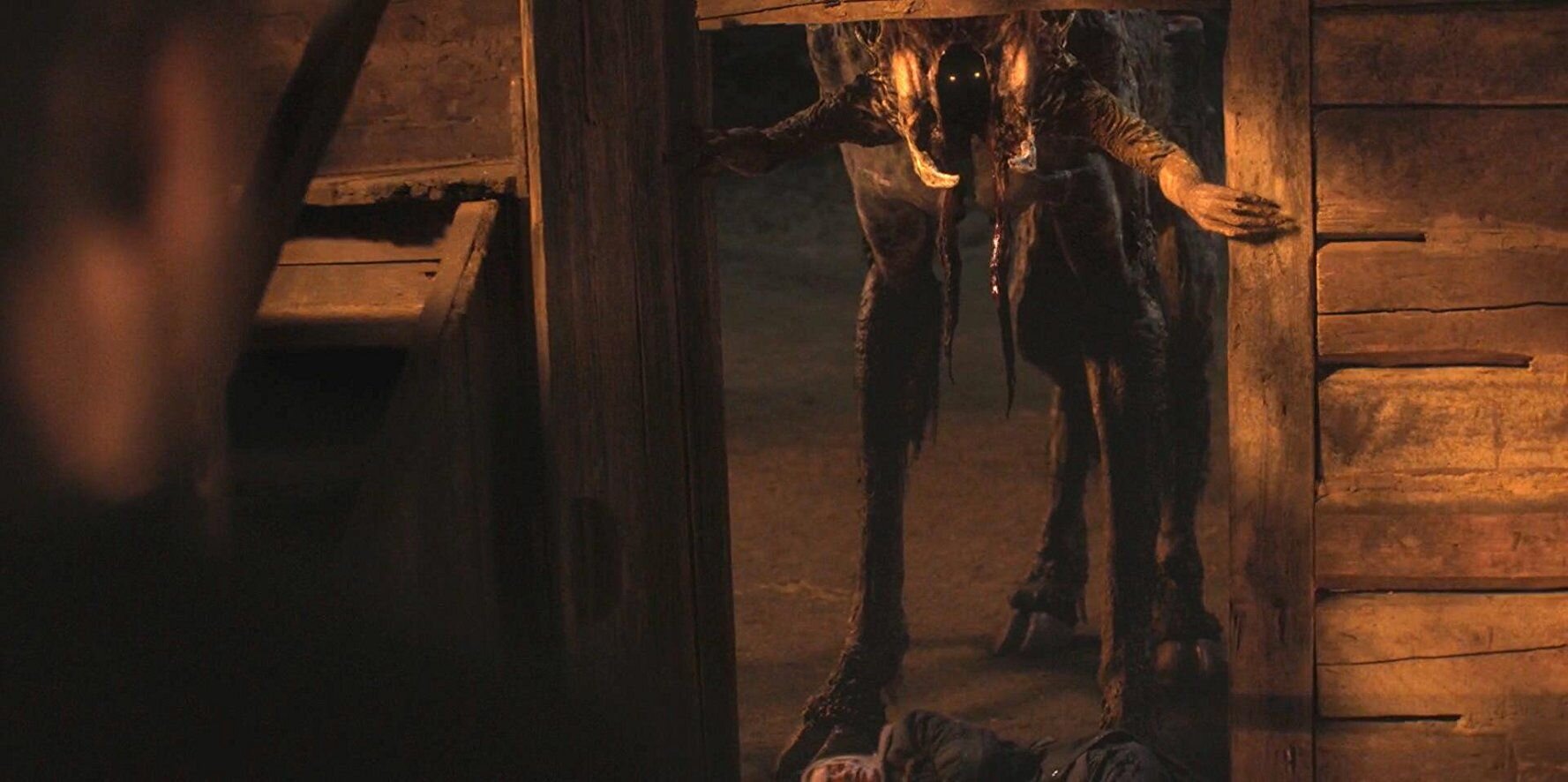
“Moder” in The Ritual (2017).
Again, here it is important to recognize that the group isn’t as closely knit as before. Typically in grief experiences, those affected crave the story where they can laugh or retell a fond memory about their lost loved one. Something where those can celebrate the love and happiness that person brought to others. However, in this story, everyone seems to only focus on the regret of the night, quietly thinking that if it wasn’t for Luke, Rob might still be with them on this trip.
As graphic and subtle as some of these scenes are, I felt that they weren’t overdone and successfully showed the viewer both sides of this tragic story. One could be quick to judge, having not been in the situation, but the horror experienced on the other end is also just as excruciatingly painful. In any death arriving too soon, doesn’t everyone question, “What could I have done differently?” These thoughts can be truly haunting until peace is made. Little did I know at the time of watching, that if only the crew was able to forgive and let go of that grief, maybe they wouldn’t have run into nightmares much larger.
In the thickness of the unwavering tension, the group confronts the map and decides that if they cut through the forest, they can return to civilization early enough to enjoy the city for another day—a move that is a cherry atop the cake of wilderness horror. Throughout this period, Bruckner does a laudable job of getting shots of the mountain range, what appears to be endless surrounding trees. In a new place, another country, with or without a map, the trek just gives you that heavy gut feeling: When everything looks the same, how do you not end up going in circles or accidentally getting lost?
Horror Manifests in the Forest
Our first sign of terror isn’t the group’s concern about going off the trail, however. Instead, it is the discovery of a gutted animal carcass, hanging in the trees, still dripping in blood. While the scene is disturbing, I was a little disappointed when it hardly seemed to bother our characters. Brushing off the abnormality of it, they decide that the carcass couldn’t have been placed long ago, and instead of further debating over the what and how, the crew continues apace. As darkness falls and rain begins to saturate the group, they conveniently stumble upon yet another less gory, but equally frightening, cabin.
Inside the building, which is old and boarded up, they discover a collection of cult-like engraved symbols and an even more disturbing statue made of straw and branches, appearing to be for some kind of worship or witchcraft. Built up like a human torso, the figure has arms holding large antlers, but lacks a head entirely. To be honest, this figure gave me the creeps. I felt that it, too, couldn’t have been there very long, as the straw would have begun to rot. I think like the animal carcass, the sign was placed in warning or as some kind of invitation. If that weren’t enough to make you worry, eerie sounds started to echo outside the cabin as well.
Possibly afflicted by the runes and/or the statue itself, every member of the group wakes up after having had terrible nightmares, to the point of pissing themselves, and each of them are found in different places in or around the cabin from where they originally fell asleep. The only one physically hurt by the experience, Luke, finds specific points stabbed into his chest. In getting their things together to leave, the group is again met by the symbols, only this time on the surrounding trees. Very much like The Blair Witch Project, if the group didn’t know that something or someone knew of their presence, they did now.
What is “The Creature” in The Ritual?
In transitioning from what was thought to be another horror movie about getting lost in the woods, Bruckner flips the script, relying on increasing mysterious and frightening sounds, cinematography and the crew’s own fear- and guilt-fueled misjudgments to guide us through the growing gloom of the situation. Whatever hope of escape we could have had for our group slowly dissipates as hints of the creature stalking them is revealed. What is this giant-like being, you wonder? Well, it takes some more running, jump scares and the discovery of an isolated community before our remaining friends and the viewer really know. According to the descendants of ancient Scandinavians living in the deep woods, they’ve given their life to the creature in question for the release of their burdening emotional pain and to live beyond natural life. To the creature––known in Norse mythology as a Jötunn––the more you suffer, the more important you are; it can feed on your pain or give you death. In the movie, one of the female community members describes the creature as an ancient god and bastard son of Loki, who is the Norse god of mischief and trickery.
However, in further research, the Jötunn is described as a “Moder” or simply “The Creature” in Nevill’s novel. While the basis of its design can’t be justified by these titles, I felt that the Jötunn encompassed the proper size, while also incorporating both the subtle characteristics in its branch/straw statute and other woodsy and animal aspects.
The Scandinavians who remain have all chosen to live, scarred much like Luke, chosen for their relentless burdens. In preparing the ritual and offerings to the Jötunn, each remaining friend is taken out individually, either to be saved or killed, given their marking status. While I won’t give away the beauty that production designers were able to manifest in creating such a haunting creature, let alone how Bruckner managed to hide the creature’s identity until the most crucial moments, I will tell you that The Ritual is worth the watch.
From internal struggles to external forces, the story keeps you at the edge of your seat wondering what’s next and how the group will survive. I think the same is to be said about both kinds of obstacles faced in our story equally. How do we deal with grief and the memories that make us feel both anxious and small? Some believe that time is the ultimate healer in losing someone close to you. As someone who recently endured a tragic loss, I think time is bullshit. In my opinion, it really does come down to finding that peace. Yes, it can take time, but the goal is to accept that you can’t change what happened, nor could you have done anything differently. I don’t think it ever changes the pain and grief you carry, however.
For this reason, my heart goes out to Luke and his inability to forgive himself, as well as how he is portrayed in carrying his grief, the weight of not just his haunting flashbacks, but also for his lack of support from his friends and loved ones during this experience. However, in the same sense of everyone else’s healing, one could assume that it might have been easier for them to point the blame and carry the anger. It’s important to remember that everyone deals with grief differently, there is no right way or guide or map.
What does it all mean?
Tying this all together, my only other question in watching this film is, “Can the will to make peace in grieving be paralleled with the will to survive?” I think in The Ritual, that is exactly what’s at stake and what Bruckner is able to take our hand and walk us through rather eloquently. From the tragic evening, into the unknown and unwavering forest, the viewer is met with horror-version visuals of what it might be like to live through that experience. Sure, not every grieving person is met with a terrifying Jötunn to exchange their pain for worship, but I think sometimes, people might wish they could. One thing is for certain, those carrying grief won’t stop searching for that peace, that acceptance of the loss, they won’t stop fighting to survive it.
Article written by Destiny Johnson
Destiny writes about true crime and thrillers. She likes movies and stories that make you question the world around you, more so than what makes you jump.

Other articles you may enjoy…

Revenge asks very little of the reader. Establish a wound. Point the wounded party toward whoever made it. We handle the rest quickly because the arithmetic feels good, and we have been practicing it since we were old enough to be treated unfairly. Scott Hawkins gives you that arithmetic early in Blacktail, then spends the rest of the book taking the calculator apart on the table in front of you.