
Movie Review: “Plan 9 from Outer Space” (1959)
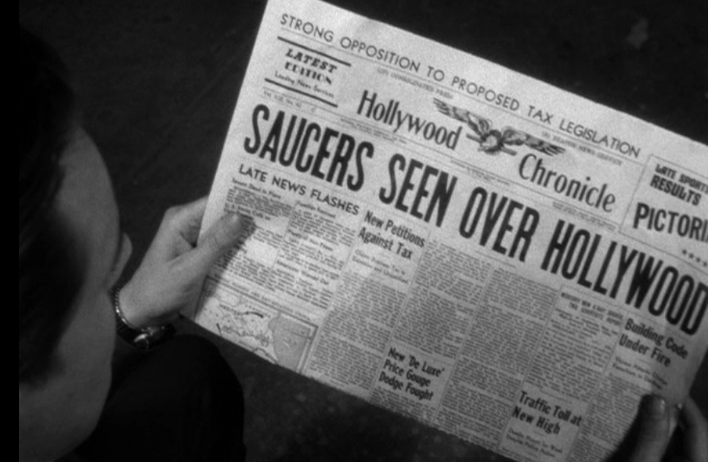
Here, just after the 75th anniversary of the first successful test of the atomic bomb, over 130,000 Americans have died because of COVID-19, tens of millions of citizens are unemployed, Black Lives Matter protests have continued unabated for over a month, and, with the catastrophic lack of a coordinated response from the U.S. government, fears regarding home and food security run high throughout the country. While protestors fight tooth and nail for a better future where Black lives are protected, cherished and uplifted, we sit squarely at a cultural crossroads where the U.S. has the chance to reckon with the atomic graveyard of its past. Film can serve as a medium to understand the past, and one of the most unusual of lenses could be argued to be Plan 9 from Outer Space.
Spoilers ahead!
The conclusion to what equates to the $23 billion (in current currency) Manhattan Project—an endeavor to beat the Axis powers in developing research in order to end World War II—the atomic bomb was detonated on July 16, 1945. Less than a handful of weeks later, the bomb known as “Little Boy” killed over 100,000 in Hiroshima. A few days later, the “Fat Man” bomb—using the same design as the bomb originally tested—was detonated over Nagasaki, killing around 70,000 nearly instantly.
With the subsequent ending of World War II, the economic, cultural and societal shades of the Cold War and the Atomic Age surfaced. The Atomic Age, which ran from the late 1940s to around 1960, is best known among movie nerd circles for cheesy sci-fi and horror dealing with fears (and humor) surrounding the potential horrors of atomic radiation. In a larger cultural context, the Atomic Age was fraught with both fear of the horrors of nuclear energy, but also what it could promise for the future. This period included titles like Attack of the 50 Foot Woman, and—certainly more popularly now—Plan 9 from Outer Space.
But at this moment, too, appears another phenomenon: With the U.S. government attempting to contain the memories of atomic trauma of Japanese survivors, there are a number of UFO sightings around government nuclear facilities in America. Since U.S. citizens did not have easy access to the testimonies and realities of the aftermath of the bombings, the UFO functions as a cultural shadow of the atomic bomb—manifesting as fears of advanced beings from beyond the stars, capable of technological terrors and wonders that we cannot hope to begin to understand. In Discordant Memories: Atomic Age Narratives and Visual Culture, written by Alison Fields, the author introduced me to the idea of “nuclear kitsch”—a way to express the anxieties connected to atomic bombs and the Cold War. In this vein, Plan 9 from Outer Space (directed, written and produced by Ed Wood) sits at an uncomfortable intersection of devastating loss, fear, economic movement, and humor.
Lovingly billed among fans and critics as one of the worst, and best, movies of all time, Plan 9 from Outer Space has a certain cult-like appeal for both horror and sci-fi fans. For horror nerds, the draw is immediately apparent. Who wouldn’t want to tune into some of the limited footage that remains of Maila Nurmi, best known for her role as the dark enchantress host Vampira? And, of course, this is the “last film” where Béla Lugosi, Dracula himself, would make an appearance.
Released in 1959, Plan 9 from Outer Space opens with a scene of grief, where a group gathers to mourn the passing of an old man’s (Béla Lugosi) wife (Maila Nurmi, credited as Vampira). Airliner pilots handling a flight passing overhead catch sight of a UFO. Led by Eros (Dudley Manlove) and Tanna (Joanna Lee), the aliens aim to implement the titular plan, a measure that will have them bring the dead back to life. Lugosi, Nurmi and a nosy cop (Tor Johnson) are among the undead to walk the cemetery, in order to keep away those who come looking for evidence of the UFOs. The plan itself is a bid to curtail the destruction that humankind will inevitably stumble into: the discovery of a worse kind of bomb that threatens the very existence of the entire universe. Strange things meet at the intersection of alien invasion and necromancy.
The parts of Plan 9 that feature Lugosi are from another film, one that was in the works before his death in 1956. Though I wonder if this splicing in of footage from another movie entirely was likely due to budget constrictions, opening Plan 9 with the death of the pillars of what could eventually become a nuclear family reads as incredibly important. The movie sets off on the immediate foot that what is seen as the very foundation of American society is no longer a reliable structure and center—the nuclear family as an assumed norm is under threat of collapse. The “nuclear” in “nuclear family” does not refer to nuclear power, though the phrase was further popularized in the Atomic Age. Rather, the “nuclear” in this context has etymological roots in the Latin word for the core of something.
“The dead will rise and rise again until they are heard.”
For Lugosi’s role, the splicing in of footage from another film is a kind of cinematic necromancy, and by toppling the foundations of the nuclear family early on, it renders the figure an even further patriarchal revenant. Re-contextualized images further erode the foundation that is the nuclear family. What was once the potential for a societal keystone is resurrected as something seemingly from the depths of Hell itself. The order of the family structure can no longer be trusted; can the boundaries between life and death?
The humor of Plan 9 seems to come from its incredibly low budget and how that reflects on set design, as well as film and acting quality. Closeup shots are incredibly rare and static, while more distant shots attempt to make the most out of what’s happening on screen. The horrors that catalyzed the Atomic Age and the interest in UFOs are not mocked in Plan 9, but rather, it strikes me those budget limitations lent themselves to a certain levity that made the anxieties around nuclear power and the future—difficult subjects—seemingly more approachable.
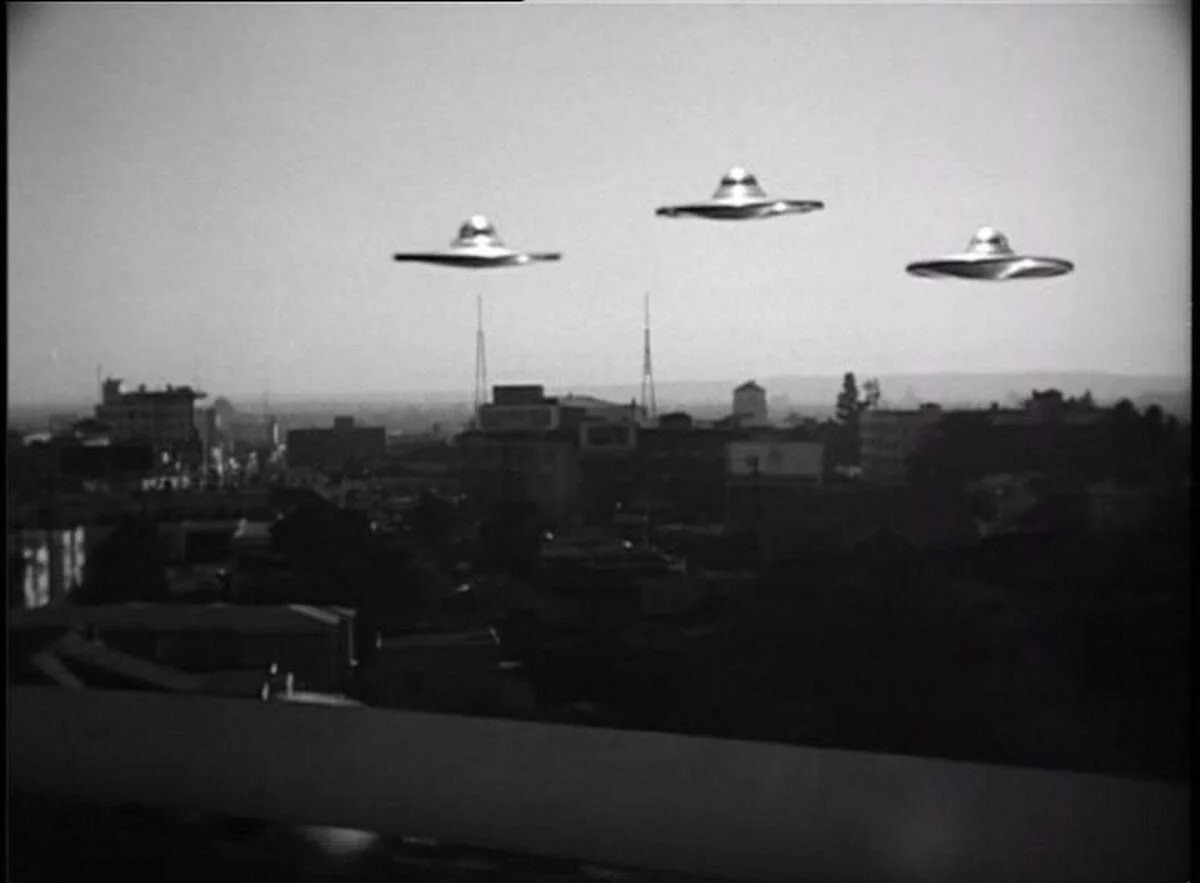
Both the cemetery and UFOs are a matched yet odd pair in how flimsy they look. Many can’t believe their eyes in seeing the flying saucers, and the cardboard cutout appearance of the headstones in the cemetery accidentally seems to reflect a similar attitude toward death. In the U.S., death is treated as something shunted into one corner, out of the way. But with the staggering loss of life that was a result of the bombings that ended World War II—and especially now, the number of deaths that have come about because of COVID-19—there remains a similar, pervasive sense of disbelief among those who refuse to wear masks. The enormity of what has happened transcends an individual’s understanding, so they mentally change the channel.
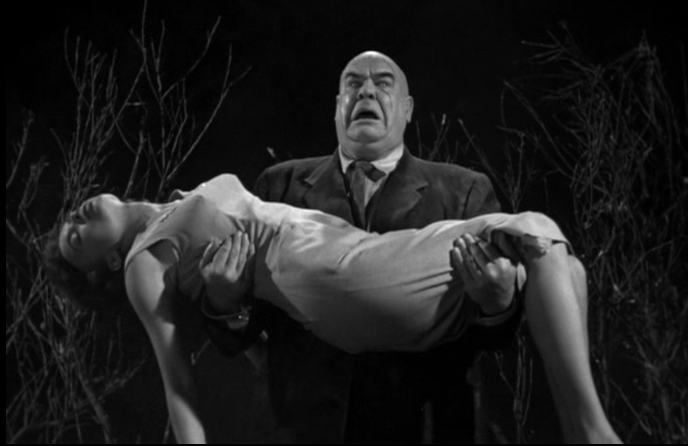
The threat of the dead coming back to life, especially in a Hollywood cemetery, is another point of interest. If you do any sort of critical reading in horror, you’ve likely encountered the idea that the past will not stay buried. In Plan 9, while the aliens resurrecting the dead is a bid to stop the inevitable discovery of a bomb that could end the universe, there is also the reality that the U.S. has largely failed in its attempts to understand the scale of the loss of life that resulted from the bombings. The dead will rise and rise again until they are heard.
When thinking of UFOs, there is also an implicit mistrust of the government. “What are they hiding from us, really?” is the running question I’ve heard in a number of circles. The contrast of the very real horrors of the atomic bombs, developed in secrecy by the U.S. government, against a theoretical threatening Other from beyond the stars displays mistrusting government as an aesthetic, not something on a critical level. There is something comforting about the liminality of UFOs, but when it comes down to the very real horrors perpetrated by the U.S. government, that rigor of questioning is missing. I genuinely doubt that we would have this level of interest in UFOs in the U.S. if the atomic bomb were developed elsewhere.
Fields also points out Holocaust survivor Elie Wiesel’s distinction between information and knowledge: Information is raw data, something that is difficult to confirm, whereas knowledge is connected “to a moral responsibility to act upon it.” In retrospect, Plan 9 reads as an example of a narrative of trying to shift information into knowledge. Though U.S. citizens had the information that the atomic bombings happened in the ‘40s, this is separate from having the knowledge of living in the aftermath. When connecting these factors, there remains a deeply uncomfortable question that comes together: “If we’re capable of developing such a tool of destruction, what can others do to us?”
In turn, Plan 9 ends with the aliens defeated. Humankind is on a projected free fall into discovering the bomb that can destroy the entire universe. And as we are now in economic free fall, I hope this can turn into a time where we defuse the bomb of militarized police and repurpose some of those tools and funding into community programs for wellbeing and support.
Article written by Laura Kemmerer
Laura tuned into horror with an interest in what these movies and books can tell us about ourselves and what societies fear. She is most interested in horror focused around the supernatural, folklore, the occult, Gothic themes, haunted media, landscape as a character, and hauntology (focusing on lost or broken futures).

Filmmaker Bari Kang discusses Itch!, from its practical gore and zombie influences to filming in his own NYC store and directing his daughter.