
Our Top 8 Road Trip Horror Movies
We can all agree that during the summer months, road trips are practically essential—at least for some with the weather is nice, let’s do something mentality. It’s also a time when friends and family can all get together because school is out. While our listicle features all demographics, the end result is one most unfavorable. From a wrong turn to a flat tire, many of our characters wish they never packed their bags.
Destiny’s Picks
Wrong Turn (2003) | Directed by Rob Schmidt
The very first time I saw this movie, I think it was only a year or so after its release, putting me around 11- or 12-years-old; very likely, as this was just when I was first getting into horror. During this period, some of the more creepy and gruesome movies were coming out, like The Ring (2002), Cabin Fever (2002), and The Grudge (2004), to name a few. With each new premiere, it felt as though I had a new favorite. But, something about Wrong Turn took things a little bit further for me.
Southbound (2015)
Unlike a curse or disease, Wrong Turn was one of the first films I’d watched that had characters who practiced cannibalism or featured a road trip gone bad. Yes, just as the title would imply, several friends are traveling together when they experience car trouble in the middle of the woods in, where else, but West Virginia. While the banjo-plucking from Deliverance (1972) wouldn’t cue in my head until I saw it years later, the inbred hillbilly horror embodied this nightmare of an adventure.
If you’re up for reliving some of your early 2000s nostalgia with a sickening plot, you might want to put this on your roster for summer road trip horrors.
Joy Ride (2001) | Directed by John Dahl
I only saw this movie for the first time about a year ago, and I was thoroughly shocked by the storyline and the chills it sent down my spine. As the story goes, college freshman Lewis Thomas (Paul Walker) is about to embark on a cross-country road trip to meet up with his girlfriend (Leelee Sobieski). Along the way, however, he ends up having to rescue his brother, Fuller (Steve Zahn). Although this doesn’t put a big dent in Lewis’s plans, things start to get weird after Fuller convinces him to play a trick on a lonely trucker over the CB radio.
I’m not sure if anyone else reading had a parent or grandparent who was ever a trucker, but if you did, you’re familiar with a CB radio. Even after my grandpa retired, he kept one in his Dodge truck and used it as a means to stay keen on traffic or any accidents when we were traveling. (This was in the very early days of GPS and cellphones.) Anyways, when Lewis and Fuller start messing with this unknown trucker, I already had a bad feeling, having been yelled at before for trying to speak over the radio without permission, let alone without a purpose.
As expected, this “Candy Cane” tease goes downhill fast and the guys end up being stalked by the trucker. While I won’t let on how the story ends—although, if you love serial killers like me, you’ll likely enjoy it—I can say that this is one twisted movie that will leave you thinking twice about pranking drivers while on the road.
Laura’s Pick
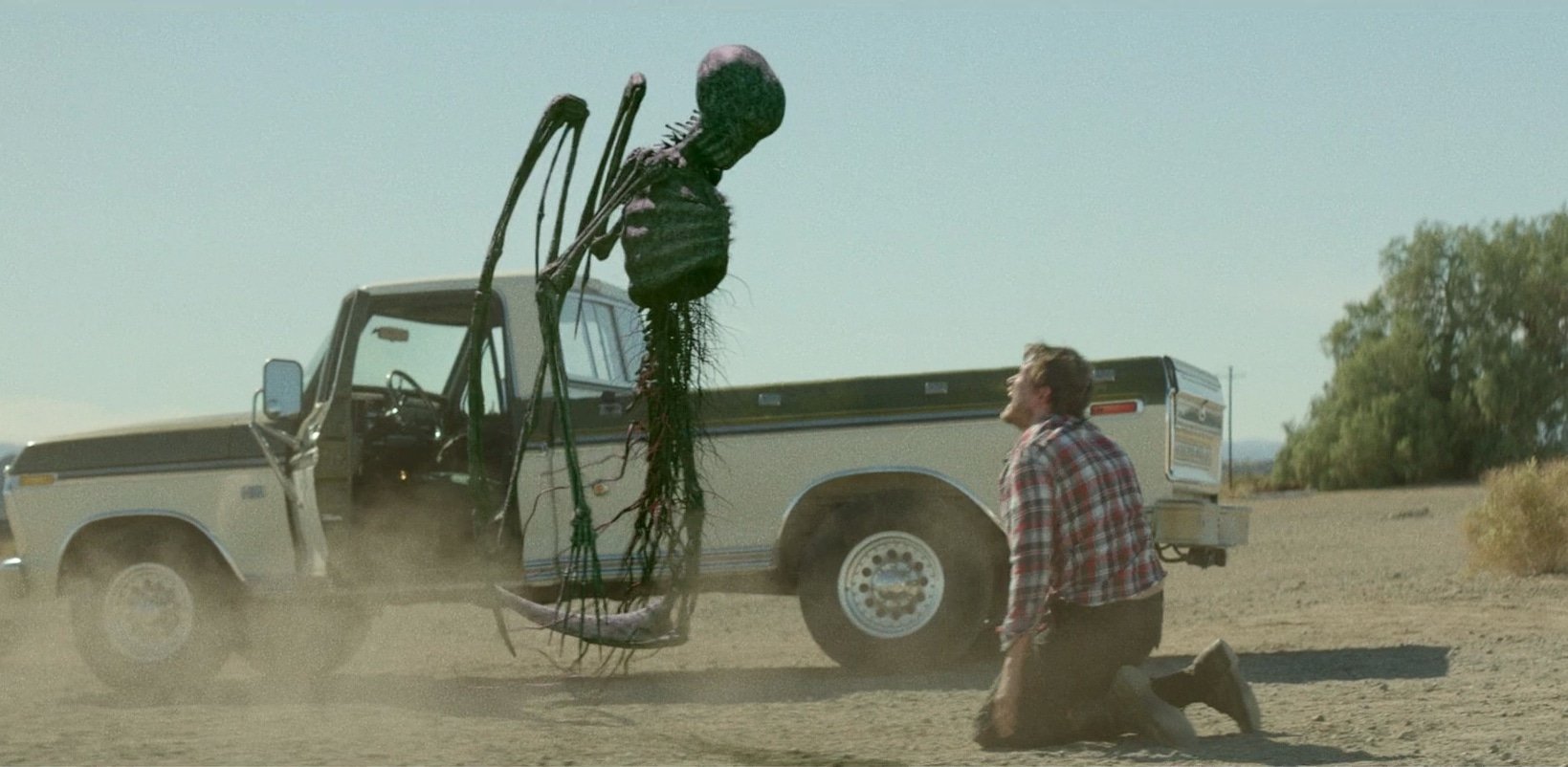
Southbound (2015) | Directors Roxanne Benjamin, Radio Silence, David Bruckner, & Patrick Horvath
I love a good horror anthology—in book or movie form. Creepshow remains one of the best to date, but there’s something about Southbound that continues to haunt me years after I’ve seen it. Southbound centers around the idea of a demon-haunted southwestern road trip—no destination in sight, only fleeing personal and literal demons. Southbound celebrates the Weird of the desert, highlighting transitory spaces, like gas stations, as pitstops for the supernatural.
In “The Way Out” (directed by Radio Silence), a father is haunted by the fact that he left his daughter behind—and must come to terms with the consequences. In “Siren” (directed by Roxanne Benjamin), a band on tour is confronted by the ghastly forces hunting them. In “The Accident” (directed by David Bruckner), a man nearly commits vehicular manslaughter, and the person he injures may not make it out alive. In “Jailbreak” (directed by Patrick Horvath), the pursued encounters a town of demons. And, finally, in “The Way In” (directed by Radio Silence), a young student about to head off to college must face down-home invaders.
None of these summaries do these shorts justice, but if you’re looking for the feeling of something that screeches out in the desert—that makes you realize you may be that think howling out in the dunes—Southbound is the road trip horror flick for you.
Theresa’s Picks
The Texas Chain Saw Massacre (1974) | Directed by Tobe Hooper
The Texas Chain Saw Massacre is perhaps the defining film of the road-trip horror ethos, and one that stands the test of time even through its many remakes and long legacy. The drawn-out scenes of never-ending highway and cattle farms are just the beginning of this nightmare. The amount of time spent on these shots where the viewer doesn’t have much action to contend with makes us feel anxious. A foreboding sense creeps into the screen despite the bright Texas sun. When we meet the disturbed (and disturbing) hitch-hiker our sense of safety is upended, however, this is just the beginning. For as long as we spend on the highway with these five kids, we spend nearly just as long with protagonist Sally as she runs full speed around and around the old family home fleeing Leatherface and his chainsaw. Sally’s road trip eventually ends with all of her friends dead, and herself back on the highway hopefully towards safety as our first-ever Final Girl.
X (2022)
The release of the original Texas Chain Saw in ‘74 reveals a sageness of the state of the world at that time. On the heels of the Charles Manson murders and nearing the end of the Vietnam war, the U.S. was particularly sensitive regarding the deaths of young people. Young men and women were stretching their legs into a big new world that was both exciting and dangerous, the very crux of the American road trip. Flashing forward to the 2003 remake of the film (directed by Marcus Nispel), viewers don’t need to wait out the hour of existential dread before reckoning with Leatherface and his family. This time, the hitch-hiker performs a lethal act of violence on herself not because she is part of the family, but because she too is trying to escape them—a strong statement for the teenage audience whose parents had been reflected in the original.
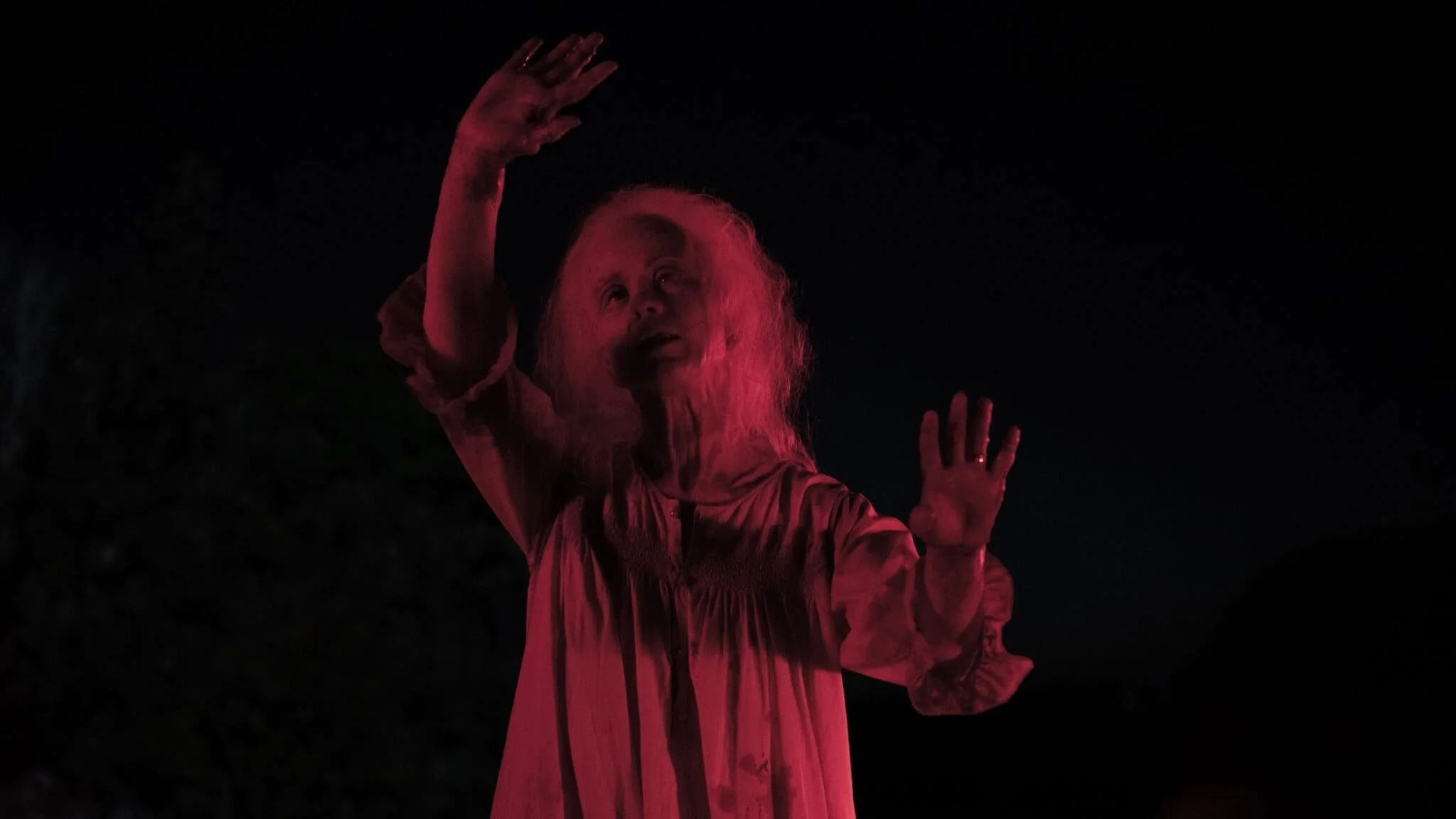
X (2022) | Directed by Ti West
With clear homages to so many other great horror films, Ti West’s X establishes its own footing in a strange and sexualized road trip turned slasher. There are the typical actors—the young people set out for a remote cabin—and the not-so-typical characters too. Cameos are made by large reptiles, blue eyeshadowed sirens, and Fleetwood Mac, but don’t be confused by the line-up, this film is definitely still scary.
I won’t give away too much. Set in 1974, a group of young people drive to a remote cabin to film an adult film in hopes of becoming X-rated stars. Each character is strangely loveable in many ways, a theme that could easily become cheesy, but one that West balances well. The violence is politely unexpected, satisfying, and clever. In keeping within the bounds of a classic horror film X delivers some truly creepy material, unique twists on tried and true characters, and calls to question who we deem murderous all while ushering in a new wave of final girls.
Ande’s Picks
Dashcam (2022) | Directed by Rob Savage
Hot off his lockdown-era success Host (2020), Rob Savage continued to build his found footage pedigree with Dashcam. While it may be stretching the definition of a “road trip” film, much of Dashcam does take place in a car, so I couldn’t pass up the opportunity to highlight it and its uniquely insufferable protagonist, Annie Hardy. Annie is an outspoken pandemic denier that never passes up an opportunity to voice it. Her modest Livestream, Bandcar (in which she literally drives around improvising freestyle raps) goes on the road as she hops a plane to the UK to surprise her old friend, Stretch. The two have a falling out, however, leading Annie to steal Stretch’s car and continue her stream on the streets of London.
As the night progresses, things go increasingly wrong for Annie and Stretch, beginning with Angela, a passenger Annie reluctantly picks up while trying to (again, I can’t stress her insufferable personality enough) sabotage Stretch’s food delivery job. At every turn, Dashcam outdoes itself, getting so insane with its kitchen-sink approach to plot twists that one can’t help but admire it. Do be warned, though, that even for a found footage film—a genre known for its intense handheld camera shots—Dashcam is not for anyone susceptible to motion sickness.
Coming Home in the Dark (2021) | Directed by James Ashcroft
Generally speaking, road horror is a uniquely American genre. Our long stretches of highway in the west, many times spanning hundreds of miles without even a gas station on the side of the road, make the perfect setting for horror. Some of the most frightening examples, however, have come, not from the U.S., but from down under, in Australia and New Zealand. Most recently, the latter has produced one of the most disturbing films in recent memory, James Ashcroft’s Coming Home in the Dark.

The Texas Chain Saw Massacre (1974)
A road-tripping family of four is setting out a picnic when they’re approached by a pair of drifters, led by an icy cool Mandrake (Daniel Gillies), whose laid-back demeanor chills to the bone. The duo kidnaps the family and takes them on a dark, sadistic journey that maintains a near frantic level of white-knuckle tension from start to finish.
Duel (1971) | Directed by Steven Spielberg
In 1971, a young Steven Spielberg would direct his first feature film, a low-budget road thriller, originally shot for TV, but eventually padded out as a full-length picture. A strong case could be made that Spielberg’s Duel spawned the “terror trucker” genre, including movies like Roadgames (1981), Road Rage (2000), and this list’s own Joy Ride (2001), among others. Loaded with bold shots and near-constant tension, Duel makes the most of its sparse plot and characters, opting instead to highlight the sense of isolation David (Dennis Weaver) feels on the road and his helplessness in the vast American West.
The unseen villain, ever behind the wheel of his hulking, rusted-out Peterbilt, is a persistent menace—lurking in background shots, in rear-view mirrors, or just out of sight, but never out of mind. No clear motive is ever established; in fact, the trucker is never even seen or heard with certainty. The focus, instead, is given entirely to the behemoth he drives. The rig always stands confidently in the desert sun, giving it the kind of apex predator presence Spielberg would later perfect in Jaws. While it may struggle slightly with pacing out its confrontations, Duel is still pound for pound one of the best dueling driver films out there.
Article written by The Academic Horror Writers League
What Sleeps Beneath is a labor of love. You can support us by reading our articles, telling your friends about us, and donating to the online magazine.

Other articles you may enjoy…


Are you tired of searching for works that describe transgender experiences accurately, let alone with complexity or compelling messiness? Want to read some horror stories that were written by and/or for trans people? Curious about this newfangled term “trans horror” and wondering where to start? Hopefully, this brief primer will be useful to you.