
Little Blue Dot: 6 Underrated Horror Films Set in Space
NASA’s recent release of images from the James Webb Space Telescope has everyone thinking that space travel, alien encounters, and knowledge of the vast unknown is more possible than ever before. The images are beautiful, and during this time of worldwide upheaval, they serve as a bit of hope for a future that comes with a better scientific understanding of our galaxy and beyond.
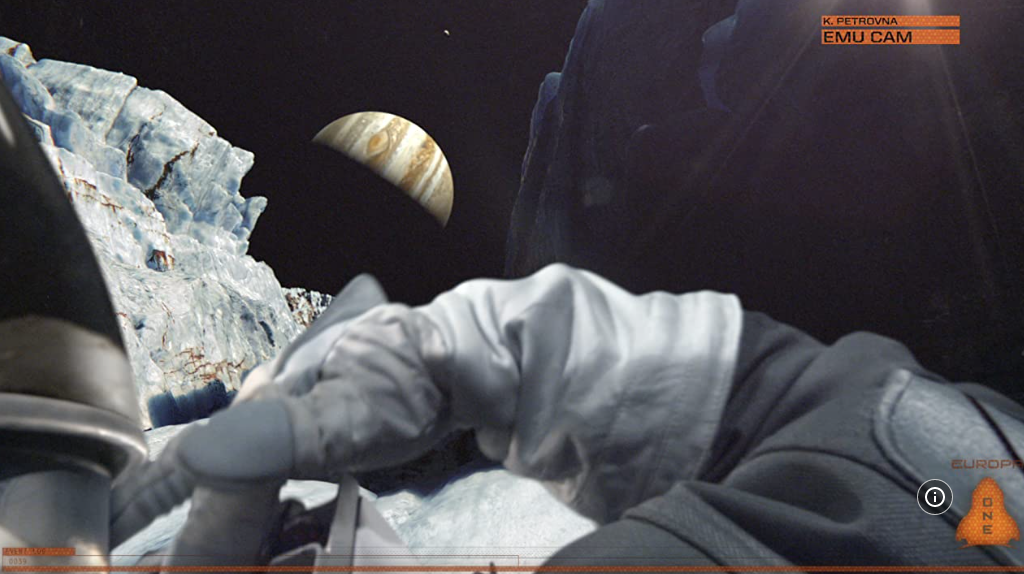
Europa Report, Image courtesy IMDB
And, of course, it makes us think about the scary parts of space, too. While hopeful, reckoning with the vast expanse of space and everything we don’t yet know is enough to push anyone into a panic attack. From aliens to technology and environment, to surviving without oxygen or gravity, to the simple horror of being the only human out there, space is a truly terrifying place. At WSB we’re celebrating Webb’s success by watching all of our favorite space horror films.
Theresa’s Pick
Europa Report (2013), dir. Sebastian Cordero
Europa Report tells the story of a privately funded mission to explore life on one of Jupiter’s moons, Europa. For any sci-fi/space-loving nerd, this is a great movie. The imagery, space travel, and character relationships are a pleasant watch without being overly cumbersome with a real-life scenario. If you’re willing to give up a little bit of disbelief, it is certainly worth a watch.
Although none of the characters are particularly memorable, they are all realistic players in the story and it quickly becomes clear just how insignificant they are. Arriving on Europa doesn’t go as planned (as is the case in so many space movies), but what the astronauts find there is a refreshingly scary take of what life may look like outside of Earth. The creature, though foreign, isn’t unbelievable. It’s recognizable in part due to its physical appearance, but also in the way that we Earthlings are accustomed to interacting with wild animals. All too often I see space films that assign human-like motives and emotions to monsters, but you won’t find that here. Europa Report seems to state that nature has her own agenda, whether or not we participate.
Laura’s Picks
Pandorum (2009), dir. Christian Alvart
What I love most about Pandorum is its isolation and fear—both deeply connected to the film’s all-too-common misanthropic vision of the apocalypse. Humankind has completely overpopulated the Earth, and 60,000 people flee to the stars to colonize another planet. As the transmission from Earth says, “You’re all that’s left of us.” Pandorum mirrors both survivors’ extreme sense of isolation, and our own complete alienation from our natural world. We no longer recognize where we are as a species—meaningfully or spatially.
The titular “Pandorum”—a psychosis brought on by emotional duress while in space—reflects a similar out-of-placeness. Both Corporal Bower and Lieutenant Payton awaken abruptly from hyperspace deep sleep, suffering from amnesia. Between power surges and finding a string of mangled bodies, both soon encounter a dangerous group of cannibalistic humanoids. The ark—the ship that was supposed to save humankind—has become its tomb. In space, no one can hear the death of a species.
Event Horizon (1997), dir. Paul W. S. Anderson
Though Event Horizon seems like a default choice for any space horror listicle, Sam Neill’s performance is always worth revisiting. Event Horizon also brings an element of the occult to space—something I’ve yet to see in thematically similar movies. In Event Horizon, the wonders of the exploration of space curdle toward destruction when a distress call is heard from the titular ship. When a rescue mission is dispatched, all the crew finds is a scene of slaughter.
Beyond the horrors of space, Event Horizon raises fascinating questions of humankind being the Other in a deadly environment, and, more importantly, consciousness. How do we relate to something inanimate that returns from the mouth of Hell with a consciousness? How does that translate to the fundamental inexpressible unknowability of being alive? These thematic throughlines also echo in Hellraiser, emphasizing the hostility of the Beyond and our own pride in thinking we can see the face of God and survive.

Pandorum, Image courtesy IMDB
Ande’s Picks
Aniara (2018), dir. Pella Kågerman and Hugo Lilja
If you have read anything I’ve written in the past few years, you should know that I won’t pass up a chance to shoehorn an unconventional film into the horror genre by whatever means necessary. Aniara, a Swedish film based on a book-length poem by Harry Martinson, is set aboard a passenger spaceship that, due to the devastating effects of climate change on Earth, is on one of many routine migrations to Mars. When the ship is forced to dodge a cloud of space debris, the nuclear reactor is damaged, forcing the Aniara to dump its entire load of fuel, leaving them adrift on an unplotted course into deep space.
Aniara covers the events of the crew and passengers as they come to grips with the realization that rescue is all but impossible. Divided into chapters, the film covers over 20 years of life aboard the ship as blame is cast, factions formed, and new leaders and prophets fight for control. There are no jump scares and no monsters, but the film is dour to its core and will undoubtedly leave you unsettled and despairing for days. The horror you feel for the passengers of the Aniara is incredibly potent.
Sunshine (2007), dir. Danny Boyle
Written by Ex Machina and Men director Alex Garland, Sunshine is a terribly underrated film with an all-star cast including Cillian Murphy, Chris Evans, Michelle Yeoh, Benedict Wong, and more, in which the crew of the Icarus II journeys toward our dying Sun, equipped with a massive nuclear bomb, intent on jump-starting the star back to life. When the team unexpectedly finds the drifting remains of the Icarus I, they decide to divert from their charted course, reasoning that if Icarus I’s payload is still intact, they’d effectively double their chance at success. As the mission proceeds, Icarus II is beset by equipment malfunctions, deteriorating mental states, attempted mutiny, and troubling revelations linked to their proximity to our nearest star.
Thematically, the film bears some passing resemblances to Paul W. S. Anderson’s Event Horizon, Andrei Tarkovsky’s Solaris, and Stanley Kubrick’s 2001: A Space Odyssey. Dealing with religion, philosophy, and the effects of the character’s psyches due to the apocalyptic nature of their mission, Sunshine is a deeply psychological horror film that, though not nearly as dismal as Aniara, still packs one hell of a punch.

Aniara, Image courtesy IMDB
Destiny’s Pick
Prometheus (2012), dir. Ridley Scott
While this movie received a lot of criticism when it was first released as a prequel for the Alien franchise, I always thought the film took on a unique perspective of how one might attempt to solve humanity’s origins.
To provide a general recap, a group of explorer-scientists embark on an expedition to the darkest corners of the universe in search of answers regarding the birth of mankind. While each character’s purpose or interest in the expedition is different from the next, the goal is ultimately to find the truth—whether that be God, Engineers, Xenomorphs or something unexpected. Unfortunately for our cast, the answer to human existence is far, far worse than what any of them could have imagined.
Just like the Greek myth the title is based on, the discovery of what are believed to be humankind’s creators are not at all welcoming. While there is no Titan-like son to be punished for stealing fire and giving it to the humans for all eternity, it would seem as though there is some serious resentment for the one(s) responsible for creating the humans, so much so that these “creators” of the same species want to destroy them all.
Even as the crew arrives, they are plagued by parasites and are refused any insight or answers to the questions they based their entire quest around. Although a movie full of doom and gloom, these unimaginable terrors are enough to make anyone question a trip into deep space.
Article written by The Academic Horror Writers League
What Sleeps Beneath is a labor of love. You can support us by reading our articles, telling your friends about us, and donating to the online magazine.