
Phil Tippett Revives Stop Motion Animation in ‘Mad God’
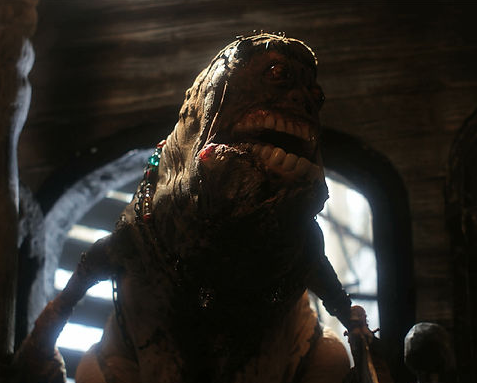
Image courtesy madgodmovie.com
Whether or not you’ve heard Phil Tippett’s name, you’ve almost certainly seen his work. The award-winning visual effects supervisor and animator is the man behind some of Hollywood’s most impressive effects, including the AT-AT Imperial Walkers in The Empire Strikes Back (1980), the ED-209 police droid in RoboCop (1987), as well as credits in Honey, I Shrunk the Kids (1989), Starship Troopers (1997), and the Jurassic Park franchise. As a director, Tippett’s career has been far more succinct, having only a handful of shorts and a single feature, Starship Troopers 2: Hero of the Federation (2004), under his belt. Over the past 30 years, however, Tippett has been working in some form or another on what might be considered his magnum opus—a dark and despairing stop-motion animation called Mad God which, after a short festival run in 2021 will finally get a limited theater release and coinciding streaming debut on Shudder on June 16, 2022.
A blend of stop-motion puppetry and live action—though probably not in the ways you might expect—Mad God is a mostly-silent film set in a post-apocalyptic “atompunk” hellscape that may or may not be some actual version of Hell. In fact, the film opens with the destruction of the Tower of Babel by a wrathful God, before intertitles foreshadow the film’s themes with a chilling declaration from the Book of Leviticus. The narrative, present but in a way that seems to only serve to justify the monumental aesthetic achievements of the film, follows “The Assassin,” known as such only through the film’s credits, a gas mask donning stormtrooper sent to deliver a suitcase bomb to a location in a grim underworld in the midst of a nuclear winter—complete with sadistic enemy troops, mutated citizenry, and an entire cast of otherworldly characters. The Assassin’s world is rich with detail, despite the muted browns and greens of its palette. Tippett’s sets somehow manage to burst with life under a seemingly desolate facade.
Support WSB (and physical media) by buying Mad God on Blu-Ray using our affiliate link at Movies Unlimited!
The retro-futuristic land of Mad God is reminiscent of those of Terry Gilliam’s dystopian films like Brazil (1985) and 12 Monkeys (1995). Miles of exposed rebar and moldy plaster line the rooms and hallways lit by dim yellow incandescent bulbs. Elaborate arrays of cathode-ray tube televisions act more as overseers than surveillance monitors. Tangled masses of wire and conduit call to mind Tetsuo: The Iron Man (1989), Shinya Tsukamoto’s disturbing underground body horror film, while massive machines evoke the organic, skeletal designs of H.R. Giger. Taken together though, if I had to reference a single work to describe the aesthetic of Mad God, I would nod towards Harlon Ellison’s deeply disturbing and sado-masochistic 1967 short story, “I Have No Mouth and I Must Scream,” as well as the 1995 point-and-click adventure video game of the same name.
“Cracking bones, squishing flesh, and slimy fluids all add to the body horror elements, making it frighteningly easy to forget you’re watching the mutilation of little more than painted clay.”
Still more inspiration is noticeable in the film’s many unnamed characters. Early on his journey, The Assassin sees the rusted remains of Robbie the Robot from Forbidden Planet (1956) among others. Entering into an asylum-like vault, he is confronted by the stone-faced glare of a wooden doll, which may be a reference to fellow stop-motion innovators, the Brothers Quay. Several more monstrous creatures appear to be inspired by the best work of the legendary Ray Harryhausen (think the Cyclops from The Seventh Voyage of Sinbad (1958) or the Kraken from Clash of the Titans (1981)). Later, a hack surgical operation bears a child that, while unique, is hard to see without thinking of Henry’s baby in Eraserhead (1977).
None of these references, by the way, should be seen as negatives—Tippett’s talent for artful homage is on full display, using each as a block on which to build his world, all the while creating something wholly his own. Dark as it is, his story is a beautiful one, tying together a wealth of creators over decades of innovative work to weave a sort of “Dante’s Inferno” for the modern age. The union of these with countless film techniques that seamlessly bring each scene to life is nothing short of astounding. Transitions between puppets and live actors, mixed frame shots that allow both to exist simultaneously have never looked better. Scenes that appear to lower the framerate on the actors in order to integrate their presence with that of the models contrast with the ethereal fluid movements of the intimidating plague doctor, who would look right at home as a boss in a Dark Souls game. The transparent nods to 2001: A Space Odyssey (1968) during the film’s climax only punctuates the awareness Tippett shows toward those giants on whose shoulders he aims to stand.
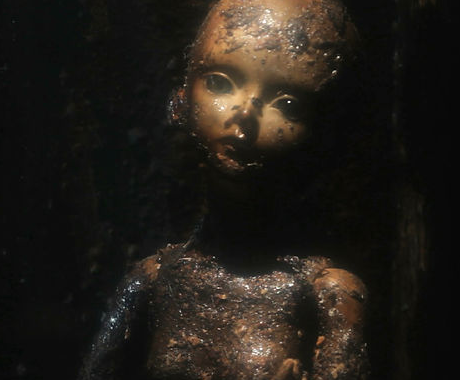
Image courtesy madgodmovie.com
Nor is the mastery of Mad God restricted to its visual techniques. Such an ambitious project could never hope to make it very far without a top-notch sound department, which Mad God has in spades. Especially given the dialogue-free nature of the film, and the loud, atmospheric world it’s set in, sound and foley work is crucial to the film’s success. As with the rest of the production, the sound department here is small but hits far above its weight. Not only is The Assassin’s world humming with enormous mechanical engineering, crackling electricity, and concussive blasts, but few characters are exempt from the organic sounds of the, uh, manipulation of their bodies. Cracking bones, squishing flesh, and slimy fluids all add to the body horror elements, making it frighteningly easy to forget you’re watching the mutilation of little more than painted clay.
If Mad God deserves any sort of criticism, it has to be said that I’m afraid its audience may be self-limiting. I worry that, given its silent nature and lack of exposition, it will be a difficult draw for casual viewers who haven’t actively sought the film out. The audience for stop-motion animation, particularly in recent years, may not be the same as the fans of those fantasy-adventure stories of half a century ago. It is a grotesque, graphic affair that will test even the strongest stomachs of Shudder’s subscribers. Regardless, this is a film worthy of a place of honor atop Phil Tippett’s impressive legacy. It is a masterpiece of design and of perseverance. With Mad God’s limited theatrical release on June 10, 2022, it is crucial that anyone with the opportunity see this film on the big screen. For the rest of us, the film debuts on Shudder a week later, on June 16, 2022.
Article written by Ande Thomas
Ande loves the intersection of sci-fi and horror, where our understanding of the natural world clashes with our fear of the new and unknown. He writes about monsters and foreign horror and can also be found over on Letterboxd.


![A Self in the Setting: Exploring Dracula’s Castle [video game horror]](https://images.squarespace-cdn.com/content/v1/5d3e481bc5a6e40001b215a8/1738798336699-OXLE0MWHEWE0DODVC10N/castlevania1997.png)

LandLord isn’t going to color inside the lines. Sure, it’ll color inside some of the lines, but this coloring book wasn’t made by someone looking to retread all the cliches. It was made by someone who almost wants you to fall for some of the tropes. If you fall for the tropes, after all, you won’t be expecting the punch.