A Self in the Setting: Exploring Dracula’s Castle [video game horror]
Out of all the pieces of pop culture that feature vampires, the Castlevania franchise stands out for one particular reason. Everyone’s favorite character? The castle. Rarely is the setting of a storyline one of the first things that fans recall. While it’s mostly fans of the Castlevania video games who are responsible for this pop culture preference, the castle depicted in the critically acclaimed Netflix series has also received praise.
The franchise’s gothic style turns the audience's relationship with the castle into something more than viewing it as the setting of the franchise. The castle is a character—a self—in and of itself that has a profound impact on not only the other characters within the story, but on the audiences interacting with it in reality. So much so that it’s difficult to discern where settings end and selves begin.
A Bite About the Franchise
Beginning with the original Castlevania release in 1986, there are now more than 30 installments of what are considered “core” Castlevania video games, along with a dozen spin-off games, a comic series, and an animated television show(s). Elements and characters from the Castlevania world have also appeared in “crossovers” in nearly a dozen other games.
Published/created by Japanese multinational entertainment company Konami, an installment of the franchise has been released on nearly every type of game console, computer, and phone. The 1997 installment Castlevania: Symphony of the Night is widely regarded as one of the best video games of all time. The franchise is described as a gothic horror action-adventure and is known for its combination of challenging gameplay, atmospheric settings, and soundtrack.
For the purpose of this essay, we will use a summary of the general themes that encompass the entire franchise with a closer look at different installments for specifics with the acknowledgment that each installment has its own plethora of themes to dissect. In general, though, in both the gameplay and the television series, audiences follow (or portray) a Belmont (Simon Belmont in the original game, and Trevor Belmont in the Netflix show), who has to navigate through the levels of Dracula’s castle and defeat him. Much of the franchise takes place within the castle of Count Dracula (Vlad Dracula Țepeș) and the stories heavily reference various horror films and series as well as folklore and mythology. Series creator Hitoshi Akamatsu reportedly wanted players to feel like they were in a classic horror film.
Being able to navigate through a horror film is one of the key reasons why audiences love the castle so much. (It’s also a keystone of the style of gameplay that Castlevania is partially credited for.) The Symphony of the Night installment along with Castlevania II and the games Metroid and Super Metroid pioneered a style of non-linear gameplay with utility-gated exploration and progression (dubbed “Metroidvania”). In these games, players can explore the world map at their leisure while they find and acquire special items and tools that they need to access different areas or defeat enemies that they encounter. This type of setup requires meticulous set design as well as careful attention to the story itself.
It’s the story, though, that makes Symphony of the Night the pinnacle. Players begin the game believing the point is to defeat an enemy named Shaft who has possessed Richter Belmont. Players have to explore the castle, acquire a specific item, and use it in a battle against Shaft to free Belmont. Except, once players do this, the scene changes. The castle that players just spent hours exploring morphs and becomes the “Inverted Castle”—an upside-down version of the castle with new enemies to defeat and a new mission. Players now have to find five bosses to collect five pieces of Dracula and then battle the newly awakened Dracula.
The castle essentially hovers upside down above the original, hidden in the clouds until the player defeats Shaft. According to Castlevania producer Koji Igarashi, creators were looking for a way to keep players in the game longer. They settled on exploration. Moreover, they decided to invert the castle simply because they found that easier than creating entirely new game elements (Mitchell). Even in that simplicity, though, the inverted castle is often hailed as one of the most iconic video game levels of all time.
In 2015, staff members at Edge Magazine wrote about why the castle was the star of the franchise. They noted that while the castle started off as typically gothic/spooky, “Beginning with Symphony of the Night, a castle was much more than just candles and stones. It was a vast maze that embodied an esoteric view of the individual’s journey through consciousness. While many would tread the main paths, only a few adepts would ascend to the highest tiers of completion percentage” (Edge).
Even as the games evolved into 3D animation, critics always came back to whether or not the castle was done “correctly,” whether comparing it to the illustration in Symphony or a beloved mockup in their head. Many think that 2010’s Lords of Shadow is true to the classics, and the producer of that installment, Dave Cox, acknowledged that the castle’s creation needed to be treated with care. “The castle was viewed as a specific character in many respects,” said Cox. “That was one of the reasons we wanted the player to take some time to get there, so it felt like meeting an important person within the story” (Edge).
In the Netflix adaptation, the castle remains a character wild card, though from a slightly different angle. Instead of the entire storyline taking place within the castle, Trevor Belmont, Alucard (Dracula’s son), and Sypha (a Speaker), have to trap the castle in one place (ideally over Belmont’s family’s ancient monster-hunting library) in order to defeat it before defeating Dracula. The castle in this installment has the ability to teleport, which Dracula uses to his advantage.
At the Belmont library, Sypha discovers a locking spell that can trap the castle in place. Though she struggles with the castle’s mechanisms, she does eventually break the castle’s ability to move—at one point causing the castle to glitch and move a short distance away, effectively killing multiple armies that were fighting outside its gates.
With the castle now stationary, the trio bursts into the halls and begins fighting Dracula, ending up in Alucard’s childhood bedroom where Alucard kills his father. Afterward, a depressed Alucard is convinced he is going to simply entomb himself in the castle, but Belmont and Sypha convince him to instead protect the magic and knowledge of both the castle and the library that it now rests on.
Throughout the television adaptation, the castle is used not only as a place but also as a tool/weapon, and furthermore, as an enemy to be defeated. While each interpretation of the castle is a bit different, the entirety of the franchise is gothic in nature and sticks to a similar look and feel. Writer Luiz H.C. describes the design influence—even all the way back to the 8-bit animation—as the “decadent crypts and gothic dining rooms of Roger Corman’s Edgar Allan Poe adaptations.”
But Why Gothic?
Author Maarten recalls that in 1986 when the first installment of Castlevania was released, the original game was one of the first to offer a “combination of a platforming mechanic with a level of difficulty” and a dark, gothic setting. This was a novelty for players at a time in which most video games were as colorful as possible and geared more toward children. It was clear that even under the constraints of 8-bit graphics, creators pushed the aesthetic to its limits to create a game that was inherently “mature.”

Castlevania poster depicting its Bishōnen style
Even though the game was pulling from popular culture and Hollywood horror, it developed an identity all its own. Maarten partly accredits this to the infusion of Japanese Bishōnen style by artist Ayami Kojima. Instead of this making the game “campy,” it added elegance to the gothic horror adventure.
In 2015, one of the franchise’s masterminds, Koji Igarashi, launched a Kickstarter for a new installment, saying that the contemporary gaming landscape had a distinct absence of “gothic horror” and that the “horror” media that is being backed in this time period revolves more around zombies, psychological thrillers, or survival games—not so much the oddity that is gothic horror.
Laura Hardgrave describes this style, saying:
“Metroidvania games lend themselves perfectly to the Gothic horror style. They feature design elements that largely contribute to the tone and atmosphere of these games: a resonating aura of trepidation, a fear of the unknown as you dive into the darkened hallways and through ominous doorways. As much as Metroidvania and Gothic horror are about slaying the ancient monsters that curse men, it’s also about unlocking cosmic secrets and inner demons. It’s no accident that the almighty Alucard, son of Dracula, is stripped of most of his abilities and weapons (convenient game design, as well) in the first few minutes of the game. Symphony of the Night’s story is as much about Alucard facing his own mortality as he literally comes face to face with death.”
Hardgrave notes that the aesthetics of gothic horror aren’t the easiest to produce since the whole point is to be both eccentric and intricate, which sets the scene for unique storytelling and imagination. “It’s fun to explore games in which enemies surprise us with their grotesqueries and make us question our perception of reality” (Hardgrave). She notes that it’s this very style choice that keeps audiences coming back to the castle.
Jason Johnson attempts to describe the architecture of the castle and likens it mostly to Giovanni Battista Piranesi’s famous “The Prisons” prints. He says that, like “The Prisons,” the castle feels “too big to properly hold” but also filled with oddities. “Why is it that decor like furniture and paintings is repeated over and over indefinitely, while things that should be symmetrical—say, the wings of the house—are not? The parapets stand in unnatural arrangements. There are towers where the castle lacks a necessary foundation, floating in midair. The entire architectural body is sitting on top of an underground river. The whole thing is suggestive of an architect gone mad” (Johnson). However, when Igarashi was asked about artistic inspiration for the castle, he insisted that there was none and that it was all born out of the need to keep players playing the game for as long as possible.
This means, Johnson notes, that the credit can only go to the castle itself.
The Castle as a Thinned Place
In “Body, Self, and Landscape,” Edward Casey contends with the intersection of geography and philosophy. In it, he first explores the historically derived difference between place and space and references Robert Sack, who said that the “very fact that place combines the unconstructed physical space in conjunction with social rules and meaning enables place to draw together the three realms, and makes place constitutive of ourselves as agents.” Casey critiques this, saying this implies that space is “simply there”—something to be “made into spaces.” He notes that while this notion used to hold true as space and place weren’t really in competition with each other, the world has changed and that he believes that “space and place are two different orders of reality between which no simple or direct comparisons are possible” (Casey 404).
With that, he delves into the self, body, and landscape. “The self has to do with the agency and identity of the geographical subject; body is what links this self to lived place in its sensible and perceptible features; and landscape is the presented layout of a set of places, their sensuous self-presentation, as it were” (Casey 405).
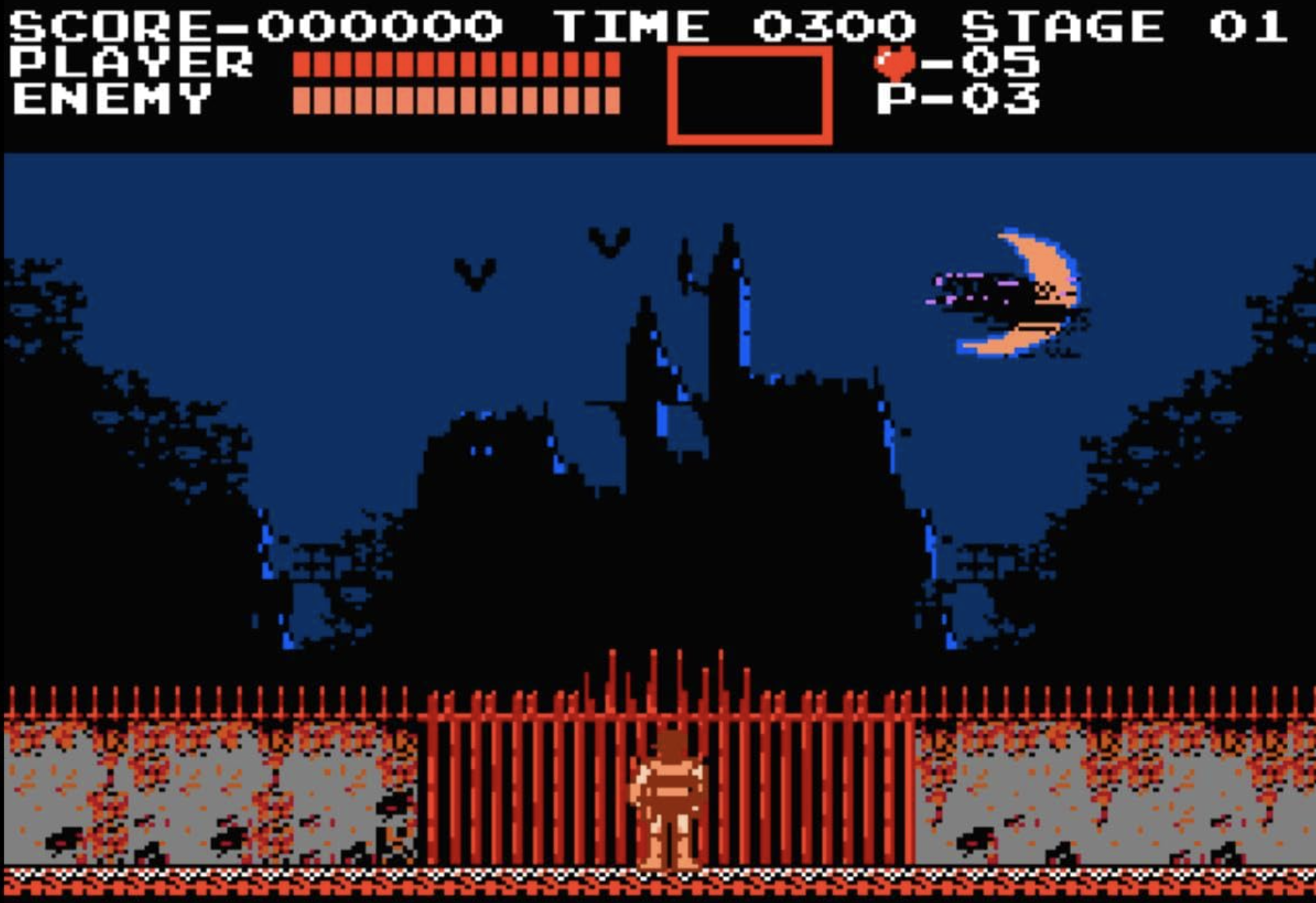
Castlevania (1986) image via IMDB
Most Western philosophical theories of selfhood tie it to awareness or consciousness, which is the way in which we can recall Dracula’s castle. It’s not completely, simply, a place as it doesn’t only belong to the physical world (or at least, doesn’t abide by the rules of the physical world), yet it isn’t simply space either because there is in fact a physical component to it. One could apply selfhood to the castle in some respects, but knowing that someone or something bestowed these aspects onto the castle means that it couldn’t be considered wholly conscious, either.
Casey tries to answer “Just how, then, is place constitutive of the self?” Casey brings in Sack again to reference the term “thinned-out places,” where “as places become more attenuated in their hold upon us, they merge into an indifferent state that is reminiscent of nothing so much as space” (Casey 406). He likens this to the idea of the “work-world” from Heidegger’s Being and Time. “At the very least, it tells us that certain habitual patterns of relating to place have become weakened to the point of disappearing altogether. In this lies the act of absorption—when the self and the work-world” combine (Casey 406).
Every self associated with the franchise, whether it’s a character within the story or the audience/players themselves, is absorbed by the castle. This makes the boundaries of the relationship with the castle thin and brings with it the question of whether the castle is a space, a place, or a self. I would argue that the very existence of this question on its own is enough to draw audience members back to the castle, along with the intended pull of the gothic aesthetic.
A gothic space is cryptic by design—both an emotional and physical labyrinth of aesthetic intricacies. Castlevania’s adorned mazes draw us in and force us to interact. And, much like Symphony of the Night turns the castle upside down, the gothic application turns definitions of place, space, and self upside down as well.
-
Casey, Edward S. “BODY, SELF, AND LANDSCAPE: A Geophilosophical Inquiry into the Place-World.” Textures of Place: Exploring Humanist Geographies, edited by Paul C. Adams et al., NED-New edition, University of Minnesota Press, 2001, pp. 403–25. JSTOR, www.jstor.org/stable/10.5749/j.cttttg77.29.
Edge Staff. “Why Dracula’s castle is the real star of Castlevania.” Edge Magazine, Gamesradar+, 28 Oct. 2015, www.gamesradar.com/creating-draculas-castle-castlevania/.
Hardgrave, Laura. “Castlevania: Symphony of the Night & the Importance of the Gothic Horror Genre.” Den of Geek, 18 May 2015, www.denofgeek.com/games/castlevania-symphony-
of-the-night-the-importance-of-the-gothic-horror-genre/.H.C., Luiz. “Looking Back at the Horror Movies and Their Monsters That Inspired ‘Castlevania.’” Bloody Disgusting, 1 Sept. 2021, bloody-disgusting.com/editorials/
3679719/looking-back-horror-movies-inspired-castlevania/.Heidegger, Martin. Being and Time. SUNY Press, 1927.
IGN Staff. “The Top 100 Video Games of All Time.” IGN.com, 23 May 2024, www.ign.com/articles/the-best-100-video-games-of-all-time.
Johnson, Jason. “The Impossible Architecture of Castlevania: Symphony of the Night.” Kill Screen, 24 Feb. 2015, killscreen.com/previously/articles/impossible-architecture-castlevania-
symphony-night/.Maarten. “The Gothic Success of Castlevania.” Cook and Becker, 16 Nov. 2017, www.cookandbecker.com/en/article/123/the-gothic-success-of-castlevania.html.
Mitchell, Richard. “‘Metroidvania’ should actually be ‘Zeldavania.’” Engadget, 24 March 2014, www.engadget.com/2014-03-24-metroidvania-should-actually-be-zeldavania.html.
Sack, Robert David. Homo Geographicus: A Framework for Action, Awareness, and Moral Concern. Johns Hopkins University Press, 1997.
“WE ASKED THE DEVELOPERS ‘What is the charm of Dracula?’” Micom BASIC, Aug. 1993, p. 198. “1993 Castlevania commentary from Micom BASIC Magazine,” thearkhound, Tumblr, 18 Mar. 2019, 4:36 AM, www.tumblr.com/thearkhound/183537621473/1993-castlevania-commentary-from-micom-basic.
Article by Dr. Brandy Hadden
Brandy is a communications professor, award-winning journalist, marketing professional, and published poet. She is a member of the Pop Culture Association as well as the National Communication Association where she supports the Film, Theater, and Multimedia division. She enjoys thrillers, true crime, and the supernatural.
Other Articles You May Enjoy…

Filmmaker Bari Kang discusses Itch!, from its practical gore and zombie influences to filming in his own NYC store and directing his daughter.