
[Book Review] ‘I Am Stone: The Gothic Weird Tales of R. Murray Gilchrist’
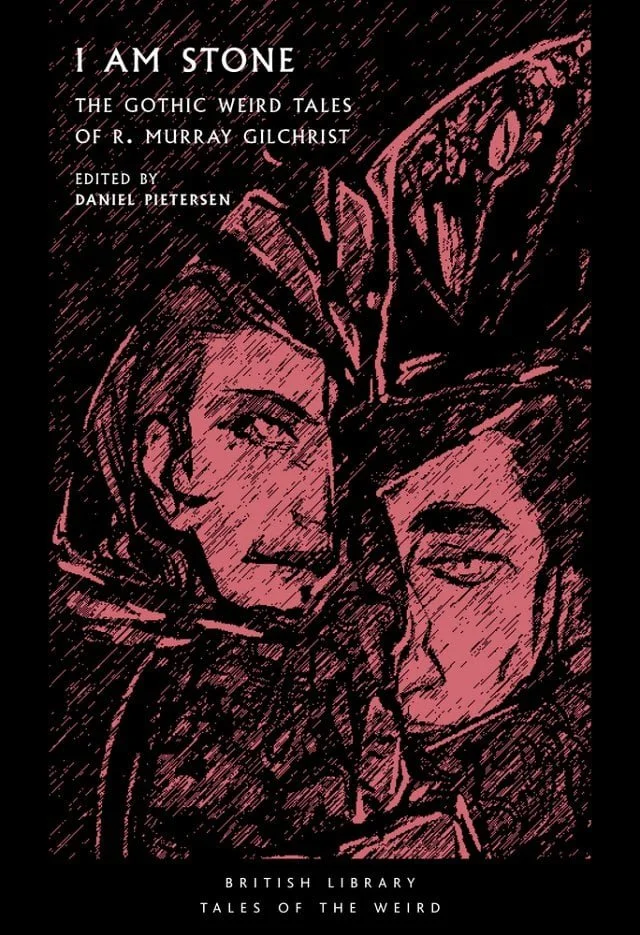
The British Library has done horror and gothic studies a service by commissioning I Am Stone: The Gothic Weird Tales of R. Murray Gilchrist (2021), edited by Daniel Pietersen. Born in 1867, and writing at the turn of the century, Gilchrist’s works lie at “the nexus” of “three strands” of late Victorian fiction: the gothic, the decadent, and the weird. His stories adopt lavish prose and imagery that is characteristic of the English Decadent Movement, a late-Victorian literary movement preoccupied with gothic themes of excess, death, and romance. His first novel, Passion the Plaything: A Novel (1890) set the tone for later fictional work with its tale of doomed romances. Critics greeted his later work, including his first collection, The Stone Dragon and Other Tragic Romances (1894), with skepticism. A Spectator review from the time describes Gilchrist, as Pietersen recalls, as a writer preoccupied with bewildering subjects that “are too ‘unreal and morbid’ to be sustained over a novel.” Compared to major authors of the period, Gilchrist is long forgotten and obscure, despite an eclectic output of “twenty-two novels, four regional guidebooks and six short story collections” (p. 10).
However, I Am Stone: The Gothic Weird Tales of R. Murray Gilchrist sheds new light on Gilchrist's short stories and makes them accessible to readers unfamiliar with his fiction. Previous editions of Gilchrist’s work, including the volume published by Wordsworth's Tales of Mystery And The Supernatural series (2006), listed the short stories in chronological order. By contrast, Pietersen frames Gilchrist's wide-ranging works in a more coherent timeline, identifying four unifying themes: the “Dead Yet Living,” “Useless Heroes,” “Of Passion And Of Death,” and “Peak Weird.” Pietersen adapts these labels from Gilchrist's own quotations, arguing that his work is “not just a unique blend of the decadent and the gothic” but also offers “early glimpses of what we would eventually come to know as weird fiction” (p. 12). As early weird writing, the best of Gilchrist’s stories reinterpret traditional psychological and supernatural demons together in their unsettling narratives. “The Lover's Ordeal” is Gilchrist’s haunting take on the vampire tale, in which a beautiful predator seduces a woman's newly-wed husband; and “The Crimson Weaver” is a dark fantasy of two lost travelers—a master and servant—entering a forbidden land ruled by the eponymous, supernatural being of the Crimson Weaver.
Queering of the Horror Genre
With their florid language, these stories are well suited for audio narration, as Pietersen himself demonstrates in his own recordings of Gilchrist's stories, available through SoundCloud. Gilchrist's authorial voice spotlights the sensual appeal of the stories. He frequently contrasts striking beauty—whether in nature or people—with tragic or grotesque elements. Paging through this collection, one finds bodies in various states of dismemberment, and the result is repulsive and extravagant in equal measure. In the “Crimson Weaver,” the eponymous villain, with the “marvelous” appearance of an angel whose beauty seems to “increas[e] a hundredfold” upon viewing, sits in her “alabaster gallery” weaving herself a “new and lustrous” robe (p. 25). At her feet, the creaking loom draws the robe's weave from the body of the Master, drawing its threads from his lifeless body with his decapitated head “ugly and cadaverous, glar[ing] from the loom” (p. 27). Displaying pain so coldly and stonily evokes one of horror's most iconic qualities: a fascination with fear, and a compulsion to look back at the object of fear, even while being afraid or repulsed.
Although Gilchrist did not write directly about sexuality, his stories engage with themes of transgression and the body in a way that perhaps anticipate the “queering” of the horror genre many decades later, led by late-twentieth century authors, such as Clive Barker. A loathing of double standards seems to animate the author’s vision of malevolent ghostly forces. Indeed, more about Gilchrist’s personal influences and life story would have benefitted the collection. In the introduction, Pietersen cites reviews of Gilchrist’s writing by peers, in magazines such as The Literary World. However, Pietersen is not given the space to unpack Gilchrist’s status within his contemporary literary world. This restriction is understandable in light of the pressure of the introduction’s word limit. Still, further detail about Gilchrist’s life story, whether his personal experiences or career stints at publications including the National Observer, would have enriched the collection.
Nevertheless, Pietersen’s thoroughly researched collection explores the gothic and weird themes within Gilchrist’s fiction that are yet to receive sustained academic critique. Alongside Gilchrist's most memorable stories, Pietersen has published a comprehensive glossary that is vital to understanding Gilchrist's work in the larger canon of weird fiction. The glossary highlights Gilchrist’s flamboyant use of language and reveals that curses in his work come in all sizes and shapes, from “Beldam” (which is an “archaic and pejorative term for an old woman, equivalent to crone or hag”) to “Marplot” (“Someone who spoils the plans of others”). The glossary also offers a list of terms covering a range of subjects, from botany to the classical world. Pietersen's definitions contextualize Gilchrist's allusions to pain, mysticism, and sexuality which ripple across the straight-laced Edwardian settings of many of his stories. As a whole, I Am Stone: The Gothic Weird Tales of R. Murray Gilchrist excels in providing an accessible introduction to Gilchrist’s work. Pietersen, and his enthusiasm for Gilchrist’s largely neglected literary work, has produced an engaging read for scholars and newcomers to gothic and weird fiction alike.
Article written by Christina Brennan
Christina Brennan is writer and reviewer whose work has appeared in various places, including Little White Lies, Flux Magazine, and Horror Homeroom. She’s been a reviewer for the Salem Horror Film Festival and Glasgow FrightFest Film Festival. She’s also writing a book on George Sluizer's The Vanishing, a film that Stanley Kubrick called the most terrifying film he'd ever seen. Read more: https://www.christinabrennan.net/ Twitter: @bigloudscreams

Other Articles You May Enjoy…

Petra finds a carnivorous plant and immediately starts thinking about medicine. I was mostly wondering how long it would take the thing to digest a person. Tatiana Schlote-Bonne builds What Feeds Below inside that gap. Her narrator is surrounded by organisms that eat, infect and rebuild human bodies, and she keeps wanting to get closer.