Gothic Children: Investigating Comics & Children's Literature with Dr. Julia Round
Like the specters that have been known to haunt the Gothic fiction genre, Gothic modes have a tendency of cropping up where they might be least expected. For Dr. Julia Round, who works as a principal lecturer in the Faculty of Media and Communication for Bournemouth University, this most recently took the form of investigating the Gothic in children’s comics.
Overall, Round’s research has focused primarily on Gothic, comics, and children's literature, with titles including: Gothic in Comics and Graphic Novels: A Critical Approach, an exploration of the intersection of both media and genre; the co-edited collection Real Lives, Celebrity Stories, an anthology focused on narrative theory and how we process stories of real people; and most recently, Gothic for Girls: Misty and British Comics, a cultural history of the British Misty comics. (The Misty comics were made for girls, focusing largely on the supernatural and horror.)
Additionally, Round serves as an editor for the Studies in Comics, as well as a co-organizer for the International Graphic Novel and Comics Conference. She has also published several comics, along with developing open access resources for British comics.
What initially drew you to horror? What inspired you to pursue horror studies?
I’ve always been interested in gothic and horror—my teenage years were shaped by films like The Lost Boys and The Crow (particularly the first one, which I watched repeatedly). Musically, as a teenager in the late 1980s and early 1990s, I found myself moving from rock and glam into darker, more industrial sounds, from Guns N’ Roses and Alice Cooper through Nine Inch Nails and Front 242, and on into the dark. I was introduced to comics like Neil Gaiman’s Sandman and Garth Ennis/Steve Dillon’s Preacher by my brother, and devoured the DC Vertigo imprint—I was fascinated by the types of dark, offbeat, literary re-workings it was offering. I wouldn’t say I was a lifestyle Goth, but Goth culture and music definitely shaped my style and interests in a very lasting way.
In terms of studying, I’ve always been most interested in analyzing the things that appeal to me—sometimes it’s hard to get critical distance, but equally you have a great knowledge base to draw on if you’re already a fan of something. So after my degree (English Literature) and a dalliance with creative writing, I decided to do a Ph.D. looking at the ways the Vertigo comics adapted and developed genre conventions taken from horror, myth, fantasy, and so on. The horror chapter was the one that really took off, thanks to my Ph.D. supervisor (Gothic theorist David Punter), and it became the subject of my first book, Gothic in Comics and Graphic Novels (McFarland, 2014). It’s not a survey of horror comics or their history; instead I was trying to use gothic criticism to re-approach and reconsider comics theory. The moments on the comics page that have had the greatest impact on me have been wildly variable, and I’ve often struggled to find a critical model that would help me explain why. I’ve flitted between cultural criticism, formal analysis, and close textual reading but never found a satisfactory way of demonstrating why this page, why this phrase, why this image is the one with resonance. So it was my attempt to bring these critical areas together and to create a model that would allow these texts to be assessed on their own terms.
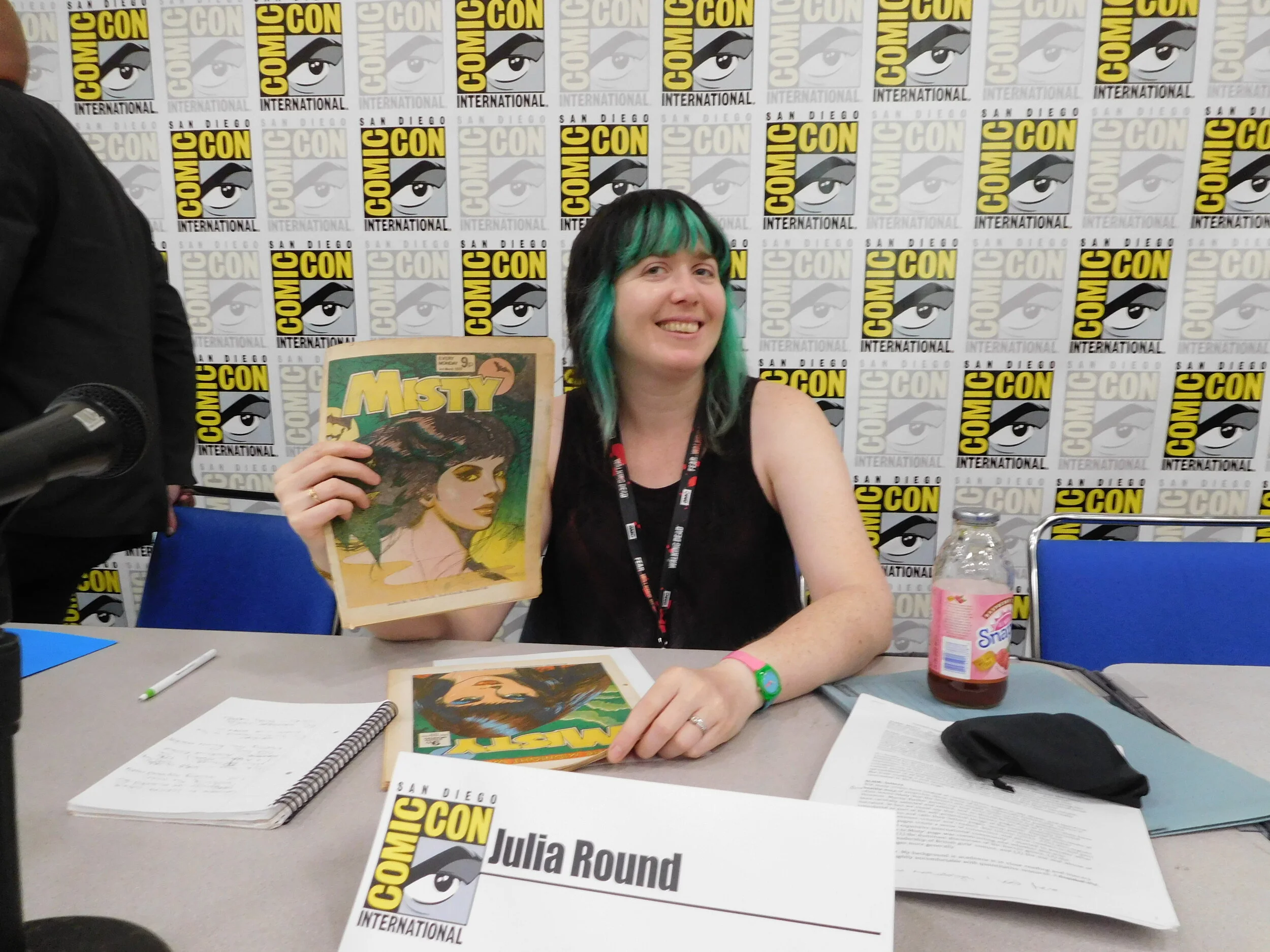
Dr Julia Round
My most recent book started as an even more personal project—to find a story from a horror comic that I remembered reading when I was eight or nine years old and which gave me nightmares for quite some time. It was about a girl who was not very pretty. She was given a magic mirror and told it would make her beautiful if she followed its instructions correctly. And it worked! But as she got more lovely, she also became mean and vain, and one day she did something wrong with the instructions, and when she woke up the next day and looked in her mirror, her beautiful face was shattered and warped. The story ended with the phrase: “How would you like to wake up every day . . . like this?” Although I threw the comic away and (temporarily) banned myself from anything horror-based, I never forgot that story. Years later, I would periodically find myself searching for it online, and when I was looking for a new project after my Gothic book, I decided this would be it. But although it began as an attempt to track down a half-remembered story and explore my ideas about Gothic in comics from a new angle, my Misty book then grew far beyond that and it’s easily been the most rewarding project I’ve done to date. As well as my book (which came out last year), I’ve produced a database of all the Misty stories, which includes all known writer and artist credits, story summaries, and their publication details, at www.juliaround.com/misty. It's a significant piece of work because the stories in British comics were not credited, and so I am indebted to experts such as David Roach and comics community forum discussions for much of the information I’ve gathered. I hope my database will enable further research and be a useful tool to help fans and scholars find those stories that they half remember or that are relevant to their work. I’ve also published some of the interviews I have done on the same website, and last year I published an open access article that explores the idea of Gothic for Girls by comparing Spellbound and Misty. (You can read that for free at: https://www.nature.com/articles/palcomms201737).
What drew you to elevating awareness of comics for young women?
Firstly because they have been shamefully overlooked and ignored, by almost everyone. British comics in general are a sadly forgotten industry, which is a terrible state of affairs because at one point they dominated children’s entertainment media in this country. Between the 1950s and the 1980s there were literally hundreds of weekly titles, many with sales of between 200,000 and a million copies. And the girls’ titles outsold the boys’ ones! Romance comics absolutely dominated the 1950s and 1960s, but things got even more interesting when the two main publishers (DC Thomson and IPC/Fleetway) began to seriously compete for the biggest market share. They pushed each other to fantastic lengths to be creative, exciting, and shocking. These comics were aimed at preteen and young adult girls, and they had better storytelling and characterisation than the boys’ war, sports, and adventure titles. They were all about misunderstood protagonists struggling to fit in, tortured girls trapped in unhappy home lives or spooky situations, and uncanny and terrifying mystery stories that kept readers guessing each week. Themed titles like Spellbound and Misty in particular told supernatural mystery stories, and so they were also a great fit for my research into Gothic.
I’m indebted to the work of scholars such as Martin Barker, Roger Sabin, Mel Gibson, Chris Murray, Joan Ormrod, Dave Huxley, and many more who are publishing great work on this underwritten area, but it’s still a relatively small crew of people. And within this lack of published work on British comics, the girls’ comics get even less attention. In terms of wider periodicals, there are very few studies on (say) what women read—and those that do exist often seem compelled to prove an argument that women’s magazines and literature are basically rubbish.
“Childhood is a time of great discovery but also great uncertainty...Gothic stories echo a loss of control & how to regain it”
I also felt there was a good fit with my research in another way, since Gothic has a similar blindness when it comes to the tastes of young female readers—despite the fact that this audience is a very large and vocal one when it comes to Gothic stories. Catherine Spooner, Chloe Buckley, and Joseph Crawford have all published books recently that explore these marginalised and sidelined Gothics (ranging from Emily the Strange to children’s stories to Twilight), and I wanted to add to this critical body of work and explore something with even less visibility. For example, Crawford demonstrates the way that online and published criticism systematically undermines readers of Stephanie Meyer’s Twilight series. He says there are three main theories that used to argue against its appeal: that its fans are too stupid to understand its message or are blinded by Edward; that its fans are sucked in by marketing; and that its fans are already ideologically brainwashed into accepting abuse as romance. All these positions are massively insulting to its readership! [These also] sync very well with lots of previous studies about women’s magazines and reading. Joan Ormrod and Hannah Priest have published similar work on the outcry against “sparkly” vampires.
So in general I think female readers, especially young readers, and their artifacts, have often been sidelined by academia. When those artefacts are deemed, like comics, to be disposable, and when they exist within a genre like Gothic, which has been characterised and canonised as a serious and mostly male tradition, then there’s a kind of Bermuda Triangle of marginalization. I definitely wanted to dive into that!

In your research, has the reaction of younger audiences to horror surprised you at any point? Are there specific themes in horror that younger readers respond to better than others?
I was surprised by how much horror was actually out there for a young readership, and how far back it goes! A very wide argument could trace it all the way back to the Grimms’ fairy tales, which are full of danger, fear, mutilation, and supernatural (or magical) transformations. Early chapbooks and religious texts also had their share of horrifying scenes and punishments! Critics such as David Rudd and Chloe Buckley argue that it is entirely possible to trace a Gothic strand in children’s writing from the Victorian period to the present day. Buckley lists authors such as Frances Hodgson Burnett (The Secret Garden, 1911); John Masefield (The Midnight Folk, 1927); Philippa Pearce (Tom’s Midnight Garden, 1958); Susan Cooper (The Dark Is Rising series, 1965–77); Alan Garner (The Weirdstone of Brisingamen trilogy, 1960–2012); Roald Dahl (The Witches, 1983); Robert Swindells (Room 13, 1989); Gillian Cross (Wolf, 1990); and Christopher Pike (Spooksville series, 1995–98); alongside publisher series such as Point Horror (launched 1991) and Goosebumps (launched 1992). To this list I could easily add writers such as Penelope Lively (The Ghost of Thomas Kempe, 1973); Gene Kemp (Mr. Magus Is Waiting for You, 1986); Neil Gaiman (Coraline, 2002); right up to modern franchises like Harry Potter and Lemony Snicket.
My research looked closely at these sorts of tales alongside a really deep dive into the Misty stories. Looking more closely at Misty, I was struck by how many tales were basically warnings about irresponsible behaviour, as heroines would discover a dangerous magical item, use it unwisely, and be punished in some extreme way. As well as stories being about explicit girlhood worries (like friendship, bullying, etc.), protagonists would find themselves trapped in a new or misshapen body, or imprisoned in a world or place they cannot escape. So many of its themes can also be read as metaphors for the experiences of a teenage audience.
In your assessments of children's literature, have you found that what children find frightening has changed over time? Or are there prevailing themes that have remained largely the same?
Ooh, good question! In many ways I think the underlying themes are much the same to be honest. Childhood is a time of great discovery but also great uncertainty, and lots of children’s Gothic stories echo this. For example, they might be about a loss of control and how to regain this. Alternatively, they could focus on coming to terms with some new ability or discovery—basically, learning to accept yourself as you are and to overcome fears and shortcomings. There’s a strong background focus on issues of power, control, and doubt—fears that your parents (or other authority figures or guardians) aren’t who they say they are, or have been hiding something from you.
There’s been some interesting work done linking modern children’s literature to much older iterations. For example, Karen Coats points out that Coraline and Gaiman’s short film Mirrormask both continue a tradition set by a short story written by Lucy Lane Clifford that is nearly 150 years old. It’s called “The New Mother” (1882), and it’s about two kids who are tempted to be naughty by a mysterious stranger who says she can only show her magical talents to truly naughty children. Their mother warns them against this and says that if they are naughty, they will prove they do not love her and she will have to leave and be replaced by a new mother with shiny glass eyes and a wooden tail. The little girls ignore her and do their best to be wicked but fail to be naughty enough—but their mother leaves anyway and the new mother with her shiny glass eyes arrives and forces them to live in the woods behind their house. So it’s another spooky cautionary tale that’s based on realistic childhood fears about growing up and independence, asking things like what if my mother leaves me, or consumes me, or is replaced by something else? (A common theme in fairy tales more generally!)
What are your research plans for the future? Any forthcoming books or specific conferences you're planning on attending?
I’m supposed to be slowing things down at the moment, but to be honest, it doesn’t feel like that! I’ve just submitted the manuscript for a Guide to Comics Scholarship, which I’ve co-authored with two other scholars, Rikke Platz Cortsen and Maaheen Ahmed. It’s basically a road map into comics scholarship for students and new researchers, flagging up recent developments and trying to give a picture of where the field is right now. I’m also working on developing more open access resources on British comics. Currently, I’m compiling a database of all the stories and creator details I can find for Spellbound, which was another supernatural girls’ comic series that predated Misty. I’m writing a few articles on different aspects of horror in girls’ comics—one on exploitation and adaptation (exploring the way that the British comics reused and rewrote popular adult stories, e.g. Jaws, Carrie, etc), and another on how short-form storytelling (like comic strips) affects the characteristics of Gothic. Finally, the big project I have going is to try and put together a bigger database of British comics that contains loads of additional information beyond stories and creators—prices, page references, scans, etc. I’m working on this with colleagues at Bournemouth University and we’re very excited about it!

I co-organise the annual International Graphic Novel and Comics Conference (IGNCC). You can find out more about that at www.IGNCC.com. I'm sure I have lots more other stuff on the go. I’ve been dipping my toe into practice-based research recently, and I’ve written a few short comics. That’s been lots of fun, although I seem to be producing them at the rate of one a year so I won’t give up the day job just yet! If you’d like to read them, then please do check out my website: www.juliaround.com for a selection of my comics and critical work, as well as a lot of the research resources that I’ve created, plus interviews, lectures, and much more.
This interview was edited for length and clarity. The purchase links are not part of a referral program for What Sleeps Beneath.
Interview by Laura Kemmerer
Laura tuned into horror with an interest in what these movies and books can tell us about ourselves and what societies fear. She is most interested in horror focused around the supernatural, folklore, the occult, Gothic themes, haunted media, landscape as a character, and hauntology.

Other Articles You May Enjoy…
Filmmaker Bari Kang discusses Itch!, from its practical gore and zombie influences to filming in his own NYC store and directing his daughter.