
Challenging Perception in ‘The Last Wave’
horror noun | hor·ror | ˈhȯr-ər |
1a: painful and intense fear, dread, or dismay
fright noun | ˈfrīt |
1: fear excited by sudden danger; alarm
When talking to horror fans about their favorite films, you’ll undoubtedly, at some point, begin the inevitable debate over which movies are the scariest. It’s not uncommon to hear refrains like “Movie X is a classic, but it’s not really scary,” or “I’m not saying Film Y is great, but it was terrifying!” More often than not, what these people are thinking of when they think of a “terrifying” horror film is actually more of a frightening horror film. To me, the two have long existed as distinct subgenres, with only the occasional crossover. For example, in recent years, horror has been dominated by what I’ll call fright films. These are films which rely on sudden (and frequent) jump scares—think films in The Conjuring universe. These films make for great popcorn-tossers, but when the credits roll, you aren’t often left feeling any lingering sense of foreboding; any sense of fear you feel before crawling into bed has to do with a tangible threat lurking in the dark.
Where fright films try to appeal to one’s instinctual sense of fight or flight, though, the “terrifying” horror film—or for the sake of clarity, we can just call the dread film—attempts to upend one’s sense of reason. The goal of the dread film is not to make you jump out of your seat, but to keep you on edge for days or even weeks. There usually isn’t an acute danger that might jump out at you; rather, it’s a fear that permeates your thoughts. The dread film wants you to come back and watch it again, not for the roller coaster ride of adrenaline, but because you feel like there was an understanding in its message—a forbidden knowledge that might ease your anxiety if you could just reach out and grasp it. It might come as no surprise which of these two categories I esteem more highly. That’s okay. I’m not here to argue about movie preferences. Rather, I make this distinction here because there are a fair number of movies that the average person would flat-out refuse to categorize as “horror,” but which I would unequivocally argue tooth and nail they are. One of these is Peter Weir’s 1977 masterpiece, The Last Wave.
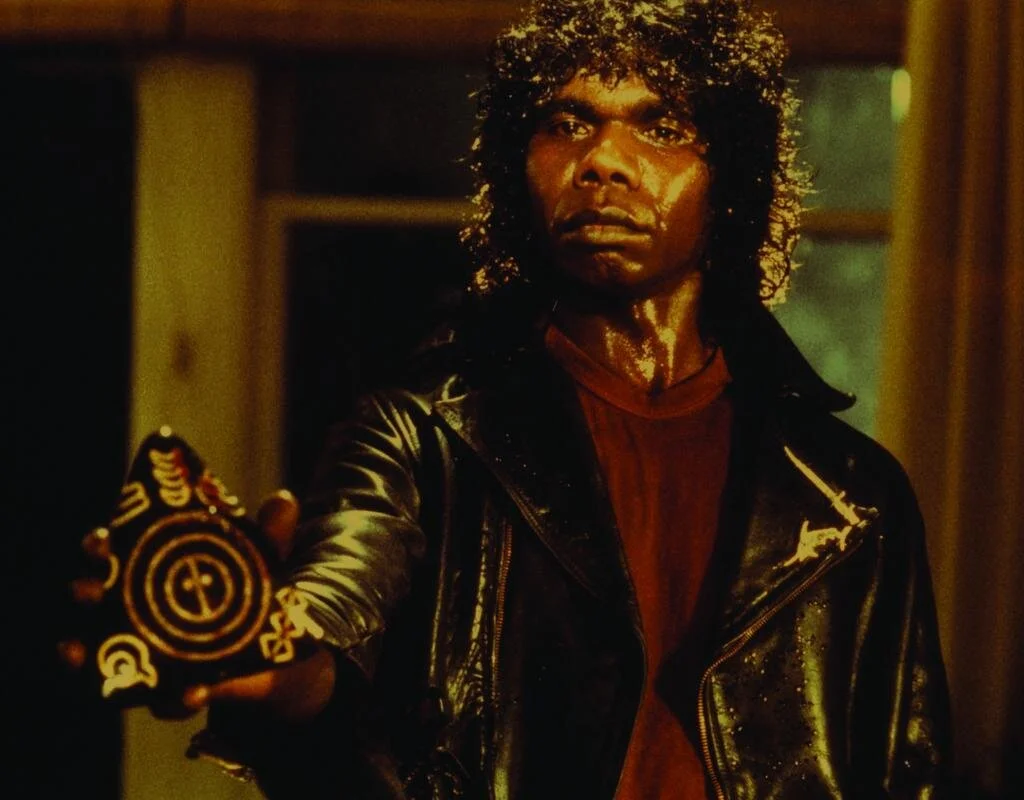
Most would place The Last Wave firmly in the realm of mystery films. The film follows Australian tax attorney David Burton (Richard Chamberlain), who finds himself charged with the public defense of a group of Aboriginal men, accused of murdering one of their own. The defendants, though they claim absolute innocence, admit to being present, and to fighting with the victim. They offer no information or explanation for the death beyond, “Billy died, that’s all” (00:27:48). Add to this the strange storms that have been brewing across the continent and David’s own eerie relationship with water, and you’ve set up a fairly interesting murder mystery, subbing in the lawyer for the hard-boiled detective with a checkered past. Enter Chris, played by the inimitable David Gulpilil (Walkabout, Storm Boy). Chris first appears to Burton in a dream, before showing up at his office the next day. When Burton tells him about his dream, Chris doesn’t seem surprised. Instead, he introduces him to Charlie (Nandjiwarra Amagula), who helps David understand his dreams, the increasingly erratic weather, and the part he is to play in the coming days.
As David unravels both the mystery of Billy’s death and the mystery of his own past (and future), the film takes on a more ominous tone. As we, the viewers, are exposed to the hidden, ancient world that lies beneath a modern Sydney, so too are we asked to confront our perception that our advanced civilization hasn’t actually replaced the “old way”—it has merely masked it.
Weir had already made a name making uniquely Australian films. His previous ventures, The Cars That Ate Paris (1974) and Picnic at Hanging Rock (1975), both use genre in unexpected ways to punctuate his commentary on modern living in a hostile landscape (Sheckels 75). With The Last Wave, Weir confronts the uncomfortable truth that underlies any exploration of society’s supposed mastery of its environment—the displacement of Indigenous peoples. What’s notable is that he’s able to accomplish this without making his movie about race. As counter-intuitive as this seems, while the film draws a distinct line between the colonizing influence of the British and the old-world traditions of the Aborigines, it treats this distinction as settled history. It seems to be unconcerned with the “sins of the father,” and recreating a morality tale centered on oppression and white guilt, choosing instead to focus on the living, breathing traditions of the tribe—traditions which thrive despite being hidden behind a facade of modernity.
This isn’t to say that these issues are ignored or downplayed. In one scene, David’s barrister on the case, Michael Zeadler (Peter Carroll), disagrees with David’s attempt at presenting a “tribal law” defense—a precedent which would allow the defendants to escape provincial punishment since the crime would have occurred in accordance with tribal customs—by refusing to acknowledge their tribal status:
“I have to dispel a few rather romantic notions you seem to have. Number one, the traditional culture of the Aborigines only survives among the full bloods in the far north and some parts of the desert. Those tribal Aborigines live a thousand miles from Sydney. The people we call Aborigines in the cities are no different culturally from depressed whites. We destroy their languages, their ceremonies, songs, their dances—and their tribal laws” (00:35:34–00:36:04).
This quote does two things. First, it arrests any notion that the story will spiral into a disappointing “white savior” narrative. David’s role is not—as he initially believes—to rescue the defendants, but literally to shut up and listen to them. After this conversation, in fact, David’s role as lawyer fades away almost entirely, save for a few mild entreaties to Chris to tell him more about the night Billy died, and the trial itself. Second, Zeadler’s statement serves as the voice of the establishment. In Zeadler’s eyes, whites have so thoroughly eradicated Indigenous culture that its adherents don’t even have a rightful claim to it anymore. That he says this with such matter-of-factness is all the more startling. Though this gives us a foundation with which to build the film’s setting, this too fades into the background as the mystery comes into focus, allowing another narrative to take the lead.
No shortage exists of films in which a white director attempts to use Black and Indigenous religious practices to exoticize their supernatural thriller. What sets The Last Wave apart from these, however, is the care Weir takes in his treatment of the Indigenous culture he is fictionalizing for his story. Like David, Peter Weir is content to provide a framework of a story and allow Indigenous voices to drive the substance of the film.
“the strength in this film
comes entirely from the truth
that’s spoken through the fiction”
Despite protestations from producers who were keen on ensuring as wide an international audience as possible for the film, Weir was insistent on the Aboriginal storyline and specifically sought out Aboriginal actors to fill the roles (Nette). After meeting with the director of the Aboriginal Cultural Foundation, he was pointed in the direction of a tribal elder named Nandjiwarra Amagula. With Amagula’s participation came the implied approval needed for some of the other tribe members to fill out the roles in the film (RAIN 1). In recruiting Amagula, Weir made it clear that he didn’t want to come across as callous or intrusive, and so deferred to Amagula and Gulpilil on nearly every design decision that might cause friction between the filmmakers and the tribes. Rather than drawing on authentic tribal symbols, for instance, Weir, under Amagula’s guidance, invented glyphs and relics so as not to tread on the toes of any actual peoples (Mathews 92).
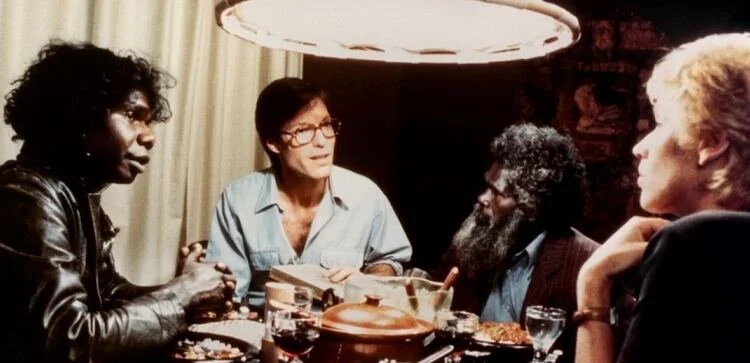
When Chris introduces David to Charlie, a wonderful scene takes place around the dinner table, as David tries to understand how Chris appeared in his dreams and what it all meant. The reason it feels like there is so much wisdom packed into this single conversation is because so much of it was genuine. Weir, recognizing the importance of letting Aboriginal voices shine through the fantasy film he envisioned himself making, worked as much dialogue as he could from his own conversations off-set with Gulpilil and Amagula (Kass). The significance that Charlie lends to “Dream Time” feels so weighty because it coincides with Amagula’s actual beliefs, and so allows his character to deliver the ideas with the full weight of 50,000 years of ancestral knowledge.
And it is this “Dream Time” which becomes the focus of the picture. Weir describes the genesis of the story simply as his wondering what might happen if a rational modern man were to have a premonition—how would he react? (Kass) As the film goes on, though, David’s premonitions give way to a reawakening of an ancient way of seeing the world—a vestigial form of perception that through generations of distancing ourselves from our natural origins, has atrophied into near nothingness. And it is here as well, that horror begins to creep back into our consciousness. In lieu of any scary villains or boogeymen, The Last Wave allows a primal awareness to roll in like a storm cloud. It happens slowly—slowly enough that we don’t even realize it’s moving toward us until it’s too late to prepare. When I finish watching a frightening movie, like, for instance, Candyman (1992), Sinister (2012), or The Descent (2005), I might turn on every light on my way to the bathroom, and it’s great. But when I finish watching The Last Wave, I’m left sitting in the dark, feeling an existential disconnect from my ancestors. I feel thousands of years of lost history bearing down on my chest. I feel a longing that likely can never be filled.
More so than any courtroom mystery or fantasy thriller, this puts The Last Wave more in line with films like Clive Barker’s Hellraiser (1987), which gnaws at the pursuit of pleasure and the afterlife, or Michael Haneke’s Funny Games (1997), which digs into the meta-voyeurism we feel as viewers of violent films, or even Joel Anderson’s grossly underrated and underseen Lake Mungo (2008), whose atmospheric dread challenges our beliefs in the paranormal in ways not seen since The Blair Witch Project (1999), another example of the kind of dread I’m thinking of. None of these examples are particularly known for jump scares, but few would ever doubt their membership in the horror genre.
The Last Wave speaks to the ever-widening gulf today’s world puts between us and our histories. It asks us to reconsider our perception that we understand how the world works while suggesting that any miscalculation could be catastrophic. It’s not as if The Last Wave is portrayed as depicting true events or a fully realized belief system that modern society has foolishly turned from. It is a fantasy tale and it never claims to be otherwise. But the strength in this film comes entirely from the truth that’s spoken through the fiction. In allowing Indigenous people the power to give a real voice to their experiences, Peter Weir was able to turn his story of a prophetic skeptic into a powerful tale of self-discovery. What could have felt like an exploitative stereotype instead becomes a parable of apocalyptic proportions.
This essay was updated on 7/16/2024 to include references and works cited.
-
Kass, Judith M. “‘It doesn’t take any imagination at all to feel awed’—Peter Weir.” Movietone News, 62–63, Dec. 1979. Parallax View, parallax-view.org/2009/12/04/it-doesnt-take-any-imagination-at-all-to-feel-awed-peter-weir/.
The Last Wave. Directed by Peter Weir, United Artists, 1977.
Mathews, Susan. “Years of Living Dangerously: The Last Wave, The Plumber, Gallipoli, The Year of Living Dangerously.” Peter Weir: Interviews, 2014, pp. 85–103.
Nette, Andrew. “Return to The Last Wave.” Overland, 6 Oct. 2015, overland.org.au/2015/10/return-to-the-last-wave/.
“[Potographs: Stills from the Film ‘The Last Wave’].” RAIN, no. 28, 1978, p. 1. JSTOR, www.jstor.org/stable/3031800.
Sheckels, Theodore E. “Fear in Peter Weir’s Australian Films: A Matter of Control.” Antipodes, vol. 23, no. 1, 2009, pp. 75–80. JSTOR, www.jstor.org/stable/41957766.
Article written by Ande Thomas
Ande loves the intersection of sci-fi and horror, where our understanding of the natural world clashes with our fear of the new and unknown. He writes about monsters and foreign horror and can also be found over on Letterboxd.

Other articles you may enjoy...


Filmmaker Bari Kang discusses Itch!, from its practical gore and zombie influences to filming in his own NYC store and directing his daughter.