
‘Sinners’ Review: Vampires, Blues, and the Fight for Cultural Identity
It would be difficult to quantify the goodwill that Ryan Coogler has accumulated with studios before Sinners. The 38-year-old director is already an indisputable master at his craft—no Coogler-directed film has scored lower than 94% among critics on Rotten Tomatoes aside from Black Panther: Wakanda Forever (which still boasts an impressive 84). It’s still hard to believe that, in this day and age, he was able to get a major studio to finance a $90 million period-set supernatural horror film, but here we are. I don’t want to bury the lede: It’s a Prohibition-busting, dust-coated, blues-singing masterpiece.
Set in 1930s Mississippi, Sinners is the story of Sammie “Preacher Boy” Moore (Miles Caton), cousin to the “Smokestack twins” (Michael B. Jordan). Gone from the Delta for the past seven years, seeking their fortune in gang-ridden Chicago (where it’s said they’d been working for Al Capone), Smoke and Stack have come back with a truck full of booze and bags full of money to open a juke joint. As they prepare for their grand opening, they round up old friends, business partners, and blues players, including young Sammie, a supernaturally gifted singer and guitarist. Unfortunately for the twins and everyone else at Club Juke’s opening night, Sammie’s talents also attract the attention of Remmick, an Irish vampire hoping to use Sammie’s gifts for his own purpose, and it’s this motive that sets Sinners apart from decades of vampire tales that have come before it.
In Sinners, music—specifically in the hands of certain musicians—has the power to pierce the veil between life and death. It becomes a window into a culture’s past, as well as its future, allowing one to commune with their ancestors in the truest sense. Not that this is the first time such power has been attributed to music. The blues, especially, have long been associated with mysticism, evolving as it did from African American spirituals and the adoption of American hoodoo into its folds. The way Coogler takes this reputation and molds the mythology into something immediately recognizable yet wholly original is nothing short of remarkable.
A New Kind of Vampire
By focusing on Remmick’s motivation for harnessing Sammie’s ability, his goal of appropriating a Black musical style to replace his own lack of ancestral awareness is handled with a nuance not commonly seen in this type of narrative. Because Remmick and his fellow vampires are constrained by the law that prevents them from entering a door uninvited, he tries appealing to a sense of kinship with his Black victims. First, by lamenting the loss of his pre-Christian culture and then by hinting at the much more recent struggle of Irish immigrants to be treated on equal footing as their Anglo-Saxon counterparts. Remmick’s argument (unlike the recent narrative of white supremacists who’ve used past Irish discrimination as a way to diminish the effects of slavery) doesn’t aim to discount the experiences of the Black sharecroppers inside Club Juke, instead hoping to fellowship with them. It just so happens that his idea of fellowship involves a brutal, bloody death.
Of course, it helps empathize audiences to Remmick’s desire for Sammie’s music that the music inside Club Juke is really, really good. The music, much of which was performed live on set, is transformative and timeless in a way only blues music can be, with a generations-spanning musical centerpiece that brilliantly showcases Sammie’s power, chaining centuries of Black culture together into a single performance that (figuratively) burns the house down.
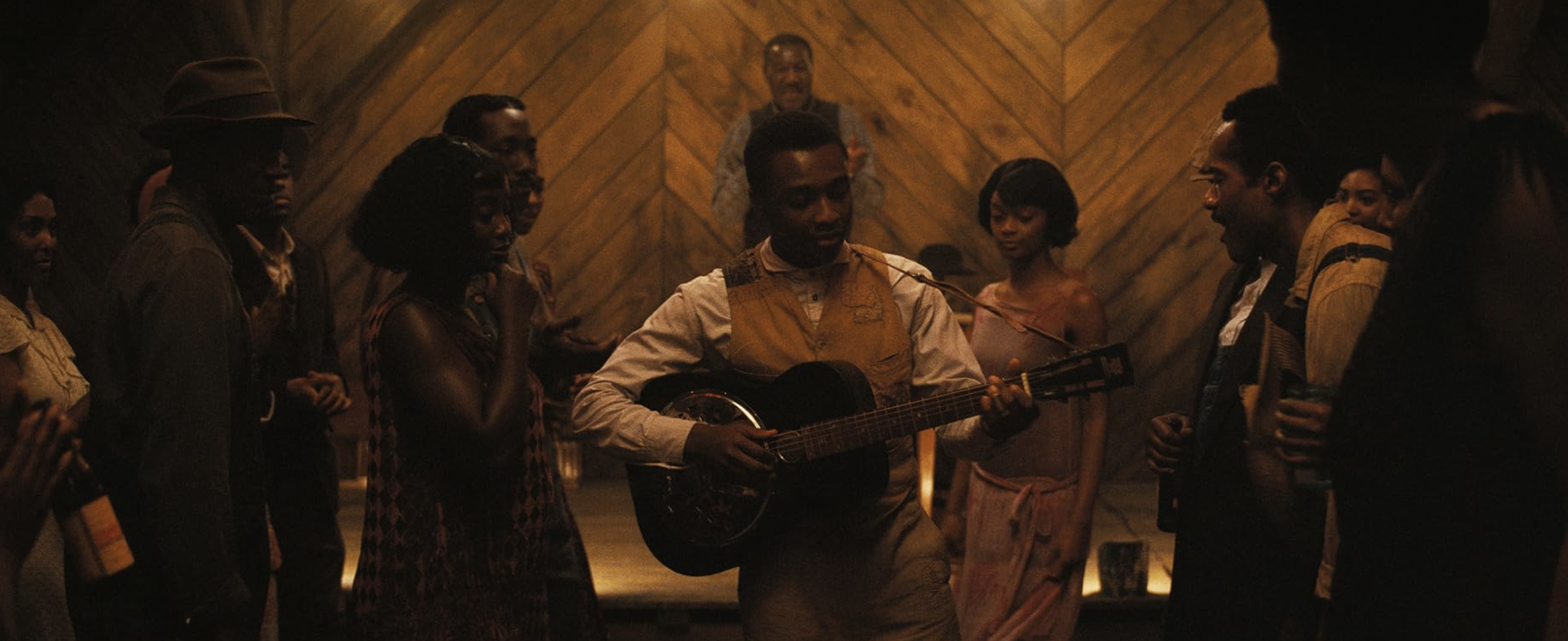
Miles Caton in Sinners, image via IMDB
As good as the musical numbers are, however, so are the performances in between. Jordan’s dual roles, in particular, are so much fun to watch, and Smoke and Stack feel like such different characters that even without their contrasting-color outfits, it’s easy to tell the two apart. It’s also a testament to Coogler’s skills as a worldbuilder that every character, from the twins down to the smallest of players, feels like a fully-fledged life with complex motivations all their own. The cast’s chemistry, including Wunmi Mosaku as Annie, Delroy Lindo as Slim, and Jayme Lawson’s Pearline, helps give the film an exciting, dynamic transition from lucrative opening night to a blood-soaked bluesy version of From Dusk til Dawn wrapped in a lyrical Mississippian accent.
No good review of a vampire film would ever be complete without talking about its vampires, though. Sinners mostly sticks to the familiar vampire rules—aversion to sunlight, silver, and garlic, stakes through the heart can kill them, etc., but it also adds some traits that, though we may have seen them before, add a great deal of personality to a film already brimming with it.
For example, one of the defining features of Remmick and his vampiric children is their reflective “eyeshine,” more commonly associated with predatory mammals like cats and wolves. As eerie as this is on its own accord, it goes double as the night wears on and we watch them stalk the outside of the juke joint like a cat around the fishbowl, waiting for their opening to strike. The detail is small but insanely effective.
Another is Remmick’s uncanny capacity for flight. The closest comparison I can make to the fly-by-wire effect Coogler uses comes from the much more comedic Renfield, when Nic Cage’s Dracula rises above his minion and his unsuspecting support group, but in Sinners, the tone is much more sinister. The way Remmick lifts from the ground in complete silence is not only terrifying, but one of the simplest—and coolest—effects I’ve seen in some time.
Sinners is somewhat of a unique beast when it comes to horror films. I will always advocate seeing movies in the theater wherever and whenever possible, and horror films are no exception. Usually, though, I want to showcase the gorgeous effects work, the sensory-engulfing atmosphere, the excitement of feeling the tension in an auditorium full of other horror fans. With Sinners, those things are actually last on my list of reasons to see this film in the movie theater; it’s the cinematography and the music and the performances that make it shine. It’s a horror film shot in 70mm on IMAX cameras, for God’s sake. Don’t let that go to waste on your TV or laptop. Sinners is one of those elusive “original films” that people keep harping on Hollywood to make and it’s one that deserves to be seen on as big a screen as you can manage.


WSB x Moving Picture Reviews is sponsored by the Pittsburgh Moving Picture Festival. The Pittsburgh Moving Picture Festival celebrates both the art of cinema and the rich motion picture exhibition tradition of the City of Pittsburgh. Our goal in this series is to highlight new and upcoming genre films and, wherever possible, to support local, independent movie theaters in the process.

Article Written by Ande Thomas
Ande loves the intersection of sci-fi and horror, where our understanding of the natural world clashes with our fear of the new and unknown. He is an independent member of the Society for Cinema and Media Studies and a supporting member of the Horror Writers Association. He writes about monsters and foreign horror and can also be found over on Letterboxd.
Other Articles You May Enjoy…


![A Self in the Setting: Exploring Dracula’s Castle [video game horror]](https://images.squarespace-cdn.com/content/v1/5d3e481bc5a6e40001b215a8/1738798336699-OXLE0MWHEWE0DODVC10N/castlevania1997.png)


In The Buffalo Hunter Hunter, blood carries the violence of colonialism, while a settler’s journal controls whose story survives. This essay examines how Stephen Graham Jones uses vampirism and layered testimony to confront historical erasure.