
Movie Review: His House (2020)
A story of South Sudanese refugees looking to make a new life in Britain, His House, written and directed by Remi Weekes, is the latest and greatest in 2020’s juggernaut social horror showcase.
Based on a story by Felicity Evans and Tony Venables, His House draws us into Bol (Sope Dirisu) and Rial’s (Wunmi Mosaku) violently disrupted world, opening on their experience in the culturally and socially liminal hell that is a detention center. When they get the news that they have been accepted into Britain, Bol tries to adapt to British expectations and “norms,” while Rial still actively grieves the loss of their daughter, Nyagak (Malaika Abigaba) and strives to remain connected with her culture and identity in the British cultural wasteland. Haunted by what they have experienced in their journey across the Mediterranean, both of them soon find that their assigned housing—filled with rot and insects and potentially dangerous electrical work—is also filled with its own spirits. His House pushes the ghost story subgenre in a new, much-needed direction.
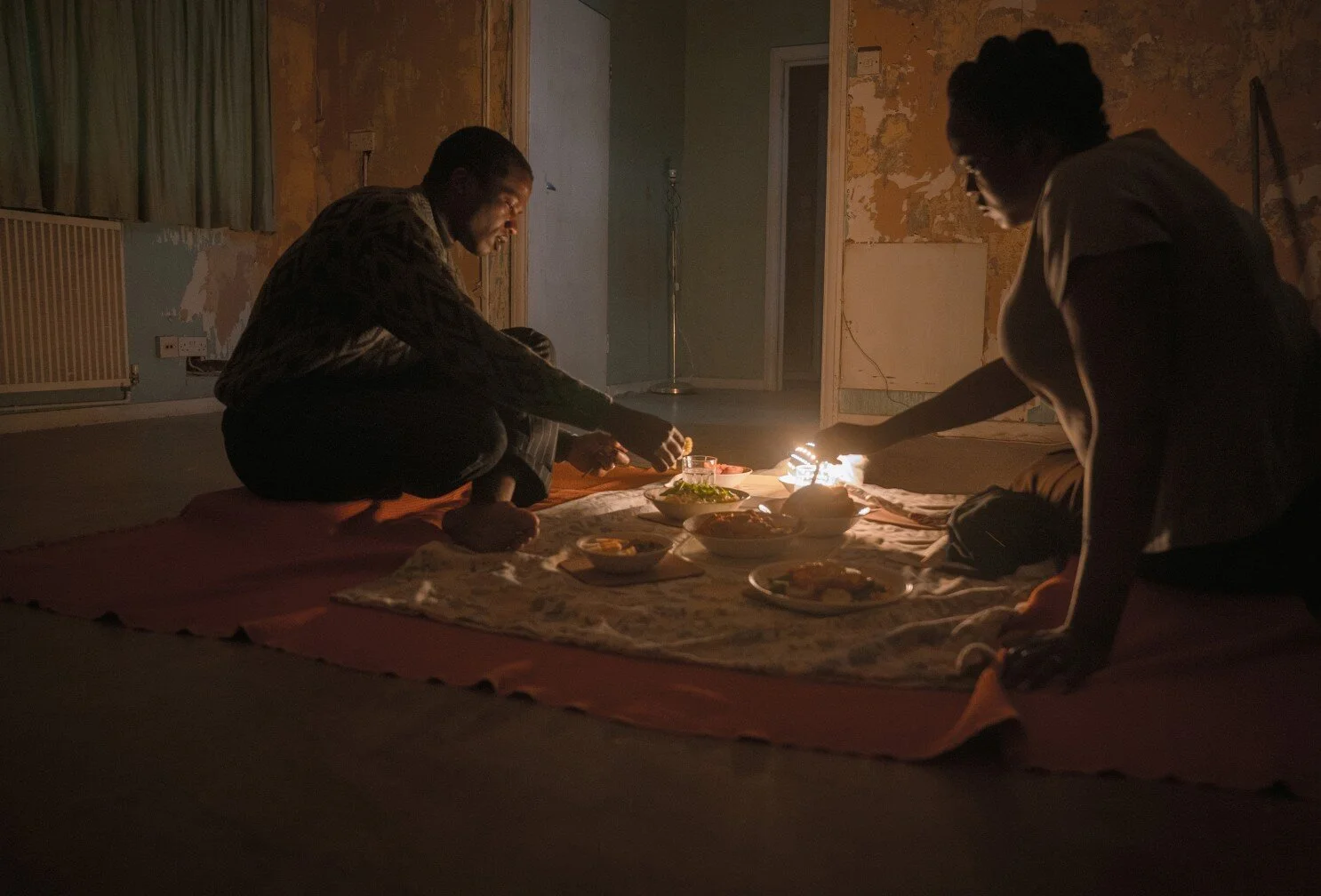
Though it is not my place to write on how His House treats the lived experience of refugees, there were several moments that struck a deep chord and provided a learning experience and a new perspective. In one scene, Rial is seeing a doctor, and as this doctor is making conversation, asking about Rial’s daughter and life, Rial speaks very plainly about losing Nyagak in the journey across the Mediterranean. The doctor becomes uncomfortable and Rial leans into this discomfort, explaining to her how she got her scarification tattoos and how much her very life depended on them. The imperialist, colonialist West comes face-to-face with the lived experience of the very people it looks and speaks down on.
These moments—among many others where husband and wife struggle to navigate this new chapter of their lives in a country that is not home while being saddled with a culture that is not theirs—provide a solid snapshot into what being stuck at this impossible crossroads must feel like. There are also scenes where Bol is made to confront his own traumatic memories of the journey and its beginning, but he actively suppresses that part of his life, looking to find the peace of falling in line with Biritsh culture and expectations. But what has happened will not be forgotten, and it searches for him in the dark of night with a vengeance.
Rial, on the other hand, maintains an active dialogue with her culture, her grief, and her ghosts. In this way, she retains a healthy balance between loss and the demands of her present. It is here we also see just how divorced Western cultures have become from the psychological image: Between work exhaustion, economic instability, and a now-ingrained habit to turn to social media to keep ourselves distracted, we seek to numb, not to process. Consumption is not culture, and without that kind of social, mental, and emotional framework to draw from and give us strength, that numbness can curdle to emotional death.
Cast performances were solid, and Mosaku’s performance as Rial shone brightly through her passion and delivery. Mosaku and Dirisu’s dynamic is also terse and fraught enough to be believable and enjoyable to watch. As an added bonus, Matt Smith (as in the 11th Doctor from Doctor Who, Matt Smith) also appears like a specter straight from 2010, and seeing him however briefly in this was a pleasant surprise.
Stylistically, the choice to make some ghosts CGI remains a perplexing one, though the story that goes into them more than makes up for this visual shortfall. The writing in His House also strikes a successful balance in introducing the viewer to enough cultural context to give these hauntings weight, which is a gift when a number of horror movies fail to do this if haunting or demonic possession isn’t rooted in Catholicism or Christianity.
Among the latest iterations of the explosion of social horror in 2020, His House also does a gargantuan level of work in pushing the boundaries of what ghost stories are capable of in the popular imagination. Flanagan’s The Haunting series has successfully introduced audiences to new ways of looking at ghost stories, but Weekes’ film shoves the boundaries of the genre even further out, opening the door for more voices and perspectives. White oppression of minority groups that emerges even in the simple lines about “fitting in” make the entire country a haunted house for Bol and Rial: “You don’t belong! You are not wanted here!” screeches the culture of a white demographic that does not want to recognize that the country is changing, reflected in the passive-aggressive commentary of a nearby neighbor.
Though some may mark the ending as too simple for their taste, the way His House ends hits very close to the right note for what this movie set out to achieve: Bol and Rial have faced their ghosts and their trauma and have learned how to live with both. And since they keep the connection to their culture alive, we know that this is Bol and Rial’s Britain.
Article Written by Laura Kemmerer
Laura tuned into horror with an interest in what these movies and books can tell us about ourselves and what societies fear. She is most interested in horror focused around the supernatural, folklore, the occult, Gothic themes, haunted media, landscape as a character, and hauntology (focusing on lost or broken futures).
