The Book of Queer Saints, Vol. 2 - Reviewed
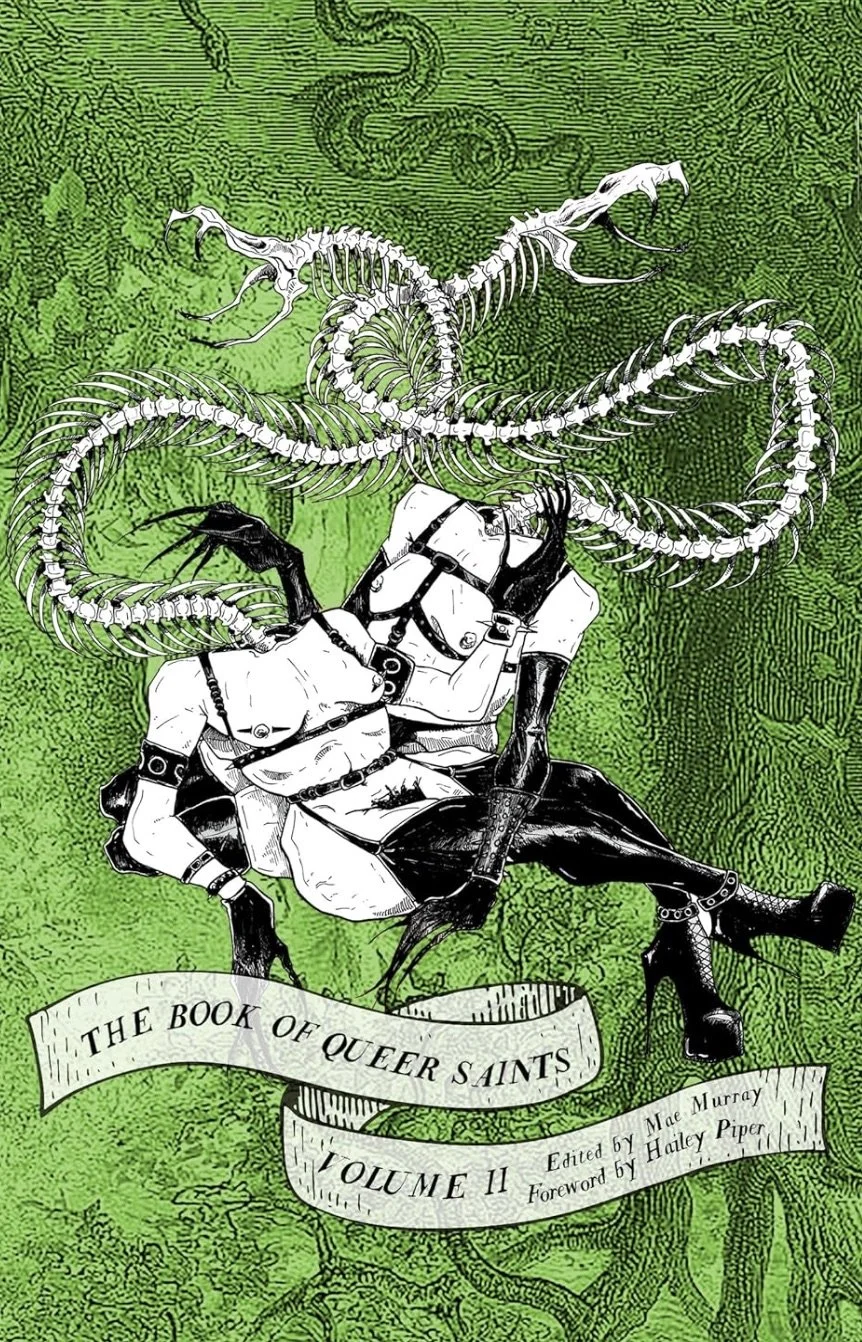
The Book of Queer Saints, Volume 2 is editor Mae Murray's highly anticipated follow-up to her own 2022 anthology focusing on horror stories written by queer and marginalized voices. Armed with a fiery foreword by modern queer horror icon Hailey Piper, this second volume promises to continue the legacy of its predecessor—to not bend to the bigots and people-pleasers. To collect stories, not of saints, but of people; complex, imperfect, messy, queer people who reflect the complex, imperfect, messy world we all share. In our review of volume one of this (hopefully) ongoing series, Laura Kemmerer wrote that the collection was a “middle finger to those who only want harmless queer representation.” My biggest hope for the second book was that it met that same standard—but instead, it far exceeded it.
From the opening story onward, the anthology rings terrifyingly relevant, forcing readers to confront cold truths facing us today. In that dystopian tale, “FAFO” by Paula D. Ashe, a mother and her wife discover firsthand that revenge isn't always best served cold. It's a swift read that hits hard and does a great job at nodding to its political overtones without drawing a circle around them in fat, black Sharpie—a feat that seems increasingly rare today. Ashe isn't alone in this approach, however. Other stories that turn a deadly gaze toward oppressive politics include “Pro Choice” by Alison Rumfitt, “It's Really For the Best” by Vivian Moira Valentine, and “Hamper” by Megan Kiekel Anderson, all of which deal, in one way or another, with the unintended consequences of forcing one person's beliefs onto another.
But the horror within these pages isn't restricted to the political. “Vining” by Emmett Nahil and “Pieces of Me and You” by Davis Walden both have some of the most skin-crawling body horror I've ever read. The former gives me the kind of strong dose of cosmic terror that keeps me running each week, while “The Pendulum Swings and the Mariposa Soars” by Xochilt Avila adds a touch of entomological folklore to the pot. “Vining” and “The Pendulum Swings…” in particular are interesting to me because while both share ecological elements, as well as madness and transformation, they take vastly different approaches to their characters’ compulsions. I love to see serendipities like this in anthologies—when stories can, unprompted, seemingly exist in the same twisted universe—a universe within which horrible ecological nightmares can tear relationships apart or, in a way, bring them closer than ever before. I don't know which is more frightening.
Another highlight is Stacy Wayne's “I LOVE YOU, LOLA!”, which tackles rabid fandom in a way that is unexpected and so satisfying, while also exemplifying the book's thesis to the letter. The protagonist in “LOLA” is funny, charismatic—selfish and self-serving, sure—but by no means scary or villainous. In a way though, he is exactly the kind of person that the evangelical protesters in the story think he is; hope he is. And it's precisely that which gives him power. “I LOVE YOU, LOLA!” stops running from the intolerant garbage constantly hurled at queer folks and revels in it—proclaiming to the bigots, “You've brought these walls down around yourselves.”
Readers should be warned, though, that The Book of Queer Saints can get very intense, very quickly. “Transmasc of the Red Death” by LC von Hessen jumps headlong into extreme horror, a notorious subgenre known for its depravity—and I absolutely love it. Touching on many of the same themes as “I LOVE YOU, LOLA!” and several others, von Hessen holds nothing back when describing the secret sadomasochistic parties in the Wickersham mansion.
So, too, does “Caregiver” by Amanda M. Blake deserve caution, in this case for anyone who may struggle with depictions of emotional abuse or end-of-life care. “Caregiver” is a savage tale with a cold, almost detached delivery that chilled me to my core. I don't mean to single these stories out as the only two in the book that need to be approached with a discerning eye, but it does bear mentioning that the stories within these pages are horror, and they are quite good at doing what they set out to do.
With Volume 2, The Book of Queer Saints has solidified its place as a collection willing to challenge the status quo, freeing queer characters from the chains of virtue, and giving them the space to be truly terrifying. There was a time when expectations were that queer characters should be paragons to keep creeping prejudices from souring readers to them before they inevitably fell victim to whatever terrors the story had coming. The Book of Queer Saints proudly announces that that time has ended. Now, we fight.
Article written by ande thomas
Ande loves the intersection of sci-fi and horror, where our understanding of the natural world clashes with our fear of the new and unknown. He writes about monsters and foreign horror and can also be found over on Letterboxd.