
Scared Sacred: Idolatry, Religion and Worship in the Horror Film
Every once in a while, I encounter a book, or even the rumor of one, that feels like it was written just for me: Scared Sacred: Idolatry, Religion and Worship in the Horror Film, an anthology of critical essays published by House of Leaves Publishing, more than lives up to the beautiful promise of its name. (I’d be lying if I said I didn’t get a little emotional at the passion evident in the opening editors’ note. Needless to say, the concluding metaphor of the reader being a pilgrim is very, very fitting.)
Ultimately, Scared Sacred is divided into four sections: Christianity, Mysticism, Occultism, and Beyond Belief, with discussion points drawn from religions all across the globe. Oh, and did I mention this book has a foreword by Doug Bradley? Yeah. Pinhead, Hellraiser, Doug Bradley.
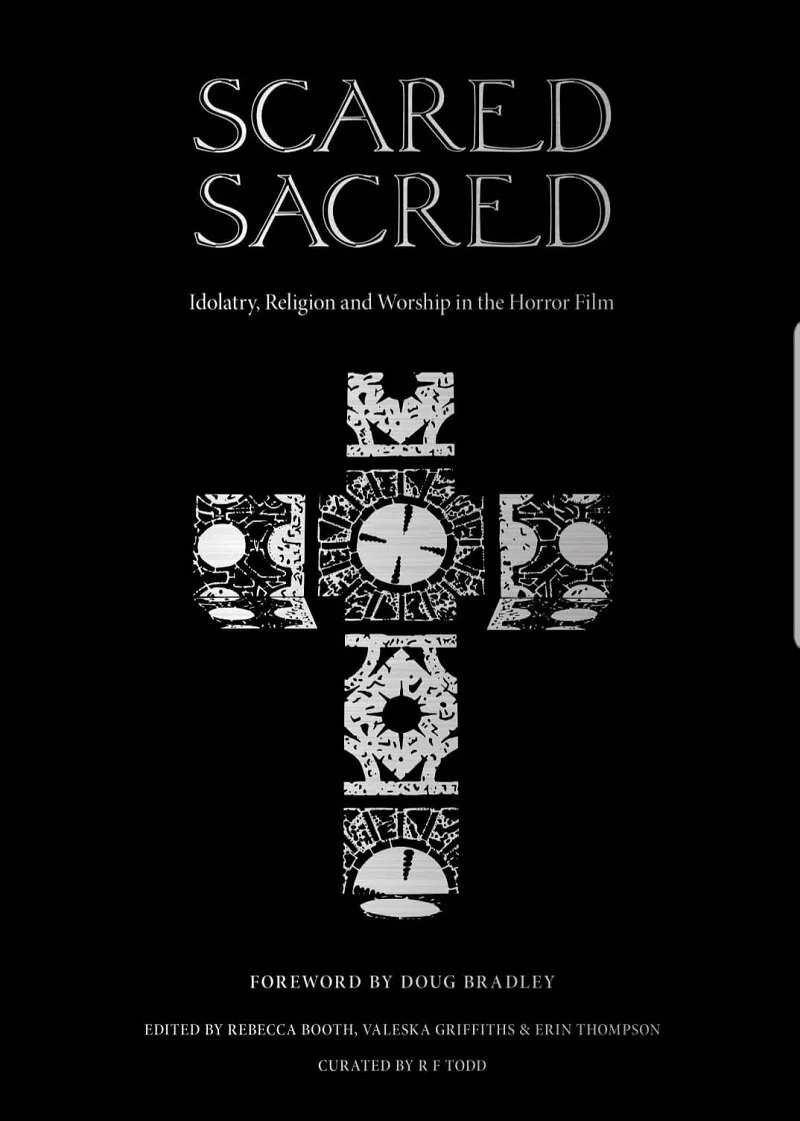
In the preview of the book House of Leaves Publishing made available for review, an essay from each section of the book was included. Though I initially anticipated something of a challenging read—by the end of my day, my brain is usually a bit soupy so I need to push myself to really engage with material that ventures more into theory—Scared Sacred immediately seized me with the engaging and approachable writing quality I found in its essays.
The pieces included in the sample were: “Onward, Christian Soldiers: Eyes of Believers in The Conjuring (2013) and The Conjuring 2” by Alexandra West; “From the Stake to the Sanitarium: Taming the Unruly Feminine in Häxan (1922) and Antichrist (2009)” by Valeska Griffiths; “I Believe In Death: William Peter Blatty and the Horror of Faith in The Ninth Configuration (1980) and The Exorcist III (1990)” by Samm Deighan; and “A Taste for Blood and Truth: Bill Gunn’s Ganja & Hess (1973)” by John Cussans.
In “Onward, Christian Soldiers,” West emphasizes the core behind the first two Conjuring movies is an overly simplistic, borderline propaganda-like view of good vs. evil, deeply rooted in the Warrens’ own Catholic faith and by extension a rather conservative view of the world.
In “From the Stake to the Sanitarium,” Griffiths closely examines the connections between the archetypes of the witch and the hysteric through both films, with Häxan serving as more of a large cultural snapshot connecting medieval concepts of witchcraft to at-the-time modern understandings of hysteria, and Antichrist being focused on presentation of what Griffiths terms the “psychic wounds” similar issues cause.
Though these two pieces were the ones I enjoyed the most, both “I Believe in Death” and “A Taste for Blood and Truth” were equally as engaging. “I Believe in Death” prompted me to further consider movies I had not seen in a very long time, and “A Taste for Blood and Truth” drew me into further consideration of the contrast between the contention in religious narratives and the personal experiences of artist of color Bill Gunn.
With my previous book reviews, I tried to exercise some kind of professional restraint in expressing my enthusiasm for a particular work, but I’ll make no such pretenses here: So far, Scared Sacred is very much the book I wish I’d had when I was first getting into horror a few years ago. We are perpetually haunted by old symbols and old ideas, and this book is a beautiful reminder of that. And while there are some assertions in the essays that I did not necessarily agree with, I’ll be the first to admit that I don’t know enough (right now at least) to publicly dispute them.
Also, I’ll be honest: If you’re anything like me, you genuinely enjoy being introduced to a person or a book or a movie that demonstrates a depth of knowledge and understanding that blows your own out of the water. But here, the approachability—the willingness to engage—is what truly makes Scared Sacred a pilgrim’s book. No matter where you are on your road with engaging with film criticism and horror film subtext, books like this will help light your way.
Scared Sacred: Idolatry, Religion and Worship in the Horror Film is currently slated to be published in February 2020. First edition hardback and paperback versions are available for purchase through the publisher’s website. (Once the initial 100 copies sell out, the hardback version will not be reprinted.)
Article Written by Laura Kemmerer
Laura tuned into horror with an interest in what these movies and books can tell us about ourselves and what societies fear. She is most interested in horror focused around the supernatural, folklore, the occult, Gothic themes, haunted media, landscape as a character, and hauntology (focusing on lost or broken futures).

Filmmaker Bari Kang discusses Itch!, from its practical gore and zombie influences to filming in his own NYC store and directing his daughter.