
Book Review — Shadow Atlas: Dark Landscapes of the Americas
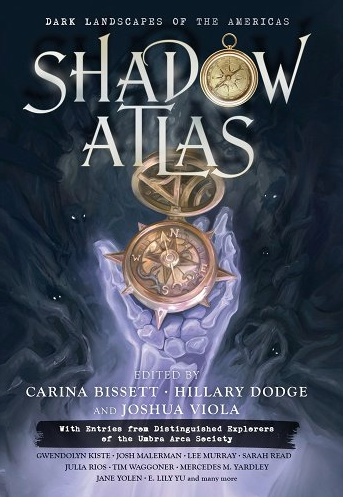
Shadow Atlas: Dark Landscapes of the Americas, an anthology released in 2021 by Hex Publishers, is a fantastic exploration of identity, landscape, and what happens when the two intersect. Many of these stories feature folkloric elements, and with a significant amount of unique poetry and beautiful artwork, Shadow Atlas truly captures the spirit of these old tales that continue to haunt us.
The more anthologies I read, the more I come to appreciate the challenges inherent in compiling such a complicated project. Editors Carina Bissett, Hillary Dodge, and Joshua Viola kept the story selections true to the focus of the book, and the structure itself feels like a story that would be told around a campfire over the course of several nights. Even more to enjoy is an overarching narrative about a genius-level scoundrel who had much to say about history and folklore, and what we could count as “real” in our world. But, as the book opens, we learn from his purported colleague that this man’s account is not to be trusted, and that the Shadow Atlas itself is supposedly a collection of “true” events committed to record by mysterious writers. An epistolary-style email chain between the editors is a nice addition to truly bringing the reader into the world of the book.
The Shadow Atlas table of contents is broken up into three segments of the Americas: North, Meso, and South. The first section features vital tales like “Moon-Eyed Women” by Kay Chronister, which follows the story of a young man with a troubled past looking to get married. But when the local Widow Nell gives him what he desires, his wife is not what she seems, and his own destructive tendencies turn their teeth back on him. Fans of Perpetual Motion Machine Publishing’s anthologies Lost Signals and Lost Films will recognize the name of Betty Rocksteady as another author in the North America segment. Rocksteady’s story, “The Man Who Wasn’t There” is a highly detailed first-person account of a student in mental turmoil when she encounters something deeply troubling.
In the Mesoamerica section we find more poetry, including the compelling pieces “Blood of Angels” by Owl Goingback, “Blood, Like Chocolate” by Stephanie M. Wytovich, and “La Ciguapa” by Christina Sng. Each, in their own way, beautifully captures dangerous yet compelling stories. “Xtabay” by Julia Rios stands out as a particularly poignant short story from this section—a multigenerational narrative that focuses on the daughter of a man who treated a beautiful young woman poorly, but she turns out to be someone who will not so easily be cast aside.
In the final section, South America, the substantial presence of poetry continues, with “Yacumama” by Christina Sng particularly standing out. Some story author names will be familiar to readers, including Josh Malerman, author of Bird Box, behind the story “Door to Door”—a warning to all bad children and the parents who may want to do the unthinkable. “Moon Under Mangroves,” authored by Juliana Spink Mills, centers around an older woman looking for what seems to be a missing part of her past, and an answer to her own uncertain sense of self and future. Fans of creepypasta and SCP pieces will particularly enjoy the case files on specific encounters with mythical creatures, written as they are in a more formal, almost bureaucratically-toned way.
Shadow Atlas: Dark Landscapes of the Americas is a worthwhile celebration of how we interact with the landscape, and the stories that can emerge at the intersection of identity and place. This is an anthology for fans of Hellboy, Baltimore: Or, the Steadfast Tin Soldier and the Vampire, and those who love dark fantasy and folklore. And, at its heart, Shadow Atlas is truly an anthology for those of us who are still nerdy mythology kids, deep down.
I was given a copy of this book in exchange for an honest review.
Article written by Laura Kemmerer
Laura tuned into horror with an interest in what these movies and books can tell us about ourselves and what societies fear. She is most interested in horror focused around the supernatural, folklore, the occult, Gothic themes, haunted media, landscape as a character, and hauntology (focusing on lost or broken futures).

![[Movie Review] Avalon Fast’s “CAMP” is the Latest in the New Wave of Transgressive Filmmaking](https://images.squarespace-cdn.com/content/v1/5d3e481bc5a6e40001b215a8/1782401219629-WQRPE1S2P04BE4SNHMJ2/mPAUB3_Q.jpeg)
After a traumatic labor, Saga wakes to the cries of her newborn son in his bassinet on the other side of the room. While most watching will likely pick up on baby Kuura’s negative reaction to sunlight—I couldn’t stop thinking about the pain it would have caused Saga to get up and gather her son herself. The irony of thinking about her struggles is further amplified by the cries and almost animalistic moans and later-described hairy body that are all chalked up as “normal” and that the couple has a perfectly healthy babe. After all, everyone insists that every baby and every pregnancy… is different.