
Smiley Face Killers Misses Potential
Blatantly scrolling through my collection of streaming services, I stumbled upon Smiley Face Killers (2020). While some might confuse them with the Happy Face Killer, also known as Keith Hunter Jesperson, the Smiley Face Killer or Killers was a theory floated for law enforcement believed might be the culprit behind a string of unsolved murders of male college students. Two of these murders were believed to happen in Pittsburgh.
When I saw the film, as if in an instant, the rumors, whispers and heartbreak returned to me from back when I was working at a restaurant on the North Shore. I didn’t know Dakota James, but in 2017, I waited on people who did. Worry-stricken faces and what felt like desperate hope in the air, I remember taking their orders and looking at each one of their shirts with James’ face plastered over them. But you didn’t have to wait on those desperately searching for James to feel the dark cloud that then plagued Pittsburgh—it was undeniable that everyone felt some tinge of fear or speculation that a serial killer could be among us.
In January of that year, James, a 23-year-old Duquesne University graduate student, went missing after a night out drinking with friends. As time went on, investigators publicized that he’d last been seen on surveillance cameras in downtown Pittsburgh. Despite the city’s search efforts, James wouldn’t be found until March 26, having washed up on the Allegheny River’s shores. Despite the outcry of possible foul play, Allegheny County Medical Examiner’s office later ruled that the death was an accidental drowning.
Three years earlier, in 2014, a similar fate had befallen Paul Kochu, a 22-year-old nurse for Allegheny General Hospital. He also disappeared after a late night drinking with friends in December. Surveillance had seen him last in the early hours of the morning on the city’s 10th Street Bridge. Months later, officials would discover Kochu washed up in Wheeling, West Virginia, along the Ohio River. His death was ruled an undetermined drowning.
As a result of these occurrences, and others reported across 25 cities and 11 states throughout the 1990s and 2010s, the rumors and conspiracies began to spread on the possibility of the deaths being linked to the “Smiley Face Killer.” All young men, mostly college students, mysteriously went missing, only to be found deceased along rivers, streams, or other bodies of water; all ruled an undetermined or accidental drowning. What earned the uncaught killer his name, however, was the smiley face graffiti often found not far from the bodies.
Given the background and having physically been so close to two of the occurrences, even telling my partner at the time for weeks to be careful coming home, I was intrigued by what I was seeing on Amazon Prime. While it wasn’t a true-crime documentary, I figured the film might be a neat “what-if” scenario for the unsolved crimes. In watching the preview, my interests were further piqued. The director of the film, Tim Hunter, worked on the once popular series Breaking Bad, and the scriptwriter, Bret Easton Ellis, worked on American Psycho (2000). In my mind, I figured this had to be good, but also questioned in that same moment how it never even pinged my radar? I clicked play.
In the film, we follow college athlete Jake (Ronen Rubinstein) as he begins struggling with his mental health and the constant lingering feeling of unease that someone is watching him—or following him, rather. He’s totally right: There is, in fact, someone in a white van, who, in serial-killer-like fashion, seems to be eyeing him up as the next victim as they follow him all around campus. Meanwhile, all of his friends, and even his girlfriend, seem to be more focused on what parties they plan to attend any given night, with drugs and a sprinkle of concern as to why Jake’s been acting so “weird” or “depressed.”
Soon, the serial killer—or killers—begin to take their stalking off the streets and into Jake’s apartment. Hiding in his closet, a member of the unknown stalking group purposely leaves a map of the state on Jake’s bed, littered with drawn on smiley faces. Without giving much background on the Smiley Face Killer besides a quick documentary-style intro, like I’ve described to you (but in much more detail—at least for my city), we can easily realize who is after Jake. Where things begin to shift for me, though, is when Jake begins getting strange text messages from an unknown contact, calling him to the water over and over. Weird, but okay.
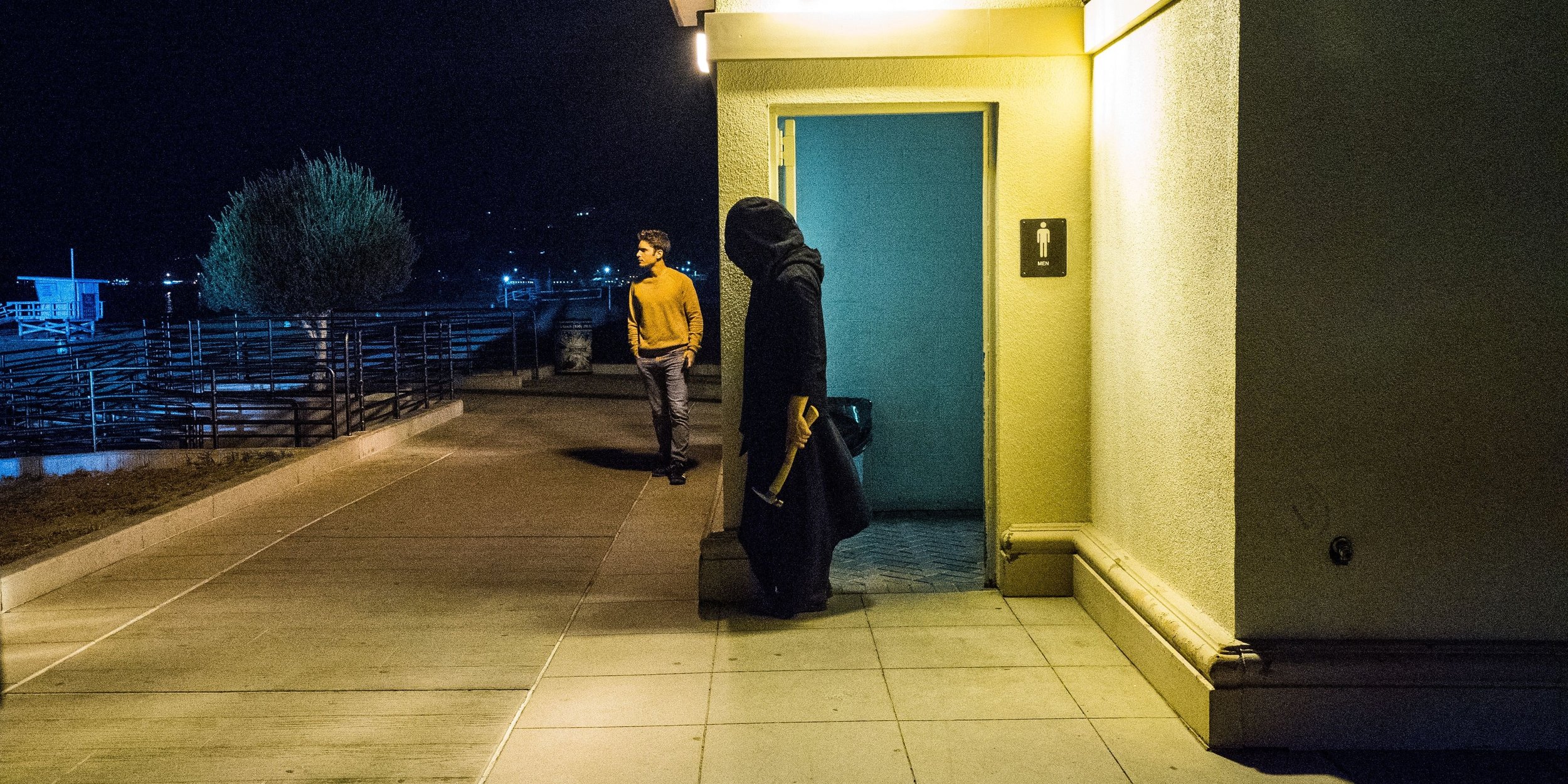
The only seemingly saving grace of what feels like is going to be an otherwise failure of a horror film, is the gruesome murder of Jake’s roomate. The makeup artists and special effects professionals working on this movie really managed to make up for some of the pitfalls in storyline progression and acting. When the hammer held by creepy horror icon Crispin Glover is swung, it does not disappoint.
While it seems as though things might be able to turn around, the movie keeps transitioning from what were supposed to be just serial killers to a skin-deep diversion of what is actually a cult that worships the water. I wish I could tell you more about the cult and the real purpose behind why they chose male victims or what water god they worship and make sacrifices to, but I don’t even know. We never actually get answers as to why, just that this is actually a cult and that killing Jake is their current purpose. Again, at least the gore makes up for this lack of explanation and need for purpose.
As for the smiley face graffiti? Yeah, that’s included, but again, no explanation. Although the movie seems to completely flop in its ending, I can’t help but wonder if the writers and directors had chosen to stick by the true-crime scenario or at least given us more about the cult, that it might have actually been alright. Unfortunately, like the conspiracy of the Smiley Face Killer themself, I guess we might never know.
Article written by Destiny Johnson
Destiny writes about true crime and thrillers. She likes movies and stories that make you question the world around you, more so than what makes you jump.