
The Entity (1982): Psychiatry, Hysteria, and Women’s Healthcare
Before reading this essay, I recommend first reading Part I of this series, in which I describe how Sidney Furie’s film The Entity tries to break down the male audience’s ability to distance themselves from the female victim of on-screen sexual violence by substituting a male attacker with a non-human spirit, unbound by our physical laws. This serves two purposes: first, to circumvent the subconscious male tendency to identify with the attacker, and second, to dissuade the belief that they might have any more control over the situation than Carla, had they been in her position.
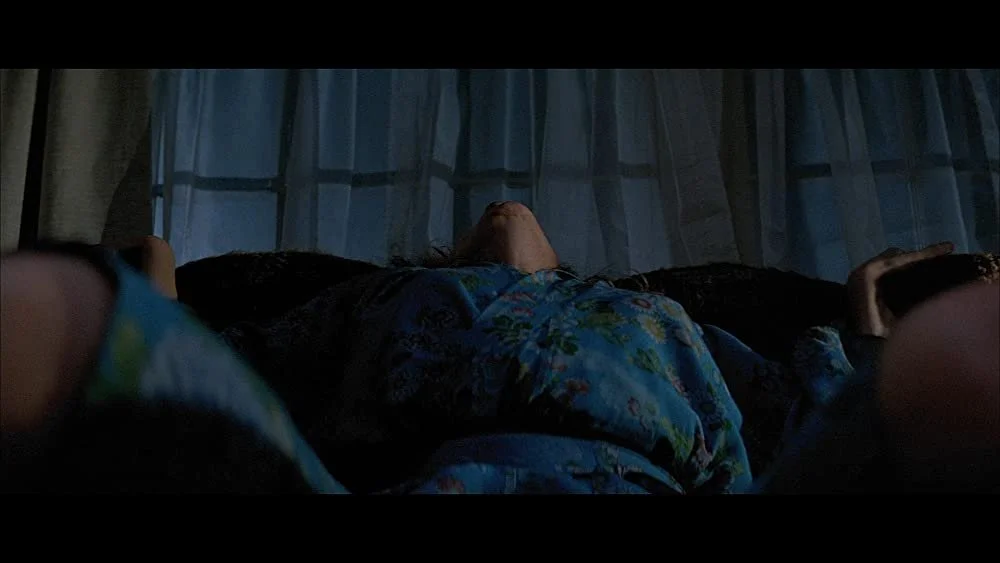
Carla seizes in The Entity.
With this essay, I’d like to explore the response Carla receives from the psychologists she consults, how it affects her character, and how it translates beyond the scope of the film’s world, following the centuries-old pattern in medicine of shrugging off symptoms felt by women as, at best, inconsequential, or at worst, evil or supernatural. The doctors in The Entity, led by Dr. Sneiderman, hardly attempt to disguise the frivolity with which they view her case, only beginning to take it seriously when they sense her turning to pursue pseudoscience rather than their own apparent expertise. Sneiderman, in particular, takes Carla’s rejection poorly, going to great lengths to try to convince her to return to his care, and under his control.
Dr. Sneiderman and the Diagnosis of Hysteria
Just before Carla’s first meeting with Dr. Sneiderman, the presumed entity takes control of her vehicle, sending her careening out of control through LA’s busy streets before being forced to an abrupt stop. Now visibly shaken, Carla sits in an examining room, and upon entering, Dr. Sneiderman immediately takes an accusatory, if clinical, position. Her story is interrupted by short, sharp questions, as if Carla were being interrogated by the doctor rather than diagnosed. “Where?” he asks. “By whom? … You mean it wasn’t a real man?” Even when she delivers hard evidence of her attacker in the form of bites and bruises, Sneiderman remains unconvinced of anything more sinister than “hysteria,” calmly lecturing Carla on the strange ways in which childhood trauma can manifest in adulthood.
His use of the term “hysteria” in such a self-assured way seats Sneiderman firmly in a branch of his field that is quickly becoming obsolete. As a diagnosable illness, hysteria dates back several millennia, used through the ages as a catch-all for any perceived emotional abnormalities observed in women. In the nineteenth and early twentieth centuries, hysteria received renewed attention in the research of a number of influential doctors including, most notably, Dr. Sigmund Freud. Early in his career, Freud asserted that hysteria was the result of repressed childhood memories of sexual abuse, which served as the basis for his seduction theory, which itself was abandoned and replaced with his later theory of infantile sexuality, from which the infamous Oedipus Complex stems. Despite the abandonment of his research into hysteria, Freud’s theory had a profound effect on women’s healthcare, lasting well beyond the removal of the term from the DSM in 1980, due to a decline in diagnoses and reports. Interesting then, that Dr. Sneiderman is so quick to brand Carla an hysteric, which, along with his prescription of a tranquilizer and “a long, hot bath” (each their own form of ineffective treatment, referring to the Valium boom of the 1950s and the rest cure of the late 1800s, respectively), are already outdated. More importantly, however, his adherence to this mode of thinking loudly signals his unwillingness to listen to what Carla has to say and his rejection of the validity of her concerns.
On the other hand, the doctor might be forgiven for his initial impressions based on the personal history Carla provides. “Terrible things did happen to me,” she tells him, “and I didn’t have a normal childhood, but how many people do, did you?” Unlike Freud’s patients, who were diagnosed using symbolism and coercion, Carla is forthcoming with her abusive past, and suddenly, the case is more interesting to Sneiderman. She tells him that she was terrified of her preacher father, “because when he held me, it wasn’t in the way a father should hold his daughter.” After her admission, Sneiderman begins drilling into Carla’s sexual history, uncovering a series of abusive relationships, beginning with Billy’s father, after she ran away from home. Certain he’s made a real breakthrough, Sneiderman convinces Carla to continue treatment with him, though, herself assured that he’s still missing the point, she makes him promise that if the problem isn’t her, then she will find her own solution.
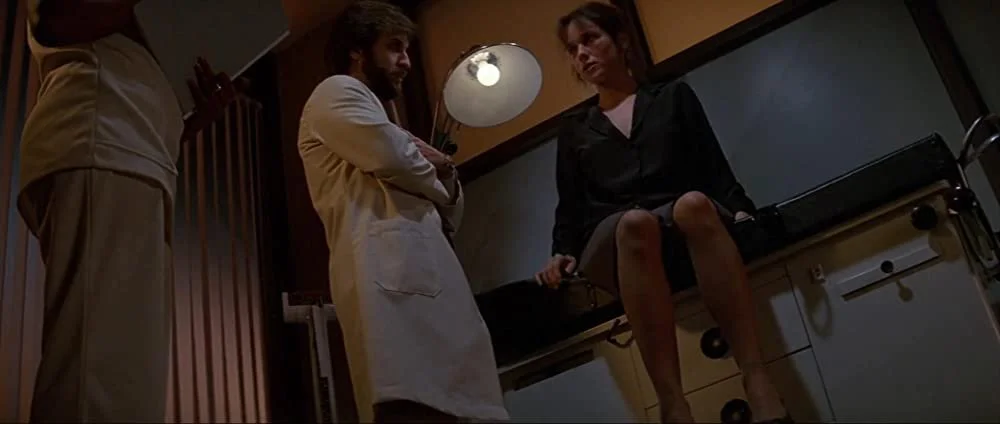
Barbara Hersey as Carla and Ron Silver as Dr. Sneiderman in The Entity.
Trauma, Epilepsy, and the Evidence Doctors Ignore
What happens next, though, gives cause to reassess Sneiderman’s diagnosis. Carla, sitting on her couch watching her children in the dining room making ice cream sundaes, is violently seized once again. Her children watch in terror as their mother writhes, mouth agape, limbs stretched, as the entity assaults her in front of them. Billy rushes to his mother’s aid but is thrown to the ground. When he gets back up, white arcs of electricity crackle from his outstretched fingers. Apart from this attempted intervention, however, Carla’s attack (shot in a wider frame than previous attacks, placing the audience in the position of spectator, like her children, as opposed to the other incidents in which we were meant to be in Carla’s shoes) looks strikingly similar to a severe epileptic seizure.
Like hysteria, epilepsy has its own long, difficult history in medicine, although due to the sudden and frightening presentation, epilepsy has endured thousands of years of stigma and mythologies; explanations of causes of the disease among common folk often lagged significantly behind the medical profession. While the Egyptians proved that epileptic fits could be a physiological response in the nervous system, it wasn’t until the fifth century B.C.E. that Hippocrates would theorize that epilepsy began entirely in the brain. A hundred years later, Aristotle would hypothesize a connection between epilepsy and sleep, an idea that would impact scientific thought for centuries to come. And while Aristotle’s concept of vapors affecting levels of consciousness seem silly today, epilepsy is associated with certain sleep disorders, including sleep paralysis, a half-waking nightmare that has long been associated with alien abductions or demonic visits. Similarly, spiritual causes of epilepsy—and in particular, demonic possession—would continue to dominate common reason, well into the nineteenth and even twentieth centuries, especially in the Catholic Church.
Women’s Testimony and Medical Authority
If Carla were suffering from epileptic seizures, it is entirely possible that visual and auditory hallucinations might accompany them, giving the impression of an invisible presence controlling her body. But Dr. Sneiderman never orders tests for epilepsy, already convinced of the psychosomatic nature of her visits. Instead, he takes Carla before a roomful of his colleagues who, in her presence at least, sound supportive of the trauma she’s been through. Once she steps out, though, it’s clear that the psychologists view her as little more than a case study. “She’s masturbating,” declares one doctor, “this entire circus, she’s invented it to cover up what every little girl does.” He continues:
“Look at the record. She believes that her father has incestuous desires. She falls in love with an adolescent, a typical full-grown kid. He tries to prove he’s a real man and he’s not. After which, she picks up with this Bob Garrett, a man old enough to be her father. You see a pattern here? Safe sex. It’s the story of Carla’s life. She’s consistently refused to get involved with the real thing…now for 32 years, Carla goes along very smoothly, and all of a sudden, she meets this fellow Jerry Anderson, and pow, she drifts into a Dionysian fantasy. Don’t you see? It’s exactly the kind of situation that can energize this sort of breakdown. A real man, mature. She wants the real thing, no more faking it with kids and old men. And faced with the real thing, Carla buckles. She falls back into an infantile reality.”
Not once do the doctors entertain the idea that Carla’s problem could be neurological. In fact, they seem to disregard entirely any physical evidence of her situation, instead concentrating solely on her personal history. Even when she insists they take into account the marks and bruises on her body, they attribute them to acts of hysteria and sexual repression. Further, not only do they place blame on Carla’s abusive past, but they are more than willing to project those abusive thoughts onto Carla, herself. She “believes” that her father has incestuous desires. She “fakes it with kids and old men.” Later, in a contentious confrontation, Dr. Sneiderman, emboldened by his colleagues, lays bare his theory. “So let’s use our imagination a little bit, okay? Your creature is a symbol, Carla. Let’s talk about your visitor friend, your visitor fantasy. He’s big, he’s strong, you told me, he’s so strong, he’s unbelievably strong. So why does he need his two little helpers, Carla? One big one and two little ones, right? Billy’s a big kid. He’s a good, strong kid. You’re having trouble with Jerry…” The insinuation is enough for Carla to end her trust in Sneiderman.
And yet the film’s language hardly rejects this explanation. In her first encounter after meeting the team of doctors, Carla is asleep when the molestation begins. She only wakes when she finds herself on the cusp of an orgasm and, recognizing what had just taken place, begins to sob, before smashing all the mirrors in her room in a blind rage. When Billy rushes in to her aid, she snaps at him, screaming “Get out!” It’s the only point in the film where she shows anger toward her son and, sandwiched between two scenes in which her psychologists remark on possible incestuous desires, the implication is clear. As a matter of fact, the original script was meant to be much more explicit, having included a dream sequence in which Carla takes her son’s virginity. While that scene may have been cut, the scenes that remain leave a clear, though far subtler complication to the plot.
The further exploration of this theme—or what remains of it after Furie’s edits—will resurface in the next article. For now, though, I think it’s appropriate to pause on what the team of psychologists show us about women's healthcare, namely, the lingering effects of centuries of systemic sexism in medicine, discounting the symptoms and testimonies of women to support preformulated conclusions. In Carla’s case, supposing, as the doctors do, that there is no paranormal root to her problems, their consensus actively ignores the physical evidence of potentially neurological causes of her attacks, instead digging their heels into a regimen that in no way needs to be mutually exclusive of a more thorough diagnosis. Though this message is complicated by the fact that the film makes clear that the entity does, in fact, exist, there’s a very convincing nondiegetic reason that Carla’s doctors may be on the right track, which we’ll take a look at in Part III.
Article written by Ande Thomas
Ande loves the intersection of sci-fi and horror, where our understanding of the natural world clashes with our fear of the new and unknown. He writes about monsters and foreign horror and can also be found over on Letterboxd.

Other articles you may enjoy…



Bones and roots adorn the walls of their dimly lit home. A mjölnir necklace hangs around K.’s neck as he hand carves incense into a small cauldron burner and a breathy soundtrack begins to play. This is a couple that is in tune—with themselves, with the natural world, and, as we will soon see, the supernatural world, as well.