A hand appears around a doorframe. We cannot see the person it belongs to, but the fingers have already begun to curl against the wood. Someone is coming into the room.
It is a small image, and an economical one. The hand establishes a presence without giving us much help interpreting it. A face might identify the intruder or show hesitation, anger, even embarrassment. Here, we have to watch the movement and wait.
Horror gets considerable mileage out of that gap. Sometimes the missing information is who the hand belongs to. Sometimes we know its owner perfectly well, and the problem is that they seem to have lost control of it.
Watching the Next Move
Hands attract attention because they do things. During a conversation, we might watch someone’s expression to judge their response. If they reach into a drawer, our attention is likely to follow the reach. Whatever they intend may be about to become an action.
Live dealer tables offer an oddly fitting modern example of the effect. Many of these streams keep the camera trained on the felt, so the viewer spends the whole session watching fingers turn cards and slide chips while the person attached to them stays mostly out of shot. Nothing sinister happens, yet the framing creates a faint tension anyway: every pause and every slow reveal belongs to a pair of hands with no expression to explain it. Horror filmmakers understood that discomfort long before anyone streamed a card game.
In a horror scene, that attention can become uncomfortable before the hand does anything threatening. Once a shot directs us toward the fingers, we begin looking for a reason. Why are they so still? What are they reaching for? Holding the shot makes an ordinary movement feel consequential. The film has given us time to anticipate something, without necessarily telling us what.
The Hands in the Walls
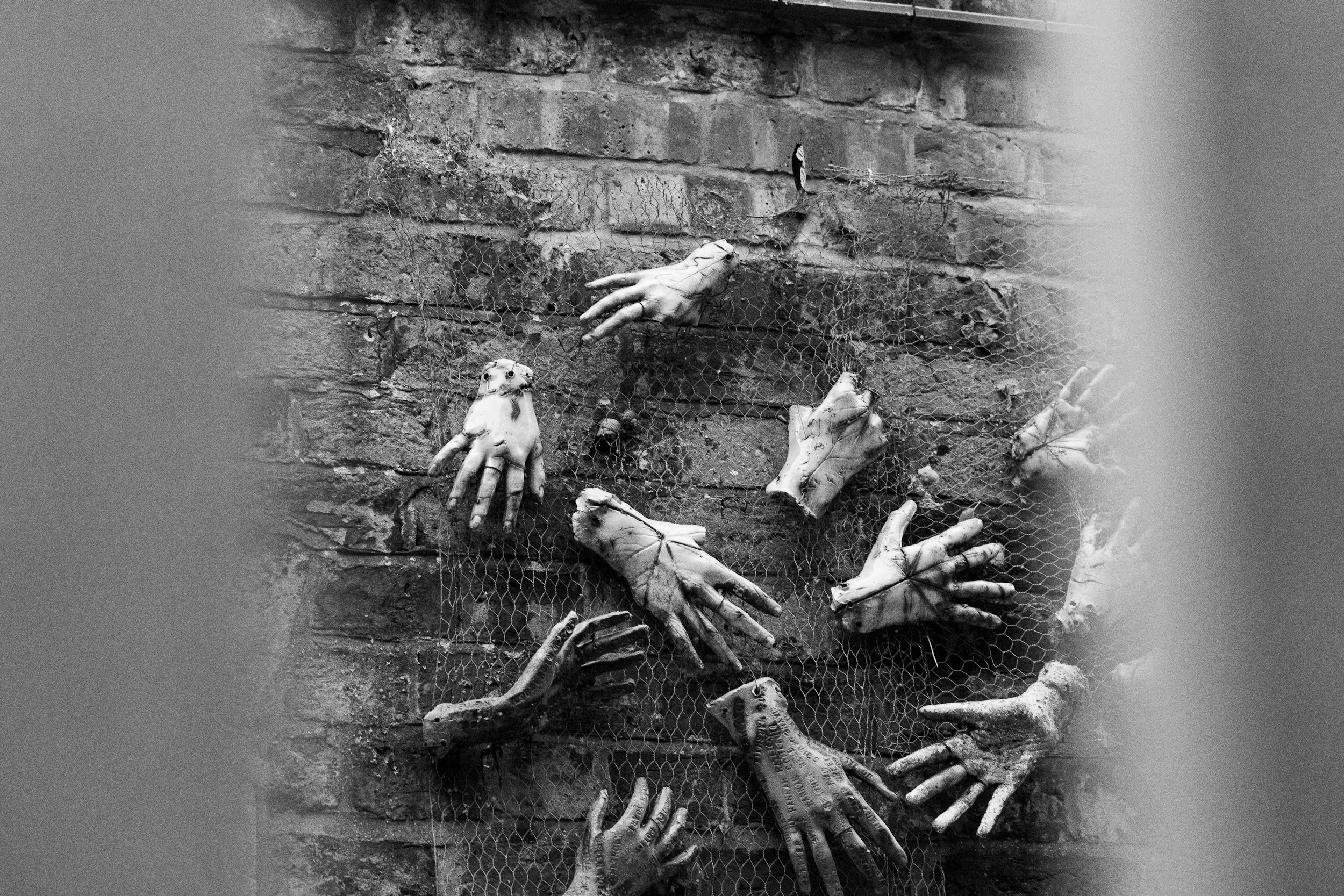
In Repulsion (1965), hands emerge from the walls and grab at Carol, played by Catherine Deneuve. There are no complete attackers to locate in the corridor. The grasping limbs intrude into the space around her, turning the apartment itself into a source of unwanted contact.
A visible assailant would give the threat a position and a body, however frightening that person might be. These hands make the danger harder to contain. Carol cannot simply put distance between herself and someone standing in front of her; the walls beside her have become unsafe.
The image also narrows the assault to the act of touching. We do not need a villain’s expression to explain it. The grasp is already a violation. Withholding the rest of the body concentrates our attention on what is happening to Carol, rather than on the identity or appearance of an attacker.
When Your Own Hand Becomes Suspect
The Hands of Orlac (1924) turns that uncertainty inward. Conrad Veidt plays a concert pianist who receives transplanted hands after a train accident and comes to believe they belonged to an executed murderer. He fears that the operation has given him more than replacement limbs.
For a pianist, this is an especially cruel suspicion. The hands through which Orlac expressed himself have become objects he watches for evidence of another person. An ordinary movement can now provoke doubt. Did he choose it? Could the next movement be something he would never willingly do?
Veidt’s performance makes the estrangement visible: Orlac scrutinizes the hands attached to him as though proximity has become a danger. The film does not need them to crawl away to make them feel separate.
Sam Raimi takes that possibility much further in Evil Dead II (1987). Ash’s possessed hand attacks him, and cutting it off fails to end the struggle. Once detached, it remains an opponent.
The sequence is funny partly because Bruce Campbell has to perform both sides of a fight while the hand is still attached. We can see the absurd physical predicament. But the joke depends on a nasty premise: the body Ash needs to defend himself is helping to hurt him. Amputation becomes a desperate attempt to establish a boundary between himself and the thing attacking him. Then the severed hand keeps going.
These films offer different degrees of separation. Orlac fears that his hands might carry someone else’s will; Ash has to fight a hand that plainly does. Neither requires the claim that hands reveal a person’s true intentions. Their horror comes from making that relationship unreliable.
Almost Familiar
Artificial hands introduce another kind of uncertainty. In his 1970 essay on the uncanny valley, roboticist Masahiro Mori described the discomfort of discovering that an apparently real hand is artificial during a handshake. Its appearance has encouraged an expectation that its texture or movement fails to meet.
A 2013 study of responses to photographs of hands found that prosthetic hands of intermediate human likeness received the highest eeriness ratings. The findings were qualified: within the categories, greater human likeness was associated with less eeriness.
That research does not explain every frightening hand in cinema. It does suggest why a familiar shape can become uncomfortable when something about it seems inconsistent. Horror effects can exploit that discrepancy. We recognize fingers and joints, then watch them move in a way our recognition has not prepared us for.
Taking the Hand
Talk to Me (2023) makes a severed, embalmed hand the means of contacting spirits. The teenagers have to grasp it to participate. A gesture associated with greeting becomes the physical beginning of possession.
That choice gives the ritual an intimacy a spoken incantation alone would lack. Someone has to reach out and maintain contact with an object that already resembles part of another person. The participants treat it as a thrill they can manage, but the gesture makes their willingness tangible. They are holding on.
Across these films, hands become frightening for particular reasons: they touch without permission, seem to carry an unfamiliar intention, or act beyond their owner’s control. A close-up gives us time to notice the trouble. The fingers move, and we look toward the face for an explanation. Sometimes it is outside the frame. Sometimes it looks just as frightened as we are.
Other Articles You May Enjoy…

Jane Schoenbrun’s debut novel turns content moderation and television franchises into interconnected forms of horror. Luna Gray examines its corporate exploitation, troubled characters, and sometimes overwhelming ambition.