‘Backrooms,’ ‘Rose of Nevada,’ and Job Anxiety Through Liminal Spaces
Somewhere in the last decade, a very specific kind of image colonized the internet. An empty motel pool lit by an unplaceable green glow. A hallway of identical doors, none of them marked. A mall corridor with the shops shuttered but the lights still humming. People started calling these images “liminal spaces.” These images spread on forums like contraband, as though viewing the images themselves could confer their eerie haunting onto the spectator. This rise in prominence of liminal spaces coincided with creepypasta—a term for internet horror stories that were often thought to haunt their readers (e.g., Slenderman). Then, in 2020, as COVID-19 plunged the world into lockdowns, everywhere became a liminal space. Videos circulated of New York City, Paris, and Tokyo—all eerily empty. Even after the COVID-19 pandemic, short-form video accounts dedicated to creating pseudo-empty cities persisted, with the comments evoking the “liminality” of these spaces. So, it’s only natural that in 2026, one of the most talked-about horror films in the English-speaking world built itself entirely out of liminal spaces. Kane Parsons’s Backrooms, adapted from the seven-year-old creepypasta that aided in popularizing liminal spaces, became A24’s highest-grossing film ever. In it, a 1990s furniture store owner, and subsequently his therapist, become lost in the non-Euclidean mazes of a fluorescent-lit office building that lend themselves to the title. Less widely publicized, Mark Jenkin’s Rose of Nevada sends a fishing crew out into a becalmed, ghost-haunted stretch of the Celtic Sea. Both films are, ostensibly, about getting lost in liminal spaces. Yet, underneath the sheen of nostalgic images and haunted aesthetics, these films can be understood as constructions contingent upon, and reflective of, societal anxieties towards job displacement.
What Are Liminal Spaces in Horror?
To understand why economic anxiety found a home in Cornish oceans and office hallways specifically, it’s necessary to trace where the liminal aesthetic, and subsequent cultural fixation, came from in the first place. Arnold van Gennep, a French folklorist, in 1909’s Les Rites de Passage (“The Rites of Passage”), first defined liminality, from the Latin limen, in the context of the middle stage of any ritual transition:
I propose to call the rites of separation from a previous world, preliminal rites, those executed during the transitional stage liminal (or threshold) rites and the ceremonies of incorporation into the new world post-liminal rites. (Gennep 21)
Thus, liminality was understood as an intermediate period in which one is in a state of having been deprived of one condition without yet arriving at the next. Only in later interpretations by Victor Turner was this definition sharpened into a description that better resembles liminal aesthetics. Turner described liminality as, “neither here nor there; they are betwixt and between [emphasis added] the positions assigned and arrayed by law, custom, convention, and ceremonial” (95). Yet, both Turner and Gennep were anthropologists; they were never concerned with architecture showing liminality. Fundamentally, liminality as a concept was about being a person whose old identity has been taken away and whose new one had not arrived yet.
It wasn’t until the 21st century that liminality became a shorthand for architecture that evokes eeriness, principally empty malls and endless hallways. While posts in the early 2010s referenced the term “liminal space,” a series of images depicting backrooms appeared on 4chan in 2018, triggering a rapid increase in the search interest of backrooms, culminating in today’s film (Figure 1). Yet, ask what a liminal space is, and definitions become vague. The original 4chan prompt originating the backrooms was simply entitled, “post disquieting images that just feel off” (qtd. in Cho and Underberg-Goode 17). As traced by Cho and Underberg-Goode, a folklore was built around the Backrooms. The yellow hue of the Backrooms was indicative of madness (see Gilman’s seminal The Yellow Wallpaper). Using terminology derived from video games, one “no-clips” into the Backrooms. It becomes, as Chornobylskyi et al. describe of creepypasta, a form of collective community, a modern-day folklore. Still, however, a liminal space was an aesthetic, lacking clear explanation. Thus, Backrooms is a direct product of internet image culture. Rose of Nevada, however, has no such lineage. It was shot on hand-processed 16mm, with no viral origin. Nonetheless, it offers the clearest thesis for what it means to be liminal.
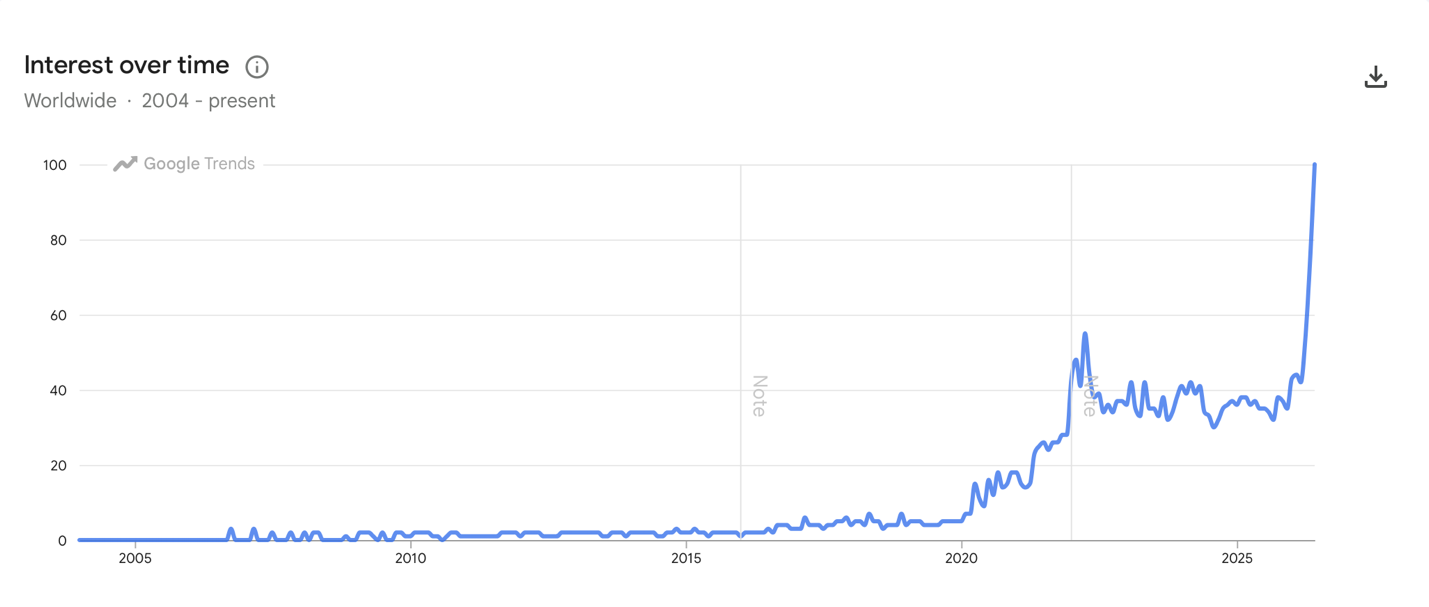
Fig. 1 Google Trends since 2004 of relative interest in the search term, “Liminal Space.”
Rose of Nevada: Fishing, Identity, and Industrial Decline
Mark Jenkin, the director of Rose of Nevada, has always been concerned with the Cornish condition—one of cultural decline. 2019’s Bait showed a fishing village getting swallowed by second-home tourism, while 2022’s Enys Men focused on the folk horror of the isolation of a Cornish island. In his most recent film, approaching the declining fishing industry in Cornwall, a time-travel device, specifically a boat, allows the protagonists to return to the industry’s heyday. Nick, a husband and father struggling to provide for his family, and Liam, an itinerant worker sleeping rough by the docks, begin in the present, or the Gennepian “previous world.” Both of their identities are fundamentally shaped by the collapse of Cornwall’s fishing economy. Upon returning to the past via their boat, they take on new identities. Liam, mistaken for Alan, is welcomed by Alan’s wife, embraces the security and belonging this borrowed identity offers. Nick, by contrast, is mistaken for Luke and desperately resists the substitution, missing his present-day family. Despite these challenges in blending into another family, both Liam and Nick are taciturn and easy to adopt the occupational identity of Alan and Luke, namely that of fishermen. Thus, liminality becomes tied both to their professions, but also to the divergent comfort in borrowing another identity altogether.
At the center of their journeys to the past is their once derelict boat, setting out to the vast ocean. The soundtrack, continuously stark, becomes grating when out at sea; the tone becomes horrific. Shots of winches, ropes, and chains appear during this transition, with one scene even containing a jump scare reminiscent of Mulholland Drive’s infamous diner scene. Together this lends a feeling of terror for both the audience and Nick and Liam when out at sea, rather than comfort. The vast sea, uncanny yet familiar, represents a liminal space, once home to the fishing industry and now devoid of ships, serving as a reminder of what once was. The ocean fully acts as a threshold space in the Gennepian sense. The protagonists begin in the present, or “the previous world.” They pass through the sea, a no-man’s land for fishermen—the liminal. Finally, they arrive in the post-liminal, or the past. Yet, in adopting this Gennepian phase-change, Jenkin’s film calls to light the eeriness of the liminal. Every time the ship is on the ocean, it is empty; through the focus on fishing throughout the film, the audience is constantly reminded of a past ocean full of boats, which is now full of nothing but the memory of boats. As Bryant asks in the chorus of the song “Cornish Lads,” “Well Cornish lads are fishermen, and Cornish lads are miners too. But when the fish and tin are gone, what are the Cornish boys to do?” Rose of Nevada, fundamentally, offers a fantasy: that of liminality-preceding a new identity. Yet, meta-textually, the viewer is reminded that it is just that—a fantasy. In the United Kingdom, since 1996, the number of fishers has fallen from around 20,000 to 11,000, down 45% (Uberoi et al.). What are the Cornish boys to do, indeed?
Backrooms: Empty Offices and AI Anxiety
Where Jenkin is looking backward at an industry already gutted, Kane Parsons is looking forward at one that hasn’t finished gutting itself yet. Parsons was sixteen when he started posting Backrooms footage to YouTube under the name Kane Pixels, and twenty when the feature made him the youngest director ever to open a film at number one. Yet, Backrooms is not unlike Rose of Nevada in its setting. Both are settings that are not inherently unsettling if not for encapsulating fears of economic precarity. This is not to say this is the only fear at root in both of these films. Indeed, the abandonment of the backrooms of office buildings and malls is itself unsettling. Yet, the aesthetics of abandoned carnivals or houses (i.e., haunted houses) have long since predated the trend of liminal spaces. Thus, both the ocean and the backrooms are liminal not just in their abandonment, but in serving as reminders of industries increasingly in ruin. In the United States, since the 1980s, the number of malls has diminished from 2,500 to less than 1,000, down 60% (Ginsberg). Are they unlike the Cornish boys?
Related reading: Continue exploring Backrooms and Gen Z Horror.
Beyond just decrying the lost futures of malls, Parsons’s films, advertently or inadvertently, suggest a concern towards artificial intelligence (AI). Even if not deliberate, the job choices of characters in Backrooms shed light. Those who enter the backrooms are white-collar workers. Clark, the first character, is a 1990s furniture store owner. Running “Cap’n Clark’s Ottoman Empire,” he longs for his past life as an architect; as he films a commercial for his store, he erupts in anger. Before entering the Backrooms, Clark is already sleeping inside his failing furniture warehouse; the Backrooms when he initially enters them, evoking his floundering business, are filled with displaced furniture and commercial signage. He is then transfixed by impossible floor plans; thus the Backrooms uniquely merge his previously abandoned identity as an architect, with his failing furniture store.
The 2000s were marked by what has been termed the retail apocalypse (Helm et al.). While multi-faceted in its causes, certainly a contributing factor to the decline of brick-and-mortar stores was large online shopping retailers (e.g., Amazon), which were only facilitated by the advent of computers. Following Clark into the Backrooms is Dr. Mary Kline, his therapist. Only a month after Backrooms’ release, the Wall Street Journal ran an article entitled, “Chatbots Are Replacing Therapists With Little Scientific Evidence Behind Them,” (Janin and Petersen). The office buildings of Backrooms are empty. AI, particularly large language models, differs from previous technological revolutions in being predicted to predominantly affect white collar professions (Orrell). Treating backrooms as allegorical for this looming threat of job loss, the offices are empty as all the white-collar workers have been fired, replaced by AI. All that is left is the ruins of American commerce, run entirely by machines that used to have people working at them.
While Kane Parsons himself has not stated the intent of the film, in his comments decrying AI usage within filmmaking, he described AI as a “cultural and economic rot” (qtd. in Garner). Even if Backrooms is not intent on evoking fears of AI in its liminal aesthetics, it has nonetheless tapped into a collective anxiety. Mercer’s most recent Global Talent Trends survey found that the share of workers who fear losing their job to AI jumped from 28 percent in 2024 to 40 percent this year. Similarly, the International Monetary Fund has estimated that 40 percent of jobs worldwide are exposed in some form to AI automation (Cazzaniga et al. 2). The jobs most at risk are not blue-collar jobs, à la Rose of Nevada’s fisherman; rather, they are scheduling and drafting duties that are constitutive of white-collar work. Yet while fears of job displacement are often discussed in relation to AI, rarely is it as simple as job loss. Autor, Levy, and Murnane’s seminal paper on dealing with expected economic turmoil owing to the implementation of computers shows that far more often task shifting occurs, wherein existing job titles take on new roles in response to automation (Autor et al.). However, Brent Orrell, a senior fellow at The American Enterprise Institute, argues against the assumption that job transformation will occur without issue; even with task-switching, workers will face “anxiety and feeling of dislocation.” Ultimately, he warns workers may be “left feeling adrift in the liminal space of the AI transition with no clear path to finding a new place in the economy” (Orrell). Applied to Gennep’s original concept, liminality represents awaiting a future expected to come.
Hauntology: Lost Pasts and Uncertain Futures
Neither film relies on this implicit conjuring of economic scarcity in order to generate scary visuals. Sigmund Freud’s unheimlich, or the familiar made strange, can aid in describing the uncanny feeling of both. Yet, it is only from these themes that both films become haunting. Haunting, in the sense of Jacques Derrida’s and later Mark Fisher’s conceptions of hauntology, which describes the discomfort of a future that never comes. Originally applied to Marx’s communism, defining the post-war period of Europe, Fisher broadened hauntology to a cultural theory. Mostly applied to architecture and music, Fisher split hauntology across two temporal axes: a haunting can occur by the “no-longer” (i.e., retro-aesthetics, Brutalism) and by the “not-yet” or lost futures (e.g., science fiction). In this dichotomy, Rose of Nevada is haunted by the no-longer (e.g., the fishing industry, a way of life, a full harbor). In it, all these past memories remain as ghosts: fishermen still lingering at harbors, telling stories in an empty harbor. Backrooms is haunted by the not-yet: empty office buildings that are occupied in the present but sit in precarity during the incoming wave of automation. Both are haunted by economic uncertainty.
Related reading: For a deeper look into hauntology in horror cinema, read The Hauntological in Lake Mungo.
The Horror of Losing Your Place in the World
The question remains: What exactly are liminal spaces? They are not caves or forests, nor are they ever depicted as such. These are spaces of the past. Yet, why are offices and airports deemed liminal when hospitals or prisons rarely are? It is useful to return to the earliest definitions of liminality. They were not concerned with architecture, or even abandonment. Rather, liminality was defined by a much more personal kind of horror: not knowing what one was anymore, because the thing they used to be (be it a fisherman or office worker) is gone, and nothing has yet replaced it. Thus, liminal spaces are just such. They are threshold spaces, ones that remind audiences of their own precarity in the world. Even before these films, the threshold that liminal aesthetics throughout their history are concerned with is often that of financial precarity, even if not explicit. For example, the 2000 book House of Leaves by Mark Z. Danielewski destabilized the home as a portending precursor to the 2008 financial crisis. Today, Rose of Nevada acts as a retrospective look at the diminished British fishing industry. In the case of Backrooms, it is a predictive anxiety. It has been argued that liminal spaces have found such prescience today due to “resonat[ing] with online communities [during COVID-19 by] . . . capturing how the modern world itself seems to persist in a permanent state of liminality” (Cho and Underberg-Goode 32–33). However, beyond this assertion, liminal spaces haunt because they call attention to the threshold. Today, as we deal with unprecedented economic upheavals, it is only through the liminal that the post-liminal can be obtained. Yet, in both Rose of Nevada and Backrooms, the post-liminal is never reached as solace.
-
Autor, David H., et al. “The Skill Content of Recent Technological Change: An Empirical Exploration.” The Quarterly Journal of Economics, vol. 118, no. 4, Nov. 2003, pp. 1279–333. Silverchair, https://doi.org/10.1162/003355303322552801.
Backrooms. Directed by Kane Parsons, With Chiwetel Ejiofor et al., A24, 21 Laps Entertainment, Atomic Monster, 2026.
Bryant, Roger. Cornish Lads. 1994, www.cornwallheritagetrust.org/wp-content/uploads/2017/12/Cornish-Lads-lead-sheet.pdf.
Cazzaniga, Mauro, et al. Gen-AI: Artificial Intelligence and the Future of Work. International Monetary Fund, 2024. Staff Discussion Notes. K10plus ISBN, https://doi.org/10.5089/9798400262548.006.
Cho, Day, and Natalie Underberg-Goode. “Lost in Liminal Space: The Internet Legend of the Backrooms.” Contemporary Legend, vol. 3, May 2025, pp. 16–35.
Chornobylskyi, Anton, et al. “Social Sharing of Emotions in Social Media System on the Example of Creepypasta on Reddit.” Information & Media, vol. 96, May 2023, pp. 65–79. www.journals.vu.lt, https://doi.org/10.15388/Im.2023.96.66.
Daskalaki, Maria, and Maria Simosi. “Unemployment as a Liminoid Phenomenon: Identity Trajectories in Times of Crisis.” Human Relations, vol. 71, no. 9, Sept. 2018, pp. 1153–78. SAGE Journals, https://doi.org/10.1177/0018726717737824.
Derrida, Jacques. “Spectres of Marx.” New Left Review, no. I/205, June 1994, pp. 31–58.
Fisher, Mark. Ghosts of My Life: Writings on Depression, Hauntology and Lost Futures. Simon and Schuster, 2014.
Garner, Glenn. “‘Backrooms’ Director Kane Parsons Calls AI ‘Genuinely Harmful.’” Deadline, 4 June 2026, deadline.com/2026/06/backrooms-kane-parsons-calls-ai-genuinely-harmful-1236940532/.
Gennep, Arnold van. The Rites of Passage. With Gabrielle L. Caffee and Monika Vizedom, Routledge and Kegan Paul, 1977.
Ginsberg, Simone. “The Death (and Revival?) Of the American Mall.” The Science Survey, thesciencesurvey.com/news/2026/01/13/the-death-and-revival-of-the-american-mall/. Accessed 15 Aug. 2026, News.
Helm, Sabrina, et al. “Navigating the ‘Retail Apocalypse’: A Framework of Consumer Evaluations of the New Retail Landscape.” Journal of Retailing and Consumer Services, vol. 54, May 2020, p. 101683. ScienceDirect, https://doi.org/10.1016/j.jretconser.2018.09.015.
Janin, Alex, and Andrea Petersen. “Chatbots Are Replacing Therapists With Little Scientific Evidence Behind Them.” Wall Street Journal, 30 June 2026. Health. www.wsj.com, www.wsj.com/health/wellness/chatbots-are-replacing-therapists-with-little-scientific-evidence-behind-them-584a1532.
Mercer. (2026). Global talent trends 2026: Solving the human–machine equation, www.mercer.com/insights/people-strategy/future-of-work/global-talent-trends/.
Orrell, Brent. “The Future of Work Is a Liminal Space.” American Enterprise Institute - AEI, 23 June 2025, www.aei.org/domestic-policy/the-future-of-work-is-a-liminal-space/.
Rose of Nevada. Directed by Mark Jenkin, With George MacKay et al., BFI Films, Bosena, Film4 Productions, 2026.
Turner, Victor, et al. The Ritual Process: Structure and Anti-Structure. Routledge, 2017, https://doi.org/10.4324/9781315134666.
Uberoi, Elise, et al. UK Fisheries Statistics. House of Common Library, 11 Oct. 2022.
Underberg-Goode, Natalie. “Introduction to Creepypasta, Digital Horror, and Legend Formation Across Interactive Media.” Contemporary Legend, vol. 3, May 2025, pp. 1–15.
Article by Kit Neikirk
Kit Neikirk (he/him) is an MA candidate in Health Humanities in the Centre for Multidisciplinary and Intercultural Inquiry (CMII) within the School of European Languages, Culture and Society (SELCS) at University College London. As an academic, his research is concerned with how artificial intelligence impacts healthcare delivery and how illness is differentially expressed across media.

Other Articles You May Enjoy…

How Backrooms and Rose of Nevada use liminal spaces to explore job insecurity, disappearing industries, and the fear of losing your place in the world.