
WSB x Moving Picture Review: Beetlejuice Beetlejuice
Michael Keaton was right: “The juice is loose.”
In an epic return since his original debut in 1988, Beetlejuice is back after years of nostalgic appreciation. Having made many appearances, such as in the late ‘80s animated cartoon series and more recently, the touring stage musical, Beetlejuice as a character and the classic tale it was born from has kept the spirit of the bio-exorcist alive and well. While I’m not sure many of us were expecting a sequel from director Tim Burton, the trailers did a great job of building our anticipation while saving viewers from any major spoilers for Beetlejuice Beetlejuice.
Written by Alfred Gough and Miles Millar—the screenwriters of Wednesday—it is no shock that in addition to the return of Keaton (Beetlejuice), Winona Ryder (Lydia Deetz), and Catherine O’Hara (Delia Deetz), the film’s casting director Sophie Holland would also decide to pull in Jenna Ortega to play Astrid, Lydia’s angsty teenage daughter. Yes, while the mother-daughter disconnect continues to be a theme in the sequel, there aren’t many moments in the film that feel like a rip-off of the original. Most nods to Beetlejuice are heartfelt and show that while much has changed about our characters since we last saw them on the big screen, they’re still managing to overcome anything life—or the dead—throws at them.
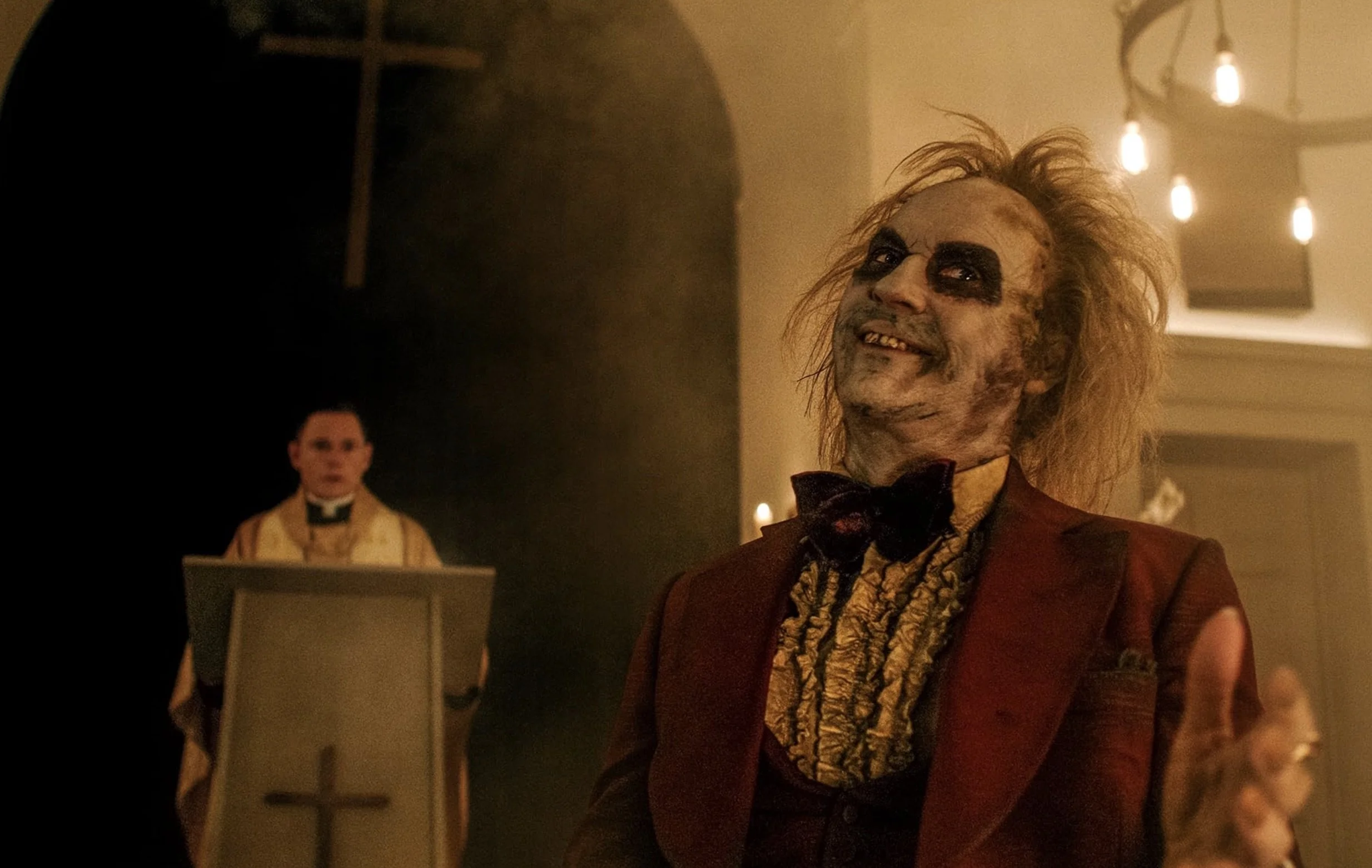
Michael Keaton as Beetlejuice in Beetlejuice Beetlejuice, image via IMDb.
During the opening credits, viewers are nearly transported through time by the music of Danny Elfman’s soundtrack as the camera sweeps over what feels like the attic model of Winter River, Connecticut (complete with the deceased Maitland couple placed by their yellow car and the red covered bridge where they died), only to transform into the real town in a seamless shot that feels both natural and transcendental. From here, reality hits and we learn quickly that Lydia has turned her strange and unusual abilities of being able to see the dead to new heights and has given showtime a whole new meaning in her TV show titled “Ghost House.” It is also here that we meet her toxic-boyfriend-turned-producer-and-almost-husband Rory (Justin Theroux). As the film goes on, you’ll find that in seemingly trying to chase the vibes of Otho (Glenn Shadix)—swapping a self-defined architecture aesthetic and séance professional for a spotlight-seeking guru for overcoming trauma—Rory offers minimal comedic relief and struggles to be a meaningful character. In a film that thrives on false pretenses, Rory’s lack of confidence makes it all too easy for viewers to see right through his false earnestness to be there for Lydia, or Astrid, and instead comes off as annoying and all too fake.
Since her days of abstract sculpting, Delia has also evolved, progressing her brand as an artist to more modern and contemporary pieces. Still very much self-obsessed, she calls Lydia to her studio where although her planned graffiti installation has become a failure, she has also learned that her husband, Lydia’s father, has passed away. No stranger to loss, having experienced her relationship with the Maitlands from the first film, the loss of her husband some years ago, and her professional work with ghosts, Lydia’s expression mirrors the hollow being we’d seen in her teenage years. Although grief appears more as a shock than a profound wound among the two women, they know that they will need to break the news and retrieve Astrid, who hasn’t attended a funeral since her father’s passing and is still very much detached from her family and their antics, from a boarding school for girls.
In returning to the staple white house on the hill, now covered in a silky black fabric overlay for mourning, the opening plot and subplots of the film really start to unfold. Like a sandworm lurking through fine grains, viewers are taken deeper into our main characters’ lives while simultaneously exposed to several side stories that will inevitably weave themselves together. Threading the needle is none other than Beetlejuice himself, and where 30 years in the afterlife is more or less a blink of an eye, Beetlejuice remains the same unhinged nuisance he’s always been. Decked out in his iconic pinstriped suit, sunken eyes, and green and rotting moss-lined frazzled hair, Beetlejuice dishes out quick-paced one-liners, cheesy but charismatic jokes, and a few shape-shifting tricks that genuinely set the bar for the film’s overall humor.
Having been a long-time lover of Tim Burton’s films and his art, I invite everyone to make a bioexorcist cocktail and head out to the movies for a notable beginning to the 2024 spooky season. Unlike some movies that have clawed at the opportunity to make another buck from a nostalgic classic, Burton presents this sequel with respect to its returning characters and a curious, yet profound and comedic exploration of the underworld.
While many of the sets in Beetlejuice Beetlejuice will feel comfortingly familiar, evoking the original film's quirky charm, others are fresh and seem to have sprung directly from Burton’s sketchbook, bursting with his signature visual style. The sense of childlike wonder, reignited and reimagined by the vibrant cast, speaks to the film's enduring ability to capture a handcrafted, tactile aesthetic. It manages to feel both nostalgic and novel, maintaining its roots in the original while offering a visually dynamic experience that continues to evolve.


WSB x Moving Picture Reviews is sponsored by the Pittsburgh Moving Picture Festival. The Pittsburgh Moving Picture Festival celebrates both the art of cinema and the rich motion picture exhibition tradition of the City of Pittsburgh. Our goal in this series is to highlight new and upcoming genre films and, wherever possible, to support local, independent movie theaters in the process.

Article Written by Destiny King
Destiny is a supporting member of the Horror Writers Association who’s been working in B2B publishing for nearly a decade. Her favorite horror subgenres are true crime, found footage, and psychological thrillers. Find her on Letterboxd.

Other Articles You May Enjoy…
![[Movie Review] Avalon Fast’s “CAMP” is the Latest in the New Wave of Transgressive Filmmaking](https://images.squarespace-cdn.com/content/v1/5d3e481bc5a6e40001b215a8/1782401219629-WQRPE1S2P04BE4SNHMJ2/mPAUB3_Q.jpeg)

After a traumatic labor, Saga wakes to the cries of her newborn son in his bassinet on the other side of the room. While most watching will likely pick up on baby Kuura’s negative reaction to sunlight—I couldn’t stop thinking about the pain it would have caused Saga to get up and gather her son herself. The irony of thinking about her struggles is further amplified by the cries and almost animalistic moans and later-described hairy body that are all chalked up as “normal” and that the couple has a perfectly healthy babe. After all, everyone insists that every baby and every pregnancy… is different.