
Cabin in the Woods: The Love/Hate Relationship with Horror Cliches
When it comes to horror movies––specifically in slasher cinema––clichés tend to serve almost as a stamp of approval. Slashers often require cheap jump scares, torture, stereotypical young adults, drugs, sex, and some sort of opportunistic set-up. (Say, a house to themselves, or in our film of discussion, a cabin in the woods.)
After experiencing some financial difficulties, screenwriters Joss Whedon (Buffy the Vampire Slayer [1997-2003]) and Drew Goddard (Cloverfield [2008]) revealed Cabin in the Woods, which was filmed in 2009 and released in 2012. As a conclusion of the duo’s writing, viewers were met with something beyond a simplistic single-genre construct. In fact, Cabin is just as much of a comedy or takes on elements of science fiction, as much as it is a “loving hate letter” to horror. The point? According to an IndieWire interview with Goddard about the writers’ choices, he proclaimed: “Certainly the germ came from horror movies but we also don’t like it when they’re bad...For me it was very important that it wasn’t just a movie about other movies.”
“What was interesting was the notion of why is there this horrific part of our society? Why do these movies exist? Why do we feel the need to objectify and destroy youth? These are questions that expand outward from the central thesis and that informs where we wanted to take this movie.”
In expanding on Goddard’s thoughts and summarizing the interview, along with other reports, the two conveyed how they were tired of how movies during the decade had chosen to evolutionize horror cinema. That, instead of progressing forward and evolving, it was as if horror films emerging after the millennium were shifting thier focus on torture porn as a means to appease viewers. As just a few examples, think of Eli Roth’s Hostel (2005), James Wan’s Saw (2004) and other sequels, Rob Zombie’s The Devil’s Rejects (2005) and Marcus Dustan’s The Collector (2009). Whedon and Goddard wanted to end the trend and give meaning back to the genre.
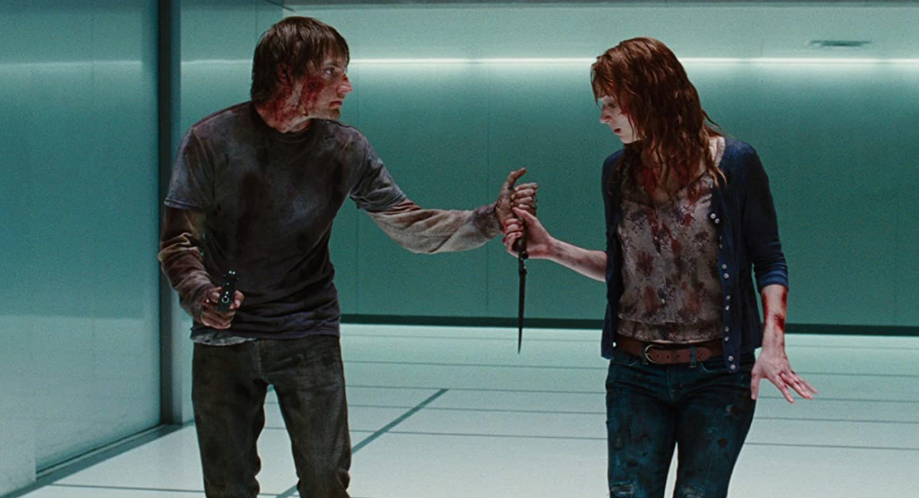
Cabin in The Woods, 2012
In Cabin, our story starts off with a group of friends, all meeting cliché archetypes: Curt, the jock/hero-type (Chris Hemsworth); Jules, the dumb blonde/bad girl (Anna Hutchison); Dana, the good girl/virgin counterpart (Kristen Connolly); Holden, the smart and handsome fellow (Jesse Williams); and Marty serving as the comedic relief/stoner (Fran Kranz). While I can’t read the minds of our writers, I think this choice was particularly interesting, as it so obviously stays true to slasher cinema. In tackling one of Goddard’s questions as to why these movies exist, I view the choices like a game. From the gate, a viewer is able to analyze and predict one’s chances of survival. In any slasher with a group of Breakfast Club-like characters, you can almost always bet that the couple (usually the jock and blonde) will die first. It’s practically an unwritten rule, not just because of their cliché characteristics, but that they’re most likely the first to introduce a sex scene, and sex is like signing your death certificate. Although ultimately, the point of the movie is to keep you guessing and find purpose in its structure. Why does the killer kill? Where did the monster come from? Who made the rules and why is whatever happening, happening?
With so many additional questions to explore and contemplate while watching a horror film, the real kicker in this movie is that over and over, and over again, it provides the viewer with twists and turns about an unfolding truth that doesn’t lie in facing ’80s-generated slasher clichés, but is instead pointed out through the brief introduction to our story’s main orchestrators Gary Sitterson (Richard Jenkins) and Steve Hadley (Bradley Whitford). White, white-collared males, the two can easily be associated with some type of government organization, but one could also go as far to say that the duo serves as representation for the film’s screenwriters themselves. This complex and unique level to the story serves to answer yet another question of Goddard’s: “Why do we feel the need to objectify and destroy youth?” Throughout the movie, we learn more about our orchestrators’ plan and purpose for the cabin trip gone wrong. That in horror, there are deeper stakes than just watching our characters die in a gory fashion, that their life is worth more than that. This is what screenwriters were trying to give back to film in the first place. Horror movies need more meaning than just well-crafted bizarre torture porn and human destruction; they need metaphor to make sense of the madness.
From this point forward, the viewer is paralleled with both the film’s cliché construct, but also the desire to know more about the work going on behind the scenes that plays a part in each character’s fate. From another ominous gas station owner, to creepy basements and storied artifacts, the film keeps you guessing and contemplating the differences between the fate of horror and a character’s free will. It returns not only to traditional horror suspense, but packages it in wrapping paper made of laughter and a bow of confusion. As the viewer, we are forced to enjoy and wait out for the answers we desire most and experience the end of something that we couldn’t have possibly ruined for ourselves.
As I watch the credits rolling, I feel like the movie deserves applause for its work to break horror norms and tastefully points out both what we tend to love and hate about the genre, all while making us laugh at essentially ourselves. While sometimes it feels good to figure out a story before its end, it also feels good to be stuck in awe and wonder. If you’re looking for a horror movie with purpose, or a horror movie that goes as far as to give other movies purpose, Cabin is worth the watch.
Article written by Destiny Johnson
Destiny writes about true crime and thrillers. She likes movies and stories that make you question the world around you, more so than what makes you jump.



Filmmaker Bari Kang discusses Itch!, from its practical gore and zombie influences to filming in his own NYC store and directing his daughter.