
What is True Love’s Sacrifice? Reviewing ‘Death of Me’
Directed by Darren Lynn Bousman and released in 2020, Death of Me takes its viewers on an intense and intriguing journey created by screenwriters Ari Margolis, James Morley III, and David Tish. While I admit that I was skeptical of the movie at first—mostly because of its acute pacing—my curiosity and interest in the story’s origins later won me over, as I was better equipped to connect the pieces that could have been easily missed without a strong focus on detail.
The film opens up with American couple Christine (Maggie Q) and husband Neil (Luke Hemsworth) waking up in their Thailand-based Airbnb—which looks to be a complete wreck with dirt and what appears to be blood, smeared across the room—without any recollection of what happened the night before. A local man approaches the glass windows of the couple’s bedroom, knocking and smiling; he unexpectedly leaves them with some fish he caught on the bay. Confused, Christine realizes they are late for their ferry to the mainland, leaving them no time to sort out what had happened, or what was happening. The couple quickly brushes off the confusion and strange encounter as they pack up.
A local weather station warns of an approaching typhoon in the background.
Conflict only continues to build as the couple’s cab driver attempts to take them in the wrong direction, away from the boarding dock. Christine also discovers that both of their passports are missing, as well as her phone, and while they search for their travel IDs, the ferry crew packs their luggage, leaving them with even less than before.
Back to where they started their hectic morning, Neil decides to go through his phone for clues about what might have happened the night before, discovering a two-hour-long video. In watching the footage, the two appear to have ended up at a local bar, celebrating their last night on the island. Seemingly wrapped up in the culture and pretty intoxicated in the video, Christine calls the waitress over as she’s offering drinks to everyone. The waitress pours what she calls “Island Magic” into both Christine and Neil’s cups and later gifts Christine a necklace, informing her that it will bring her “good health.”
Still unable to recall their visit to the bar, they continue to watch as the look on Christine’s face in the recording gives the impression that something is not right. The video goes black and some time later we see Christine and Neil drunkenly engage in intercourse, which quickly turns violent, resulting in what looks to be Neil snapping Christine’s neck and then burying her in a shallow grave. Seemingly impossible, as the two sit watching the screen together. More tension arises as they struggle to piece together what happened and how they’ll get home.
It is here that the film’s title takes over the screen, letting us know that the conquest to find the truth has only just now begun.

Now, I don’t want to walk you through the movie scene by scene, but the opening credits are very important if you are to continue through this mysterious island horror. Later in the movie, viewers discover that the mystery drink the couple consumed is called “Nam Mun Prai”—a hardcore Buddist drink brewed in the streets of Thailand reported to cause hallucinations and, if taken in excess, even death. Also known as corpse oil, it can only be created during a Thai ceremony when the body fluids are extracted from a beautiful young pregnant woman who died a violent death.
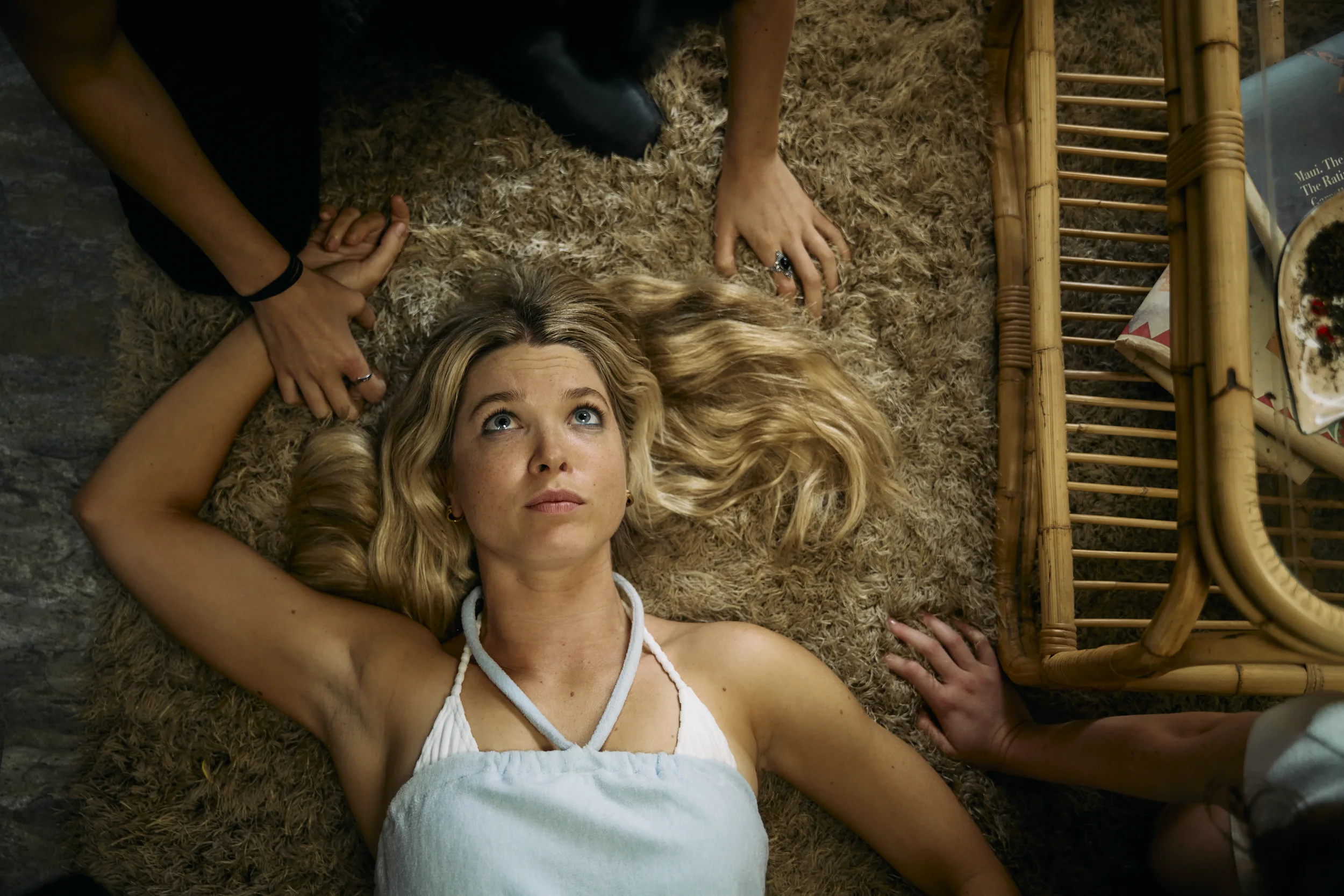
For Christine and Neil, the corpse oil took over the mind, inspiring life to be created, but also causing Neil to kill Christine and bury her soul in the soil, connecting what was to be her pregnant body to the island. In both the story of how this oil is crafted and in Christine’s own death, we see the connection in that her wandering spirit becomes hopelessly confused and overthrown by feelings of grief. As Christine stumbles back and forth between life and the spirit world, her necklace is the only thing actually keeping her from death and is the reason she keeps encountering the faceless spirits. Once connected to the spiritual plane, they are capable of preparing her for the final ritual.
This is also why, then, that every time Christine takes off her necklace, she almost immediately becomes sick. Having thrown up grass and mud, when told by a local doctor that she’s probably still hallucinating, Christine continues to suspect that something much, much worse is going on.

As mentioned—the deeper purpose of subjecting Christine and Neil to the corpse oil—was to encourage the creation of life, as according to the film and my own research into some Thai beliefs, where pregnant women feature prominently. For hundreds of years, the culture had been burying pregnant women under city pillars, or lak meuang, in most cities of Thailand. While legends tell of a young girl who was eight months pregnant when she was buried alive with the city pillar in Baan Muang Mai, other stories have suggested that the founding of a new town required voluntary or involuntary sacrifice—most of these being people whom were also pregnant—by being impaled under the posts as a means to protect the town’s inhabitants.
Of course, no one has excavated the sites of the pillars in real life, as the act would only disturb the benevolent spirits who have been guarding these places for generations.
Despite the film receiving some less-than-favorable reviews when it made its debut, it gave me the feeling that surely, there was some purpose behind the decisions to bring back island horror or the fear of cultural otherness and offerings, such as Nam Mun Prai, in the case of this film. Although different from other takes on island horror, such as Lord of the Flies (1990) or Fantasy Island (2020), which both give the viewer the feeling of being stranded or worse, damned, Death takes my mind back to movies such as The Beach (2000) and Shutter Island (2010), in that everyone inhabiting the island knows something that its visitors do not. Regardless of cultural or ritualistic reasons, or both, the ultimate goal is to keep the “outsiders” in the dark about whatever journey they’ve been destined to embark upon.

What really tied everything together, for me, was that given the movie first premiered in 2020, I found that in 2017 and 2018, both the Independent and The New York Times covered articles on Thailand’s island Koh Tao. While the island was once described as a place of paradise, boasting crystal-clear waters and a bucolic countryside, it later developed a more sinister reputation after at least nine European tourists died or disappeared over a roughly four-year period. The tales of these misfortunate happenings range from horrific vehicle accidents, scams and frauds, to highly suspicious deaths, suicides, stabbings, and even rape.
In further reading, what stuck out to me was, although the name of the island is never mentioned in the film, according to conversations in the movie, as well as signs at the ferry dock, the trip to the mainland is about two hours. The same can be said for those traveling from Koh Tao to Koh Samui. Although Koh Samui isn’t Thailand’s mainland, it is the largest Thai island within the Gulf. The island is also noted to have an abundance of marine life, which, over time, has attracted a small expat community of around 2,000 people—very similar to the small community that seems to inhabit the island in our feature.
By making even the slightest connections to these happenings and what’s being portrayed in the film, it no longer felt as though the movie was highlighting this fear of cultural otherness just because. Instead, it seemed as if the writers were creating a deeper sense of horror in that these events were so recent, only going a step further in that it does associate cultural beliefs and history with why Christine must ultimately die. Unlike the true crimes that had been committed only a few years before, a purpose is revealed; a true love’s sacrifice, if you will. While other reviews have rejected the film’s style, saying that it is too confusing for the viewer and provides no real moments to catch one’s breath in order to define what is actually happening, I found its meandering to be its strong suit, especially when I went back to watch it a second time.
Circling back to the typhoon approaching on the local news station at the beginning of the film, in addition to the growing warnings to evacuate throughout the film, many faithful islanders stayed, as they believed that the sacrifice, Christine’s sacrifice, would save them. The island had supposedly never been hit by a typhoon in over 200 years.
While I’ve left some holes in what happens between Christine’s death, her pregnancy, and ultimately her decision to save the island from natural disaster, the film offers some really good scares, both in terms of jump and gut-wrenching scenes. Despite taking on the traveling-to-a-foreign-land trope, and questioning cultural otherness and spiritual beliefs sprinkled with island magic, overall the film was a psychological journey that ultimately made me want to know more. If you're looking for something that’s both anxiety-inducing and full of terror, catch Death of Me on Netflix.
Article written by Destiny Johnson
Destiny writes about true crime and thrillers. She likes movies and stories that make you question the world around you, more so than what makes you jump.

Other articles you may enjoy...

The term “social horror” seeks to highlight and challenge real-life injustices and everyday violence. It moves away from the notion of the supernatural monster to emphasize the human being as the primary source of violence and cruelty against others.