
Transcending Boundaries: Shadow in the Cloud (2020)
Shadow in the Cloud, directed by Roseanne Liang and released just last year, serves as both an action-packed popcorn flick that’s visually reminiscent of a number of other WWII movies, while also renewing the image of the American and expanding the definition of what it means to be one, to serve, and what is worth protecting.
Spoilers ahead!
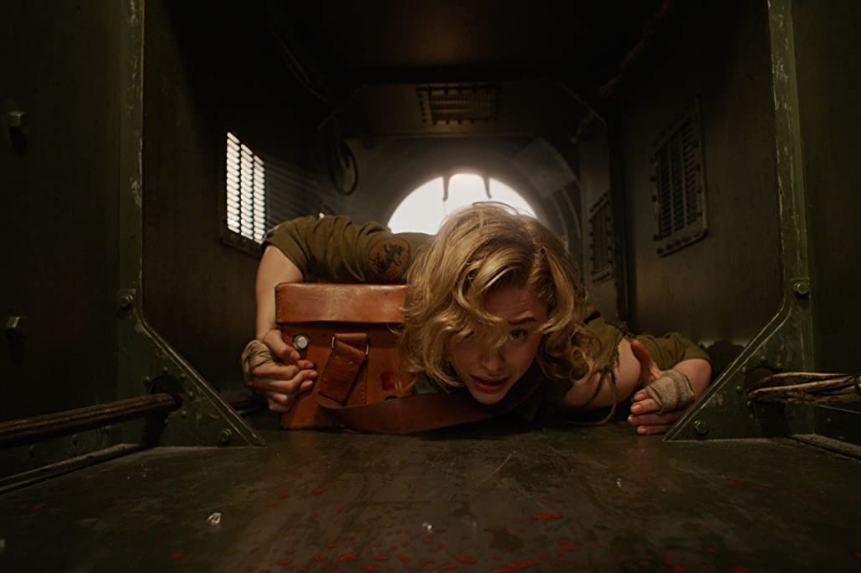
Late one cloud-covered evening, accomplished pilot and airplane mechanic Maude Garrett (Chloë Grace Moretz) turns up as a last-minute assignment aboard the plane The Fool’s Errand, hauling paperwork and a top-secret package that sits snugly over her front and middle. Looking as if she has a broken arm and completely unable to discuss her mission with the crew due to its top-secret status, Maude is soon relegated, to the hoots and hollers of an incredibly chauvinistic aircrew, to the Sperry Ball turret, with nothing between her and a death drop but glass, metal framing, and her seat. She’s had to leave her top-secret package up in the cabin with one of the only crewmembers, Walter Quaid (Taylor John Smith), who does not speak to her as if she’s meat. But things take a turn for the worse when Garrett spots enemy aircraft straight beneath them, and something out on the plane itself that she isn’t sure is real.
For any woman or feminine-presenting person, the first 30 minutes is an almost painful watch: Garrett is stuck in complete, almost claustrophobic confinement, with only the monkey-like hoots of the aircrew for company. But being a soldier, she keeps her cool, her temper only slipping when danger continues to escalate. Liang’s writing sharply hits all the right notes of the insults and verbal jabs women put up with in the claustrophobia of their own aim to better their stance in life, with many of the aircrewmen refusing to use her title, Pilot Officer, relegating her to the label of “Miss Garrett,” and reminding her of their own titles when she does not use them.
And with the sledgehammer delicacy of most action movies, if you were paying attention to the location of the bag on Garrett’s body toward the beginning of the film, it would come as no surprise to us when we find out she’s pregnant. The “top-secret mission” is the last bid of a desperate mother striving to save her baby and escape an abusive marriage by serving her country. Though I initially wished that the writing had committed fully to the “top-secret mission” perspective, I am very well aware that action movies are not the place for philosophical nuance. But here, too, Liang’s stand on keeping the baby in the story and asserting that Garrett is a mother, feels like a genuine stance that flips the script on how mothers are so often portrayed in action films. In film, motherhood, especially during pregnancy or with a very young child, is often relegated to the sidelines, looked down upon as a disability. To this, Shadow in the Cloud says, loudly and with gusto, “Yeah, so what if Garrett is a mom?” In Liang’s script, Garrett is both an excellent soldier and a mother, but her dedication to her child is something to be cherished. Protecting the vulnerable, and allowing oneself to be brave enough to be vulnerable, are both more than worth the effort it takes to keep them safe, but are themselves part of what it means to serve.
The supernatural presence aboard the plane—what we learn is a gremlin, as in someone else’s mistake given physical manifestation that looks something like a terrifying version of a kinkajou—provides an additional layer of tension, but also a sharp moment of commentary. If only the crew had listened to Garrett’s warnings—Garrett, who continued to try to help even though she was called hysterical and dismissed, who continued to try to serve her country from the womb of a damaged Ball turret—the plane wouldn’t have become so damaged. Even more than that, though, the gremlin stands in as a mockery of what these crewmen do not see and hear because of the limits of their own overinflated egos and privilege.
In this circumstance, Garrett being an American certainly does not read as incidental, either. How many WWII movies exist with Americans depicted as the ballsy heroes who take no guff from anyone, who ride in to save the day? Garrett largely fills this trope as well, but in a way that expands the footprint beyond just the role of straight white men. So many served during the War in so many different capacities, and the focus on Garrett honors that labor.
Here, too, those who survive with Garrett to the end—Stu Beckell (Nick Robinson), who Garrett treated with compassion after he was rightfully shaken after his first real encounter with combat; Quaid, and copilot Anton Williams (Beulah Koale), who did not join in on the crew’s chauvinistic mocking of Garrett and worked with her in tandem to safely land the plane, never second-guessing her skills—mark the potential for a new world to be born—one where compassion, strength, and vulnerability are all equally valued.
Major thanks to Wicca and Grindul in the Shudder Discord for recommending this one.
Article written by Laura Kemmerer
Laura tuned into horror with an interest in what these movies and books can tell us about ourselves and what societies fear. She is most interested in horror focused around the supernatural, folklore, the occult, Gothic themes, haunted media, landscape as a character, and hauntology (focusing on lost or broken futures).
