
The Overlooked Terrors of Stuart Gordon’s ‘Dagon’
Few have done more to bring the works of H.P. Lovecraft to film than Stuart Gordon. His arsenal of adaptations include cult favorites like Re-Animator (1985), From Beyond (1986), and Castle Freak (1995), but another, less frequently discussed film might be the most interesting of his Lovecraft tales—2001’s Dagon. Ironically, it’s this film and not the other, vastly more popular titles, that is loosely based on Lovecraft’s arguably most popular story, The Shadow over Innsmouth. Though it received fairly positive reviews on its release, Dagon’s limited theatrical release was an utter failure, owing what success it could muster to several short DVD releases. Its failure to drum up an audience isn’t surprising—Dagon, much more than Gordon’s other films, relies more heavily on a few CGI-laden set pieces which are, to say the least, not very convincing. Luckily, the makeup and prosthetics in the film more than make up for what the computer-generated effects lack, resulting in a highly enjoyable, if uneven, tale of cosmic horror.
Dagon centers around Paul Marsh (Ezra Godden), an uptight businessman who is vacationing with his girlfriend Barbara (Raquel Meroño) on their friends’ Howard and Vicki’s (Brendan Price and Birgit Bofarull, respectively) sailboat, off the coast of Spain. When a sudden squall dashes the boat against the rocks, Paul and Barbara are forced to take a liferaft to a nearby fishing village to enlist help for Howard and the injured Vicki. On reaching the eerily deserted village of Imboca (a rough Spanish equivalent of Innsmouth), the couple find no help until they meet the local parish priest, who Barbara is able to convince to help them. The priest takes them back to the docks where a pair of fishermen happen to be preparing their boat for sea. Paul leaves Barbara with the priest to alert the police, while he hops aboard the fishing vessel with the mysterious, silent fishermen, intent on saving his shipwrecked friends, though, unbeknownst to Paul, their fate has already been sealed.
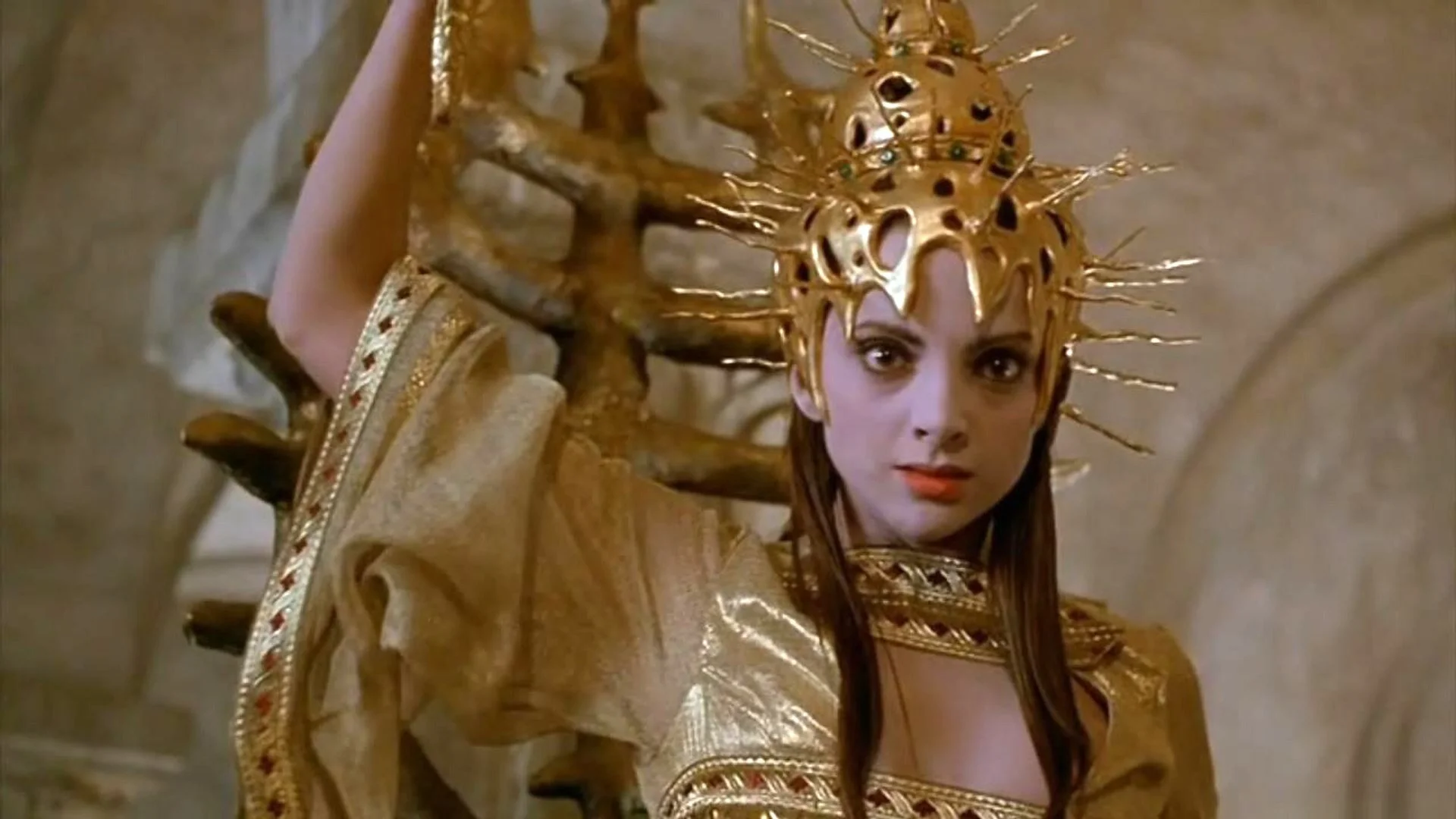
For the rest of Paul’s stay at Imboca, he struggles to reunite with his missing girlfriend while also trying to uncover the mysteries of the bizarre, hostile villagers with their grey, oily skin and fishlike features. His only confidante comes in the form of town drunk, Ezequiel, played by legendary Spanish actor Francisco (Paco) Rabal, in his final role before his death. Ezequiel tells Paul a story about how, decades ago, the townspeople of Imboca rejected Christianity, turning instead to the powerful Fish-god, Dagon, who showered the town with riches, asking only for blood sacrifice in return.
The themes of The Shadow over Innsmouth can all be recognized in Dagon, though the most prominent, and most unsavory—the horror of miscegenation—is greatly de-emphasized. In the original story, the fate of Innsmouth was to be used as breeding stock for “the Deep Ones,” a humanoid race of fish creatures with designs on conquering the surface world. While this idea is still present in Dagon, it is rightfully played down, ascribing the mating to the Fish-god himself, not the work of an entire race of creatures.
As the generations of Imbocans become closer to their deity, they become more deformed and unable to function on dry land. Dagon seems to be unconcerned with the fate of the town, so long as he can continue with his hybrid progeny. The gifts he once bestowed upon Imboca have long since ceased to have meaning for its inhabitants, who are now too inhuman to ever hope for reacquaintance with the wider world. Taken in context with the incestuous advances of Uxia (Macarena Gómez) on Paul, Gordon seems to be wisely parrying Lovecraft’s racist attitudes, turning his focus on the terror of genetic inheritance rather than interracial relationships.
It’s a shame that Dagon’s release was as lukewarm as it was—it proudly embraces its unique strangeness and stands in sharp contrast to many other horror films, even by today’s standards. As Lovecraft’s brand of cosmic horror experiences a resurgence in popularity, there’s more reason than ever to revisit the “lesser” adaptations that don’t get all the fanfare, especially if we don’t end up getting the full slate of Spectrevision’s Lovecraft films started with Richard Stanley’s The Color Out of Space. If there’s anything the past 18 months have taught me, it’s that we can always use more weird in our movies.
Article written by Ande Thomas
Ande loves the intersection of sci-fi and horror, where our understanding of the natural world clashes with our fear of the new and unknown. He writes about monsters and foreign horror and can also be found over on Letterboxd.