
Movie Review: Color Out of Space (2020)
I wish I had good things to say about 2020 so far. I’m facing extreme personal loss, and I know there have been equal, if not worse, losses that have impacted the people I care about most.
But one of the things I hold to be true, what I believe in most is: The right story will find you when you need it the most.
Enter director Richard Stanley’s filmic take on H.P. Lovecraft’s short story, The Colour Out of Space.

The moment the movie ended, I immediately said to Ande: “Instant classic.” There are so many things to love about this movie that the few flat notes connected to set and moments of dialogue are completely drowned out. And I have to say first, credit where it’s due: The team working on Color successfully adapted a Lovecraft story for the modern world. The “indescribable” horror is translated to screen via brilliant practical effects and images largely only seen through a reflection—out of the proverbial corner of the viewer’s eye, if you will. What we see otherwise is nothing short of stomach-droppingly beautiful—a visual feast reminiscent of Mandy.
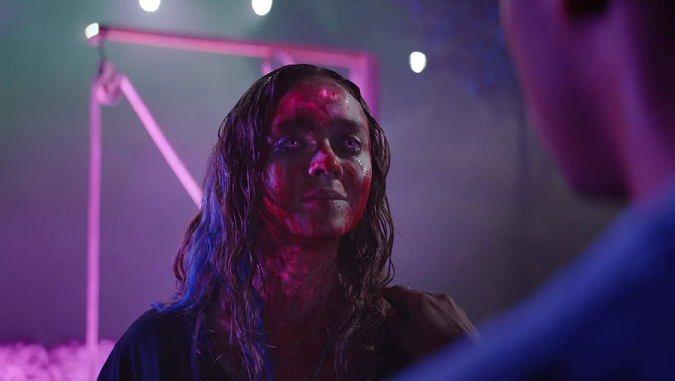
Madeleine Arthur as Lavinia, image source: IMDb
Color Out of Space opens on slow, languid, dark shots that capture the nature of the forest being filmed, and the monologue that stands with this segment eases the viewer into the flavor of dread that cosmic horror fans love most about the subgenre. The scene transitions into focusing on a young woman, Livinia Gardner, conducting a ritual—later noted to be Wiccan. The story progresses and expands to include the family unit, with its own trials and tribulations, ultimately coming face-to-face with the Color Out of Space.
According to IMDB, the cast is composed of Nic Cage as father and husband Nathan Gardner; Joely Richardson as businessperson, wife and mother, Theresa; Madeleine Arthur as the witchy, intelligent young woman and daughter, Lavinia; Brendan Meyer as the well-meaning but somewhat adrift young man and son, Benny; Julian Hilliard as the perceptive and thoughtful youngest son, Jack; and Elliot Knight as the charismatic hydrologist that the family should really have started listening to far earlier than they did, Ward. And how can we forget SpectreVision for producing both Color and Mandy, along with all of the crew that brought talent to the table to help make Color what it was?
The score, as was alluded to in a Spotify teaser playlist, was brilliant. The core theme was very reminiscent of the Annihilation soundtrack—something I’d guess was intentional. The dangerous beauty of the universe of Annihilation, which can really be seen as a completely natural l’appel du vide, pales in comparison with the horror of Color. (Though Annihilation remains an incredibly strong movie in its own right.) For me, the horror of Annihilation is the ease at which one could simply collapse and fade away. Color, on the other hand, honoring Lovecraft’s literary legacy in true form, seethes and bleeds malice that is more than an altered order of the world. What is the occult, if not an attempted grammar of the ineffability of experience?
There are many times where I feel genuinely under-equipped to write about movies, and that feeling comes back to the fore in a big way when I reflect on Color’s visual impact. It’s beautiful and horrific and so many other things I currently don’t have the vocabulary to describe, but as the story continues to descend into madness, Color’s beauty takes on a life of its own.
And exactly as you’d expect from any Lovecraft story, the core foundation of what it means to be human is perpetually eroded away, and the brilliant cast performance kept apace in a big way. Nic Cage completely owns and sells his particular acting style and talents, leaning toward a penchant for extremes that make the viewer feel queasy at best, intimidated at worst. Cage in the father role, even when things are calm, left me feeling perpetually uneasy.
And there’s a certain catharsis to horror, isn’t there? This genre—and Color especially—validates our experiences, our suffering. There is never any promise of making it out of the haunted house alive. This contaminating, corrupting thing pervades the soil, the air, the water. There is no escaping it, as there is no escaping the aftermath of a traumatic event. What has happened to us pervades the food we eat, the air we breathe, the water we drink. And while we certainly hope for a better end for ourselves than what we see in these movies, we have also seen one of the maws of Hell stretched wide and lived to tell the tale.
Loss and grief and trauma may be your own personal hellmouth. But in seeing another—something far worse than you could have ever imagined—your own suffering is not dismissed. To be human—to be alive—is the most ineffable, alien experience I can think of. And sometimes, just sometimes, movies can give us an emotional vocabulary of images to process what we are living through and who we are living as.
Color made me feel deeply uncomfortable in a way horror movies haven’t done for some time. And for that I’m grateful. But more than that—and more than anything else, in my opinion—Color is first and foremost the kind of horror movie I genuinely believe will bring the magic of cinema back to the younger kids. It’s a plain old good time, and it was a joy to see.
Article Written by Laura Kemmerer
Laura tuned into horror with an interest in what these movies and books can tell us about ourselves and what societies fear. She is most interested in horror focused around the supernatural, folklore, the occult, Gothic themes, haunted media, landscape as a character, and hauntology (focusing on lost or broken futures).

Filmmaker Bari Kang discusses Itch!, from its practical gore and zombie influences to filming in his own NYC store and directing his daughter.