‘Ginger Snaps’: Puberty and the Female Werewolf
John Fawcett’s Ginger Snaps (2000) makes the werewolf’s lunar cycle inseparable from the menstrual cycle. Ginger’s first period attracts “the Beast of Bailey Downs”; her infection then turns the bodily changes, sexual anxieties, and social expectations of puberty into horror. The film’s achievement is not simply placing a girl inside a familiar monster story. It exposes how thoroughly the werewolf myth has been coded as masculine—and what changes when female adolescence becomes the source of both terror and power.
Both Ginger and Brigitte, tactfully described by their mother, are three years late getting their first period. Though never explicitly stated, it seems as if this is the result of a willful desire to delay adolescence—the Fitzgeralds are devoted to a rebellion against normalcy. Despite being such an obvious parallel for werewolf lore to draw from, precious few narratives in horror fiction have used werewolvery as a metaphor for the cyclical nature of menstruation. Perhaps because the full moon trope is a relatively recent addition to the lycanthropic tableau, only becoming popularized in the last 100 or so years.
Prior to Hollywood’s depictions of werewolves, legends of shape-shifting humans existed separately in nearly every known civilization. The creatures we know today as werewolves weren’t actually creatures at all. In the European region of Livonia, modern-day Estonia, belief in werewolves was widespread. But rather than a curse inflicted on someone, people could become werewolves simply by means of a special belt or a wolf’s pelt—not unlike the thick, oversized sweaters and jackets worn by the sisters throughout the film.

In fact, the “were-” in werewolf originates from the Anglo-Saxon “warg,” which literally means “strangler,” and was applied to any deviant or outlaw of society. Thus, it’s likely that the original werewolves were in fact criminals and brigands who lurked in the forests of Livonia, wearing thick pelts to protect themselves from the harsh European winters. One need look no further for a vestigial remnant of these stories than in Little Red Riding Hood, with the wolf standing in for any ill-meaning stranger that stalks a young girl—his attack, in most versions, implicitly being her rape.
As the stories developed and cautionary tales took shape, werewolves came to represent the baser desires of man. They became an expression of the dual nature of humanity—not just good and evil, but civilized and primal, reasoning and instinctive, repressed and liberated. This reading of the monster became more pronounced with the rise of industrialization and the rapid shift in women’s role in society in the early part of the 20th century. The standard characteristics of werewolves, as we know them today, had not yet been set and wouldn’t be until 1943’s Frankenstein Meets the Wolf Man, but their interpretation as a sleeping evil that exists in all men was quickly taking shape.
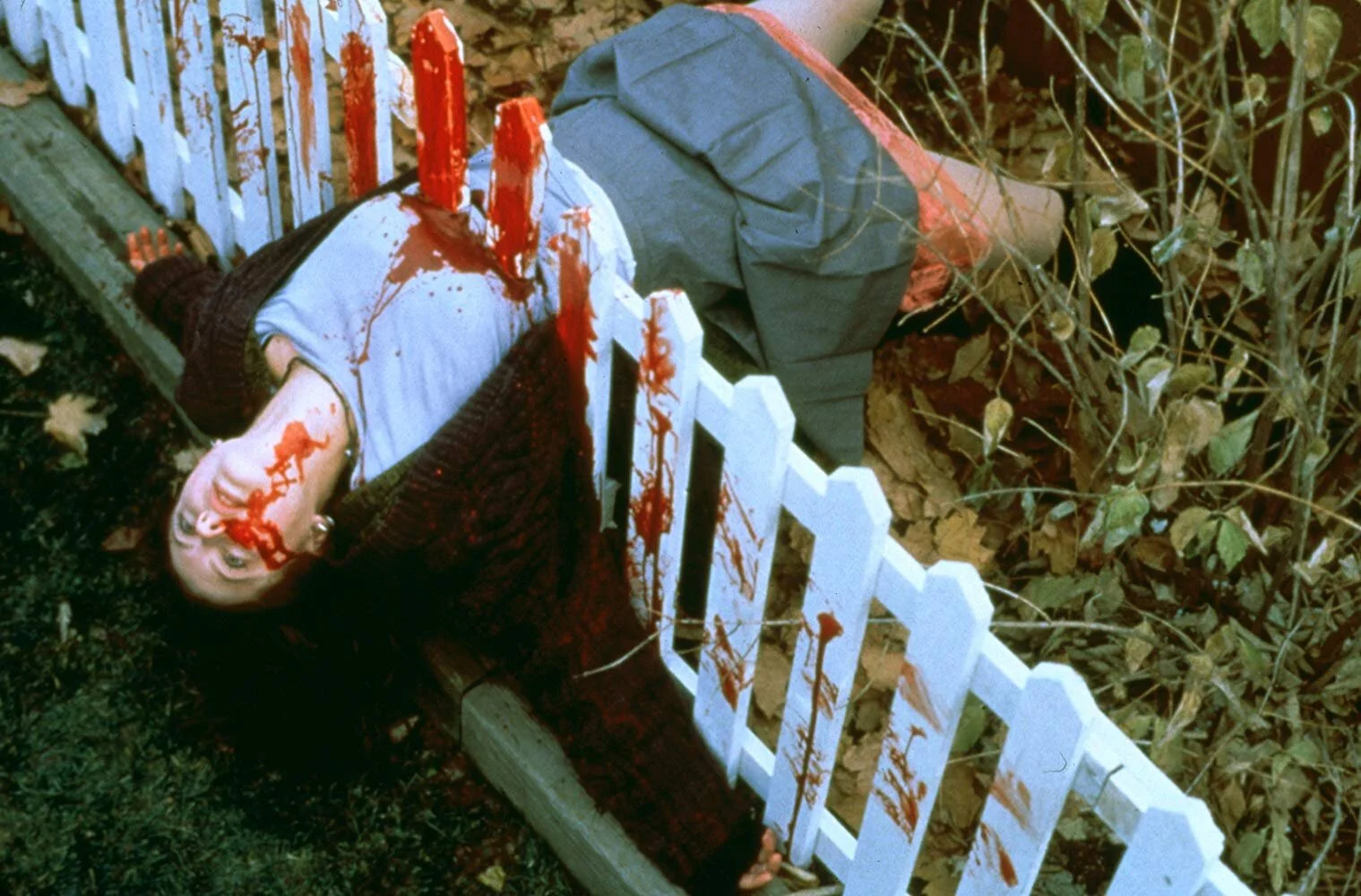
Katherine Isabelle in Gingersnaps, image via IMDB
A number of films in post-war Hollywood have used werewolves as a stand-in for puberty, such as I Was a Teenage Werewolf, Full Moon High, and Teen Wolf. But in all of these cases, the wolf analogy is used primarily to highlight the bodily changes and aggression associated with hyper-masculinity, rather than the cyclical nature of the transformation itself. Ginger Snaps, on the other hand, doesn’t ignore these other aspects of werewolfdom: It embraces and subverts them, creating probably the most complete picture of what a werewolf tale can be.
Perhaps the closest we get to Ginger’s feminized version of monstrous transformation is 1942’s Cat People, in which Simone Simon stars as Irena, a Serbian immigrant who fears she suffers from an ancestral curse that causes her to metamorphose into a great panther any time she is overcome with strong emotion, such as when angry or sexually aroused. Irena’s fear of the curse prevents her from making any strong connections with people—until of course, she does.
While Cat People may have had more in common, thematically, with Dr. Jekyll and Mr. Hyde than The Wolf Man, its connection to Ginger Snaps lies in its expression of female sexuality as something to be feared or repressed. Though Ginger’s curse isn’t inherited as Irena’s is, or Scott’s in Teen Wolf, it is ostensibly her menarche that attracts the beast to her. (After the attack, Brigitte points out that she’s heard that: “Bears will, like, come after a girl on the rag because of the smell.”) Likewise, Ginger’s slow transformation throughout the film is marked both by hallmarks of puberty and subversions of it. Like Irena, Ginger’s curse is exhibited through sexuality. In Irena’s case, she is ashamed and afraid of the aggressiveness that comes with arousal. Ginger, on the other hand, embraces it. During his sexual encounter with Ginger, Jason is almost offended by Ginger’s dominant behavior, asking, “Who's the guy here?” Ginger responds angrily, jumping on top of him and, as we learn later, transmitting her curse to him. When she gets home, she admits to Brigitte that she thought her insatiable urges were for sex but instead, they are to “tear everything to pieces.” Later in her transformation, she equates the feeling of killing to orgasm.
Growing Up Werewolf
In both films, grave consequences result from the attempt to cage female sexuality through societal norms. In Cat People, this is literal—Irena spends a fair amount of her free time at the zoo where a panther paces back and forth in its tiny enclosure; at another point, Irena herself, in panther form, is locked in a small apartment room as authorities try to sedate her. Ginger, meanwhile, never feels impeded by her urges although she is confused by the decidedly masculine expression of her development. Referring to Jason, Ginger laments that: “He got laid…. I’m just ‘the lay.’” When the first physical evidence of her affliction—an eerily phallic tail—emerges, Ginger first tries taping it down—a scene that reminds me of a similar one in 2008’s Girl, which deals with body dysmorphia in a much more reality-rooted way—and then by trying in vain to cut it off. Initially, Ginger’s misplaced rage is directed in jealousy towards the attention Brigitte receives from Sam, an older boy who begins hanging out with Brigitte in an attempt to help with the werewolf predicament. Increasingly however, this rage manifests in a more fraternal protective instinct of her sister—whereas before, Ginger’s protective instinct was restricted more or less to field hockey, now she holds herself responsible for any older male who so much as looks at Brigitte.
The actions of both sisters are informed by their developing views of sexuality. Brigitte feels increasingly alienated by her sister, lacking the experience (violent or otherwise) to personally relate to her exploits. If Ginger’s transformation is a manifestation of her blossoming womanhood, then both Brigitte and their mother express a desire to prevent Ginger’s growing up. Brigitte recognizes the key difference between her research into Ginger’s affliction and the reality of it—Ginger doesn’t transform on the full moon, her metamorphosis is a slow and gradual process, culminating with the full moon on the 30th. Recognizing that once her transformation is complete—once Ginger reaches her full potential—she will never get back the sister she once had. Their mother likely realizes the same and, already unwilling to let the girls grow up without her supervision, will not only forgive Ginger for her crimes, but will burn their house down and bail on their father and their lives to start fresh elsewhere. Ginger, on the other hand, sees her sister’s naivety and knows that there is no putting the genie back in the bottle, urging her instead to join her in a new pact.
Where Ginger Snaps succeeds is in its layered approach to using werewolves as a coming-of-age analogy that recognizes and uses our societal gender stereotypes against us. Ginger’s masculine characteristics as she transforms both scare her and excite her. After the initial period of exploring her newly developed identity, she accepts herself, to the horror of her sister. When she infects Jason, he isn’t given a standard hyper-masculinized werewolf arc to follow. Instead, he finds blood in his urine and spotting on his khakis. His encounter with Ginger transmits more than one “curse.” It’s Jason again who needs to be saved by Brigitte’s cure, the male victim who becomes a damsel in distress, not Brigitte and not Ginger. Ultimately, Ginger Snaps can simply exist as a fun horror film. But more importantly, it serves as a cautionary tale that rejects the accepted “normal” narrative of what it means to transition from childhood to adulthood in a modern Western society.
Sometimes, the girl doesn’t need a man to save her. And sometimes, the wolf isn’t the stranger on the wooded path. Sometimes, it’s her.

Article Written by Ande Thomas
Ande loves the intersection of sci-fi and horror, where our understanding of the natural world clashes with our fear of the new and unknown. He writes about monsters and foreign horror and can also be found over on Letterboxd.
Other Articles You May Enjoy…

In The Buffalo Hunter Hunter, blood carries the violence of colonialism, while a settler’s journal controls whose story survives. This essay examines how Stephen Graham Jones uses vampirism and layered testimony to confront historical erasure.