
Female Antagonists in Horror: Annie Wilkes
In observance of Women in Horror Month, I’d like to spotlight one of the horror genre’s most iconic female antagonists: Annie Wilkes (Kathy Bates) from Rob Reiner’s Misery (1990)—a retelling of Stephen King’s 1987 novel. A rare occurrence in both film and Gothic literature, Wilkes breaks traditional gender stereotypes to deliver a character that leaves viewers—and readers—in almost constant suspense.
To celebrate finishing his latest novel, famous romance author Paul Sheldon (James Caan) travels to Silver Creek, Colorado—a reported ritual, as Sheldon traditionally celebrates the completion of a book with champagne and a single cigarette. However, when Sheldon packs up and begins his return back to New York City from his writing oasis, he is met with an unruly winter storm that causes him to crash his car over a mountain bank. Though we might assume that the character will die right there, luck prevails as a bundled and bulky figure pries Sheldon’s car door open with a crowbar and hoists him over their shoulder, taking his manuscript with them as well.
Sheldon wakes up after being out for a few days, learning quickly that he’s busted both of his legs and shoulder. Although, instead of waking up in a hospital, he comes to in a remote farmhouse, cared for by retired nurse, believed heroine, and most notably Sheldon’s “number-one fan,” Annie Wilkes. Wilkes blames the bad weather for not taking him to a more formal facility and plans to call his folks about the accident once the phone lines are back up. A somewhat busty woman, Wilkes isn’t the traditional beauty we might see in the horror antagonist realm, but still upholds the stereotypical female role of caretaker we see in King’s work, notably Donna Trenton (Dee Wallace) in Cujo (1983) and Rachel Creed (Denise Crosby or Amy Seimetz) in Pet Sematary (1989 & 2019).
As a form of gratitude for her hospitality and care, Sheldon allows Wilkes to read his manuscript after hearing about her collection of his Misery novels, which follow the story of Misery Chastain, a sort of Victorian-era heroine. Already, the parallels can be drawn between Chastain and Wilkes and why the books have appealed to her so greatly: They give her hope and a reason to smile, to be nerdy or occasionally awkward—I mean, even her pet sow is named “Misery”. However, opposing this relatively normal and even childlike personality is the reality that Wilkes is alone on her farm following a divorce, which reveals that she is also depressed and deserving of sympathy.
“Wilkes is more of a double-sided coin that breaks and challenges both gender roles and Gothic styles.”
This perfect depiction doesn’t last long; only a few chapters into reading the manuscript, Wilkes loses her temper over its profanities while feeding Sheldon. Apologetic, Wilkes’ incident appears to be something out of character and is brushed off the following day. This creates a false sense of security—almost like a blanket—through the caretaker role and the desire to continuously sympathize with Wilkes’ hardships and seemingly undiagnosed bipolar disorder. The viewer is convinced that while something might not be quite right, surely, Wilkes is still a good person, or she wouldn't have saved Sheldon in the first place.
Not quite. Wilkes is only able to control her emotions until reading that Sheldon has killed off her beloved Chastain, in what is meant to be the final book in the series. Unable to handle the news, she goes as far as forcing Sheldon to burn the only copy of his new manuscript and forces him to write a new novel where Misery gets to live.
According to Asmat Nabi’s “Gender Represented in the Gothic Novel,” there are two main female roles in gothic literature: the predator and the victim. Traditionally speaking, the predator is dangerous but very attractive, usually portraying the paradox between pleasure and pain, while the victim is fragile, vulnerable, and tends to give heroes something to rescue. However, in King’s telling of the story, and in Reiner’s film adaptation, we do not see an attractive woman—only danger and pain. Dually, we also don’t witness a victim in the sense that Wilkes is in need of being rescued by a hero, but that instead, she is the victim of her own mental illness.
Comparing Wilkes to King’s stereotypical women—the Monster, the Helpmate, and the Madonna—she still fails to fit. Critic Mary Pharr coined the terms for King’s portrayal of women, and goes as far as to say that each is determined by her adherence to the female gender roles of wife, mother, and homemaker, or the “domestic test.” Wilkes can’t fit the description of Monster because she is so nurturing and occasionally shows affection for Sheldon, so the domestic test isn’t completely shunned or distorted. Wilkes also can’t be the Helpmate because she doesn’t uphold the dedication it takes to be a good wife, mother, or housekeeper, nor does she appear to have a definite or mature sex life (except maybe in her previous marriage). She also can’t fulfill the role of the Madonna because while she is a non-sexualized character in Sheldon’s eyes, she is neither pure, chaste, nor above reproach.
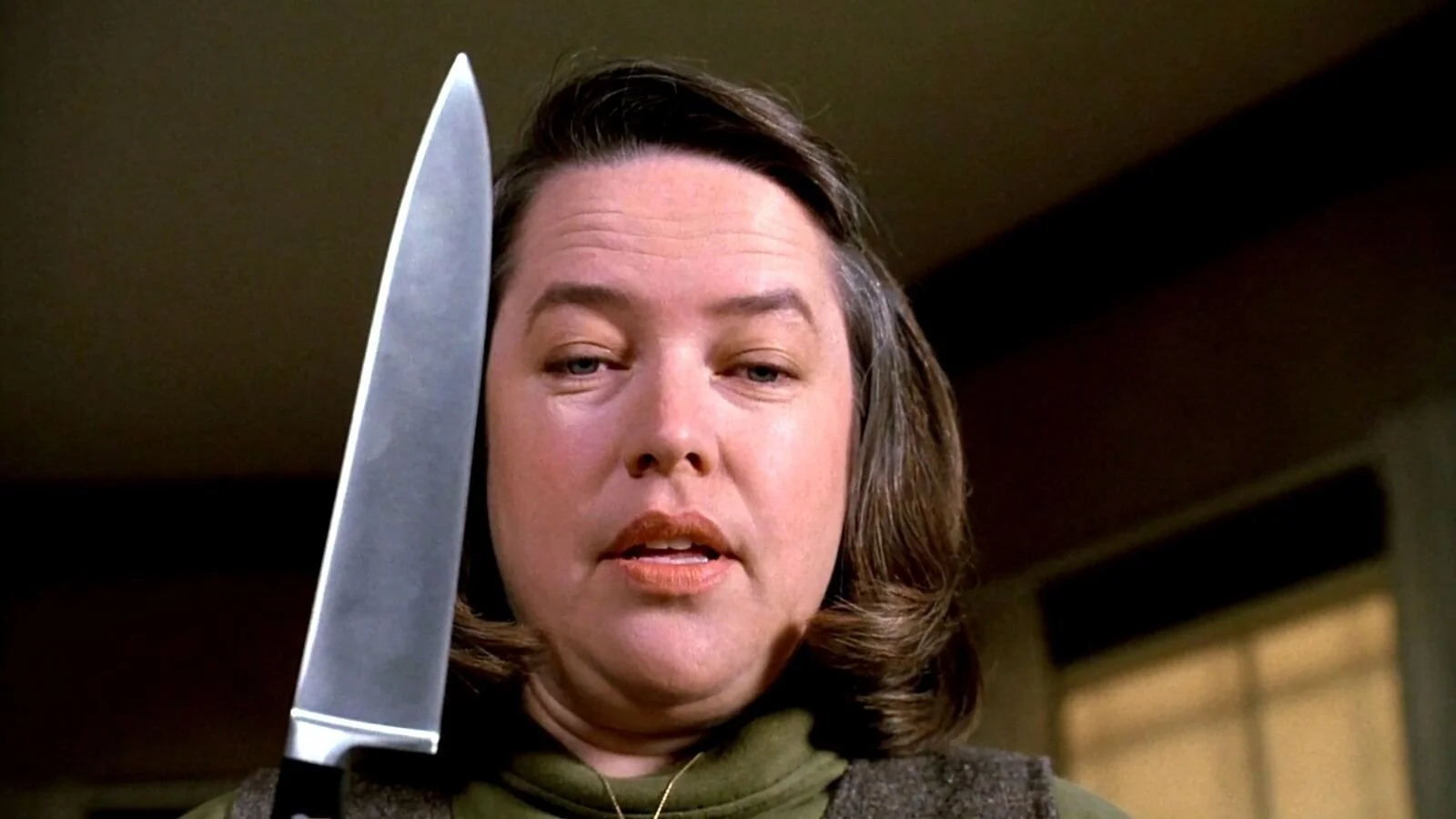
Annie Wilkes, Misery
Instead, Wilkes is more of a double-sided coin that breaks and challenges both gender roles and Gothic styles. While she isn’t a sexualized character, she’s not supernatural or immortal either, and she does convey some motherly traits as she tries to nurture Sheldon back to health. She could also almost be labeled as having wife-like traits when the two share a candle-lit dinner. On the other side of that coin is something much darker, however: Driven by her emotions when things do not go as planned, Wilkes is very dark, abusive, and even reckless. Throughout both versions of the story, we learn that Wilkes is also a serial killer, having kept a scrapbook of her victims, and isn’t new to inflicting violence in what can only be described as one of horror’s teeth-clenching, iconic torture scenes.
According to Kimberly S. Beal in “‘Sometimes Being a Bitch is All a Woman Has’: Stephen King, Gothic Stereotypes, and the Representation of Women,” this is because “King manipulates and inverts the standard gender roles of the Gothic by creating two different Gothic struggles: Paul’s struggle to free himself from Annie’s grasp and Annie’s struggle to free herself from Paul’s novel.” Due to the duality of the situation, the traditional gender roles have to be reversed, with Sheldon serving as the helpless victim who must fight to stay alive as antagonist Wilkes is constantly forcing him to stay and appease her requirements for the new book. But, even then, Sheldon learns that once the book is finished, she plans to kill them both in some kind of murder-suicide, as her insanity will never let her be caught for everything that’s happened.
The end result? A character that is so complex, we still aren’t sure if we should hate her for being this baby-killing, torturous monster, or feel sorry for her for her shortcomings and undiagnosed mental issues. For her success in the film’s adaptation, Bates was given an Academy Award. (Misery is still the only King film to receive an Oscar.) The story as a whole gave us a successful glimpse of what a horror villain might look like as a woman. She is not confined by the unspoken rules of horror, and she is not confined by her sexuality or the domestic test. Instead, she rises above all those things to deliver us a fear that sticks with all of us because it is realistic: This could happen to you. The disguised evil underneath kindness, compassion, misunderstanding, and a seemingly harmless appearance, just makes your skin crawl wondering about other dormant psychopaths.
Article Written by Destiny Johnson
Destiny writes about true crime and thrillers. She likes movies and stories that make you question the world around you, more so than what makes you jump.