
Sundance 2021: ‘In the Earth’ & ‘Eight for Silver’, reviewed
Over the next several weeks, I plan on going more in depth on a number of the screenings I attended during the 2021 Sundance Film Festival—for better or for worse. Some of these films I covered in my preview, and others just missed the cut. Regardless, the festival was a resounding success and I’m thrilled to give you a deeper look at these films and what’s more, I can’t wait for everyone else to get the chance to see them for themselves in the coming months. With this article, I want to take a look at two films that I was most excited for going into the weekend: Ben Wheatley’s In the Earth and Sean Ellis’s Eight for Silver.
Editor’s Note: Since the time of writing, Eight for Silver has been renamed The Cursed.
In the Earth, dir. Ben Wheatley
In my festival preview, I said that I hoped that Ben Wheatley’s Neon-produced horror feature would signal a return to the weird, indie-oriented Ben Wheatley we love, and with great enthusiasm, I can confidently say that In the Earth was one of my favorite films at the Sundance Film Festival.

In the Earth, Image courtesy Sundance Institute
In the Earth is the story of Dr. Martin Lowery (Joel Fry), a researcher who, with guidance from park ranger Alma (Ellora Torchia), travels deep into the forest to make contact with his colleague, Dr. Wendle (Hayley Squires), who is in the middle of a research project and hasn’t been heard from in some time. The first thing that struck me about the film was how “normal” their precautions felt. The events of In the Earth take place during a global pandemic—but rather than the hazmat suits and military checkpoints that have been the hallmarks of deadly viruses in decades of films prior, In the Earth takes a more familiar route. Martin is met by employees wearing simple face coverings, the bare park lodge is decorated with safety posters and hand sanitizing stations, and decontamination is handled by means of a nasal swab and questionnaire. To understand the gravity of the situation the characters are in, we no longer need grand theatrics—we already know. It’s a striking change to how science fiction is presented to its audience, probably for years to come.
The two waste little time in getting underway. Alma explains that there are no trails that lead to Dr. Wendle’s camp—no car or ATV can get them there. It’ll be a several-day hike. Martin is a bit nonplussed at this news. Passionate as he is about his work with plant life, he’s a bit ill-suited to the type of backcountry trek they’d be making. Thankfully, he’s in Alma’s capable hands. That is, until they stop to make camp. In the dead of night, the pair are inexplicably attacked by unknown assailants. Their camp is torn apart and they are rendered unconscious. In the morning, they find that even their boots have been taken, forcing them to go the rest of the way barefoot.
After making slow progress in this manner, they stumble across a hermit, Zach (Reece Shearsmith), who cautiously offers to help them so long as they don’t tell the authorities that he’s squatting on their land. They accept, but unfortunately for Martin and Alma, their luck will only get worse from here.
To this point, In the Earth has a fairly straightforward premise: The deeper they get toward the center of the forest, the more unhinged things become. Punctuated by bold sound design and a skin-crawling score from Clint Mansell, In the Earth takes a pretty steep drop into a gory, acid-soaked light show of nightmare fuel. The stark difference between the first and second halves of the film will be jarring for many, and indeed, many fellow attendees were turned off by the apparent lack of cohesion in the film, but the disjointed approach and hazy final act really worked for me. The theme and execution gave me a strong sense of eldritch horror which is being successfully explored with increasing frequency these days, and makes for a fitting companion to a horror film produced and set in the unprecedented times we’re now living through. By no means will In the Earth be universally enjoyed, but it is a trippy, wild, unapologetic adventure in madness and that, as I’ve said previously, is exactly where I get the most fun from Wheatley’s films.
Eight for Silver, dir. Sean Ellis
On the other end of the spectrum, however, is Eight for Silver. Going into the weekend, this self-described “new take” on the werewolf legend from Sean Ellis was one of my most anticipated horror films. There’s a soft spot in my heart for werewolf films—there is a rich, if fragmented, history to the lore, and few monsters can claim to represent so much of humanity. Werewolves can be used as a door to any number of cultural legends, with stories of shapeshifters being among the oldest stories mankind has ever told. It’s a shame that Hollywood has so frequently handcuffed itself to its own cobbled-together mythology, and so I hoped that Sean Ellis meant to shake loose from those trappings.
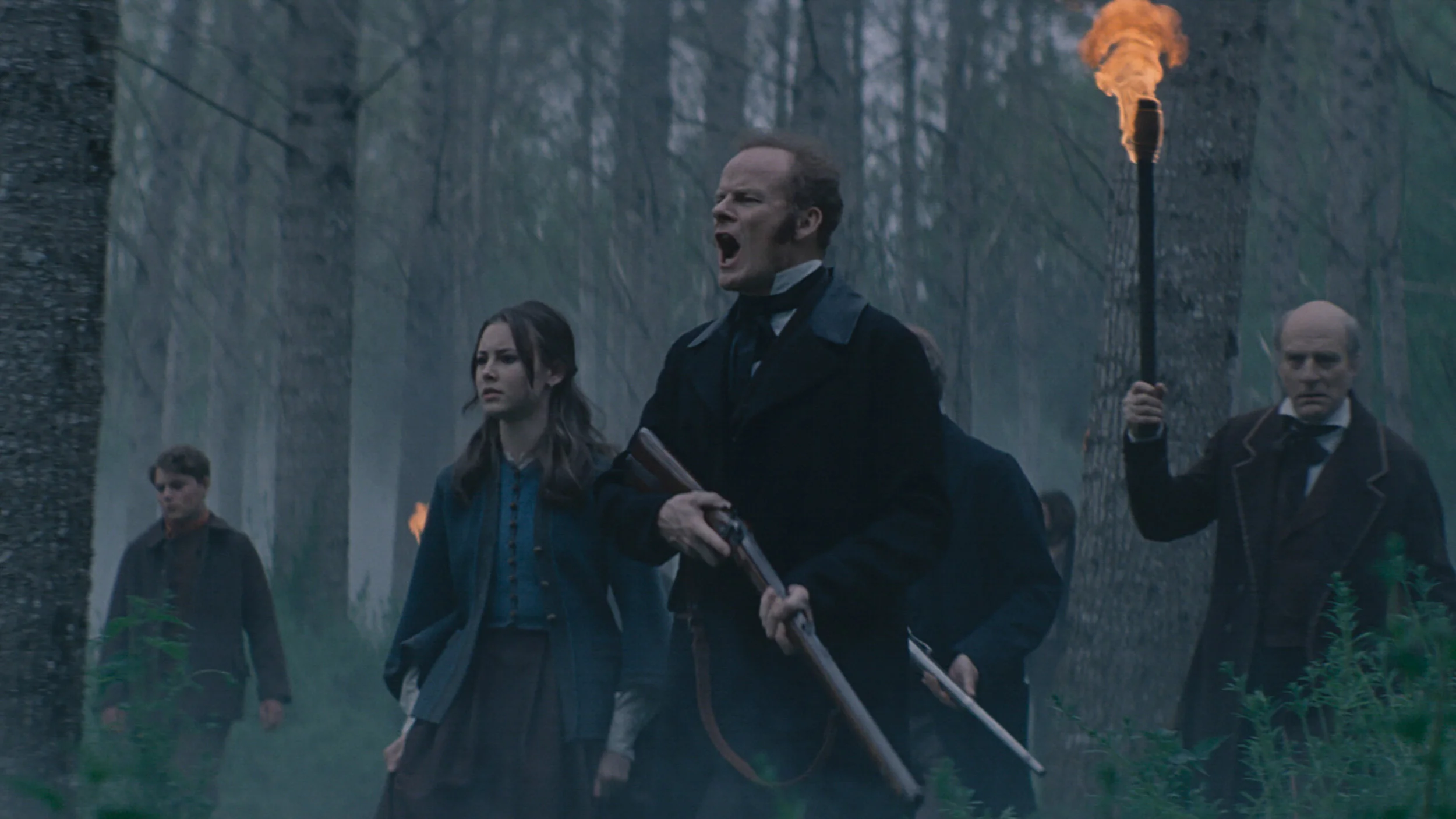
Eight for Silver, Image courtesy Sundance Institute
Unfortunately, Eight for Silver falls well short of this ambition. Set near the turn of the 20th century, the film opens on a World War I battlefield, which would be the first source of my disappointment. This is a vastly underutilized setting in film and I would have loved to see lycanthropes charging through lines at the Somme. But aside from a combat medic pulling a single large silver bullet from the wound of a soldier, the scene bears no impact on the rest of the film.
Instead, the story rewinds 30 years as a group of landowners contemplates how to handle a Roma caravan that has set up camp on their land. The visitors, it seems, have a verifiable claim to a large portion of their land and so the rich white landowners do what rich white landowners are expected to do: They cede the lawfully claimed land and move on to build their fortunes elsewhere. I’m just kidding; they massacre the caravan.
Granted, the massacre is one of the most impressive pieces of cinematography in the film. Shot in one wide, uninterrupted scene, we witness the attack from the hilltop where the baron waits and watches—unemotionally separating himself from the slaying he ordered, keeping his distance from the screams and cries below. Had the rest of the film maintained this level of tonal control, things might have gotten interesting. But Ellis seems more interested in using this act as the impetus for another egregious sin in filmmaking—the Romani curse.
I admit that when first reading about this film, part of me was concerned that this would be where it was headed, but I had kept my fingers crossed. This trope, a racist demonization of marginalized people, is by no means a “new take” on werewolves. If Ellis wanted to use it as a means for introducing the monsters, he needed to be careful to use it in a way that does not villainize or “Other-ize” the Roma clan. The intentions of the filmmaker must be crystal clear if they seek to subvert the trope for a modern telling. Unfortunately, Ellis fails spectacularly. Aside from the unique means of transferring the curse onto the town, no new ground is broken here, and worse, no stereotypes are broken—rather, they are perpetuated.
Coupled with a dragging second act that weighs the film down, losing any momentum it had gained from the brutality of Act I, as well as a shoddily put together addiction metaphor and some questionable directorial decisions that made the action on-screen difficult to follow, Eight for Silver has little going for it. The costume and set design were top-notch, as expected, and the film did boast some fine practical props, but those combined certainly couldn’t save it from retrodding the same steps that dozens of writers have already taken—a path that we ought to have moved well beyond by now.
Understandably, an event that boasts over 70 new feature films is bound to have at least a few misses, but this past week was full of success stories waiting to happen. I’ll share some of my favorites over the next few weeks, as well as some disappointments. In the meantime, you can also check out my official lineup from the festival on Letterboxd for a sneak peek at what might be coming up. I’m really looking forward to the rest of this series. We have such sights to show you.
Article Written by Ande Thomas
Ande loves the intersection of sci-fi and horror, where our understanding of the natural world clashes with our fear of the new and unknown. He writes about monsters and foreign horror and can also be found over on Letterboxd.

Other articles you may enjoy...

Filmmaker Bari Kang discusses Itch!, from its practical gore and zombie influences to filming in his own NYC store and directing his daughter.