
Reading the Bible with Horror: An Interview with Professor Brandon Grafius
There is something both viscerally compelling and haunting about religious horror, whether it simply be flavored with something like Catholic iconography or saturated with a terrifying belief system baked into the very writing. The Hellraiser franchise casts a very long shadow for a reason, as does The VVitch. In the next of our series of interviews that explore the reach of horror and academia, I had the opportunity to speak with Dr. Brandon Grafius—who currently serves as an assistant professor of Biblical Studies at Ecumenical Theological Seminary in Detroit—about the intersection of the Bible and horror.
Grafius’ background includes a Ph.D. from the Chicago Theological Seminary in Bible, Culture, and Hermeneutics; an Mdiv from Ecumenical Theological Seminary; and an MA in English, with a concentration in Creative Writing, from the University of California-Davis. The vein of exploring the Bible and horror is a well-established phenomenon in Grafius’ work: previously, he authored Reading Phinehas, Watching Slashers—a revised version of his dissertation. Grafius’ publishing track record also includes a handful of essays published over the last several years, some of which examine the Bible from the viewpoint of horror, and others that are the inverse by examining horror through questions about the use of religion in the genre.
In his most recent book, Reading the Bible with Horror, which was published in October, Grafius examines the Hebrew Bible’s Leviathan in context with monster theory and uses discussion of Derrida as a tool to take a look at the haunting landscape of the Bible, among other fascinating points. Reading the Bible with Horror was also listed on the preliminary ballot for the Bram Stoker Award in nonfiction, and has been nominated for a Grawemeyer Award in Religion.
Currently, Grafius also has two co-edited volumes going through the peer review process: Seeing the Apocalypse: Essays on Bird Box, which was co-edited with Gregory Stevenson; and Theology and Horror, which was co-edited with John W. Morehead. His work on The VVitch, authored for the Devil’s Advocate series, is currently in the process of being published. (The Devil’s Advocates series is a collection, published by Auteur, that explores classic horror movies.)
What initially drew you to the horror genre? How did you eventually find the intersection of the Bible and horror?
I’ve been a horror fan as long as I can remember. When I was a kid—probably eight or nine—I was always looking for books and movies that took me seriously. I was enticed by the mystery and the threat of things like The Hardy Boys, but wanted to throw the book across the room when I got to the end and found it was just another creepy old guy trying to keep everyone away from the Old Mill. I stumbled on the Disney movie Something Wicked This Way Comes, based on the Ray Bradbury novel. It was made in the early ‘80s, and people from my generation remember it coming in the white clamshell DVD cases that marked Disney films. But it was so much darker than it had any right to be. The threats were real, and so were the anxieties the characters felt. There was a kid who would give up anything to be a grownup, and I got it right away. I held onto that movie for years, and was always drawn to any scary movie that I could get by the parental censors.
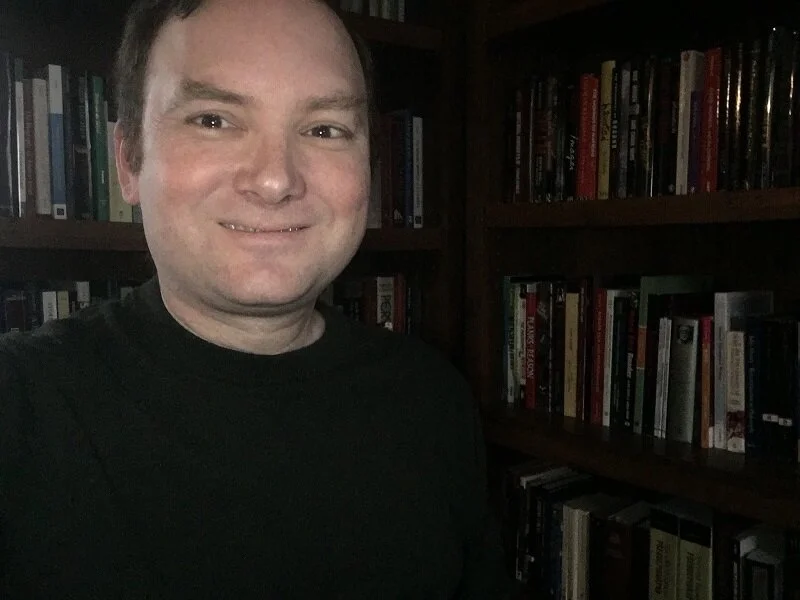
Dr. Grafius in his home office, where his personal library intersects between Bible and horror studies.
I was working at a bookstore in my early 20s (shout out to the Next Chapter in Woodland, California!), and stumbled on Carol Clover’s Men, Women and Chain Saws, one of the earliest academic works on horror films. I was fascinated that studying horror films could actually be something that a person did, but I kind of filed it away in my brain for a decade or so. It wasn’t until I was in my Ph.D. program (studying the Bible, not horror) that I read a footnote in Anathea Portier-Young’s book Apocalypse Against Empire that mentioned monster theory, citing Carroll’s classic book and the (at the time) two books in the realm of biblical studies that dealt heavily with monster theory. I’d been keeping my love of horror as a guilty pleasure for a long time, and I think it was at that moment that I decided to stop feeling guilty about it. Fortunately, I was at Chicago Theological Seminary, which is well-known for being open to a wide range of theoretical approaches. And even more fortunately, my advisor, Timothy Sandoval, was supportive. As long as I demonstrated that I could do the historical-critical groundwork (which makes up the first half of my first book), he was okay with the horror stuff. I worked hard on that dissertation to show that these two ways of approaching the text didn’t have to be opposed to each other, that they could play nice in the sandbox together. So my first book (Reading Phinehas, Watching Slashers) has detailed analysis of the Hebrew text, work with the history of scholarship on my particular passage, and all that you would expect from a dissertation in the field of biblical studies. But it also has Freud’s Uncanny and Robin Wood, and Kristeva’s abject and Clover’s Final Girl. My new book, Reading the Bible with Horror, is a little broader in scope—I’m hoping it will be useful not only to biblical scholars and students, but scholars and students who are more generally interested in religion, or horror, or just want to see how this seemingly odd combination of topics can work together.
Out of all the stories in the Bible, which would you say is the most emblematic of classic horror?
Usually, my work involves taking a thematic element from the Bible and making a connection with themes from horror films; for example, in my new book, I talk about a ritual in the Book of Numbers that is to be used in cases of suspected adultery. It involves publicly administering something called “bitter water” to the suspected woman (not the man she’s suspected of having an affair with!) and seeing what happens—if she’s guilty of adultery, it seems like the drink will induce a miscarriage. If she’s innocent, she’ll just be very uncomfortable. I connect this with the opening shower scene in Carrie, where the onset of Carrie’s menstruation subjects her to a similar ritual of public humiliation. In both cases, I argue that women’s sexuality is viewed as a dangerous, destabilizing force, one which needs to be controlled through shame. So I wouldn’t call this ritual from Numbers a classic horror story in the sense of narrative structure or the appearance of a monster, but it’s sure got horrific elements that allow for connections with contemporary horror.
There are a few stories from the Bible that stand out as being classic horror stories. Rhiannon Graybill has written about Jael’s murder of Sisera in Judges 5 in connection with rape-revenge films, and Leland Merritt has done something similar with the rape of Dinah in Genesis 34. For my money, Judges 19 is the most horrific story in the Bible, depicting the gang-rape, death and dismemberment of a Levite’s concubine. It’s really nasty stuff, and it’s pretty hard to find anything redeeming in the story. In my dissertation (published as my first book), I looked at the Phinehas story of Numbers 25 – it really does read like a classic slasher film from the 1980s. This story takes place while the Israelites are wandering in the wilderness. They start messing around with foreign women, and God tells them to stop. But an Israelite brings a Midianite woman into the camp, and they go into the tent together. Moses doesn’t know what to do, but Aaron’s grandson Phinehas takes a spear, and skewers the two of them. God then tells Phinehas how pleased he is with his “zeal,” and promises that all of Phinehas’s descendants will be priests. I see all of the elements of the classic slasher films here—not only the connection between sex and violence, but violence as a tool of patriarchal control. I argue that it shows the same kind of anxieties that we find in the ‘80s slashers—while those were a product of the Reagan revolution, Numbers 25 is a product of the exile (or soon afterwards), when the Israelites had all sorts of anxieties about national and religious identity. I was reading this story in graduate school, and was struck by a bolt of lightning: “Hey, this same scene happens in Friday the 13tb Part 2!” (Or Bay of Blood, if we’re really going back to the source.)
Is there a particular horror movie that you feel is closest to the truth regarding Christianity/Catholicism?
I’d say it depends on what kind of truth you’re talking about!
Of course, I have my own personal faith beliefs, but they’re not the main thing I pursue in my scholarship. I guess when I’m writing, I’m less interested in a single truth about Christianity, and more interested in the multiple ways that various strands of Christianity has expressed itself through history, how it’s represented in the Bible, how the Church and the wider culture have interpreted the Bible in various times and places, and what all of these various things say about us as people.
That means I don’t worry so much about whether a movie presents Christianity in a way that feels comfortable to me. Instead, I focus on how a movie develops the traditions and ideas that have been handed down to us from the Christian religion. I’ve got an article coming out in a few months about images of messiahs in horror films—I used that as an opportunity to talk about the French film Martyrs and The Mist, both of which question the benevolence of God. I find that chilling, and fascinating—in these two movies, it’s not that the divine reality is unknowable, it’s that we maybe don’t want to know. And that’s an idea that the Bible wrestles with as well—the Book of Job is a great example. I don’t necessarily think these two films present the “truth” about Christianity, but they use the Christian tradition to offer some profound ideas and reflect on our place in the world in an extremely interesting way. I find that extremely valuable in films.
If there were something you could change about the genre's treatment of faith and clergy, what would it be?
While the horror genre as a whole is frequently critical of religious institutions, it often has a deep respect for the faith of individual believers. I understand that; the Church as an institution has done a lot over the years to merit criticism. While the structures of religion are frequently portrayed as corrupt or powerless, it’s also pretty common for horror movies to give a large amount of power to the symbols of faith, and faith itself. It’s an interesting dynamic, far too complex to say that horror as a genre (or even a particular subgenre of horror) has one dominant representation of faith. I appreciate that diversity, and that room to explore different ideas. For me, it’s a good approximation of how faith works in so many different ways in our own lives.
Beyond The Witch book you're currently working on, what are your research plans for the future?
I just sent a draft of my Devil’s Advocate volume on The Witch to the publisher, so it should be out in a few months. That volume is more accessible than the academic work I’ve been involved in so far, aimed more at horror fans than at scholars. While I’m still writing academic articles, my plans are for a book that is aimed at the wider public, hopefully something that can capture the imagination of people who read The New Yorker, listen to NPR or shop at bookstores. The working title is Monster in the Pews, and the hook is simple—watching horror movies with a Bible scholar. I should have a good idea soon about whether there’s enough interest to keep working on it, or if I should go back to my office and keep writing for academia!
Frequently, academics like myself spend years and years studying our specific field, learning all of its history and methodologies, and then labor over a work that we know no one will ever read. I’m excited with how much energy there is behind horror right now, and at the opportunities it gives those of us who study horror films to communicate with a wider audience. I think we have the chance to really participate in a vital conversation, one that can tell us a lot about how the movies we watch reflect and wrestle with the traditions, values and hopes that are most important to us.
This interview has been edited for length and clarity.
Article Written by Laura Kemmerer
Laura tuned into horror with an interest in what these movies and books can tell us about ourselves and what societies fear. She is most interested in horror focused around the supernatural, folklore, the occult, Gothic themes, haunted media, landscape as a character, and hauntology (focusing on lost or broken futures).

Other Articles You May Enjoy…
Filmmaker Bari Kang discusses Itch!, from its practical gore and zombie influences to filming in his own NYC store and directing his daughter.