
The Wilds of the Religious Landscape in ‘The Green Knight’
As many of us waited with bated breath for David Lowery’s The Green Knight to finally hit the silver screen, our personal worlds shrunk down to the claustrophobia of our homes and the abject terror of going to work or going grocery shopping. With that change in physical habits, our interior landscapes also changed, dramatically—even now, many of us may not have recognized who we’ve become over the last year-plus. The Green Knight, though, was a beautiful reminder of the vast interiority and resiliency of the human spirit, and also the power implicit in the act of dreaming.
As others have already aptly mentioned, the poem Sir Gawain and the Green Knight begins near Christmas, with the challenge issued by the Knight himself a holiday game. Though this would seem to situate the story soundly as a Christian tale, Lowery’s filmic interpretation does almost entirely away with the symbol of the cross; instead, we are given the repeated motif of what might be confused at first to be a pentagram, but is actually representative of the virtues of knights and the five wounds of Christ. Though Gawain’s shield bears the pentangle in the poem, for modern viewers, the emphasis on the five-pointed star points more toward occult readings of the film. When readers and watchers think of stories like The Green Knight, Christianity is often seen as a foregone conclusion, as such an essential part of the text it almost becomes part of the backdrop. But Lowery’s visual emphasis on the pentangle challenges this assumption for modern viewers: The presence and dominion of Christianity is not a foregone conclusion; the faith coexists and contends often with the pagan landscape, its residents, and its spirits. This is highlighted nowhere better than the appearance of the Knight himself: Though in the poem he is also clearly described as green, the film’s prosthetic interpretation likens the Knight to a gnarled old tree, something that belongs to the deeps and secrets of the earth.
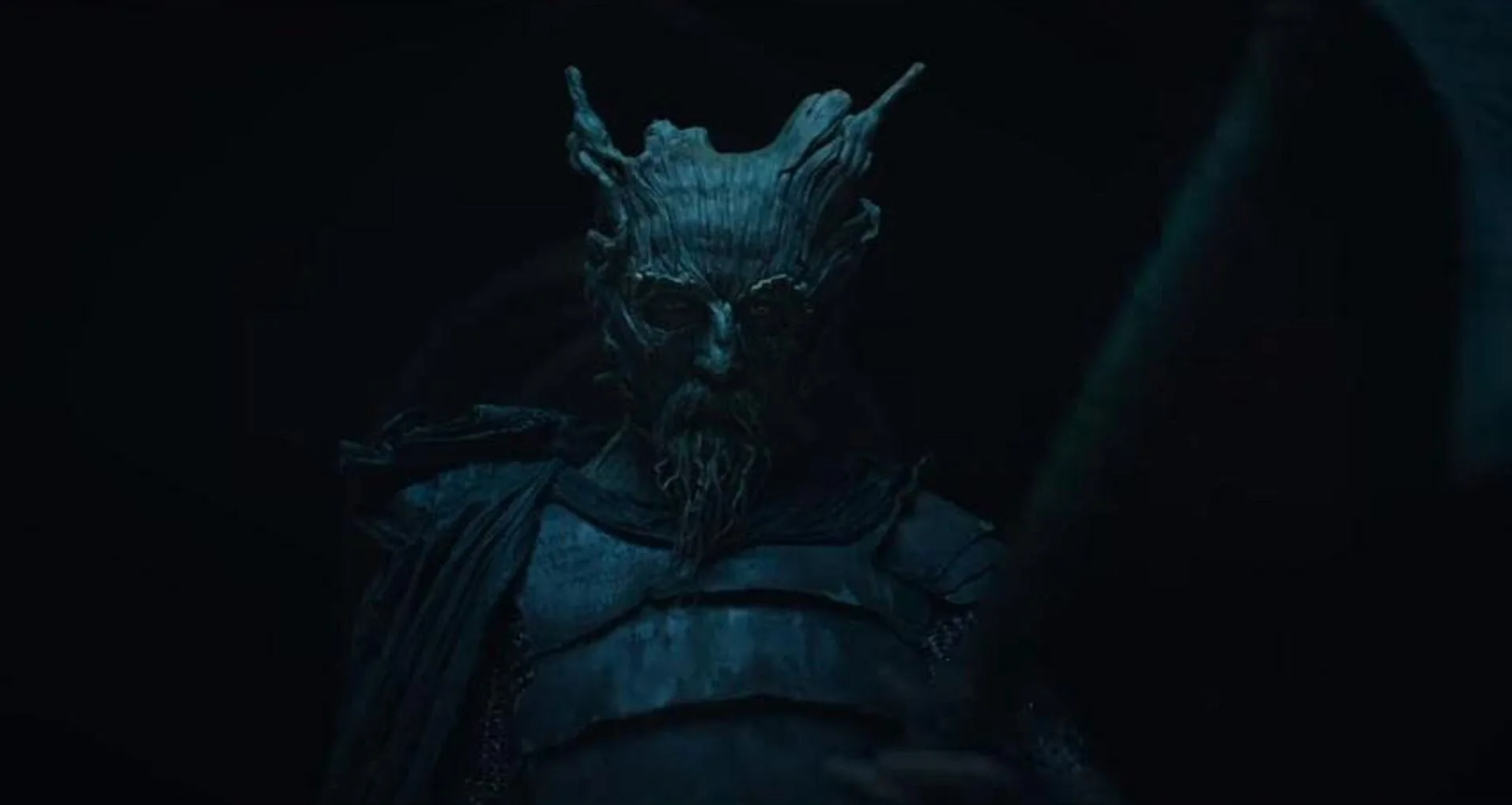
Image courtesy IMDB
In the film, Gawain (Dev Patel) himself also coexists uncertainly between these two worlds, with dreams of making a name for himself in the knightly fashion while also being the son of Morgan le Fay (Sarita Choudhury). It is his mother’s magic and craftsmanship—a green belt woven with glimmering threads—that gives him the opportunity to possibly save his own head while retaining his honor. But this item exists beyond the terms Gawain accepted, marking his quest with the doom of death rather than simply the doom of fate.
When it comes time to find the Green Knight, Gawain’s journey is a haunted one, marked by encounters with ghosts (both real and metaphorical at the end of a recent battle), scavengers, giants, and a strange fox with an almost human-like intelligence that won’t leave Gawain alone, despite the knight’s attempts to shoo him off. (Shoutout to Reynard from the poem.) These encounters, all dangerous and compelling in their own right, are also symptomatic of a still wild landscape still fertile with old beliefs and old gods. The only mark of the Christian faith out here is the final destination of Gawain’s quest: the Green Chapel. But even then, in both the poem and the film, the name is misleading at best—a danger hidden in plain sight at worst.
Having proved himself unable to manage his belongings let alone his horse, Gawain eventually stumbles upon a sole stately home in the wilds, the residence of a mysterious, yet generous Lord and Lady. The Lady (a mirror of Gawain’s own love interest back home, played by Alicia Vikander) is deeply mesmerizing, and threatens in private to lead Gawain astray from his goal and his knightly virtues. During one cozy scene, as they all gather together after a shared meal, conversation turns to the importance of color. The Lady gives an impassioned, almost feverish, speech about the nuances of the color green—of rot, life, fertility, and how it will grow to consume all. This vibrant, alive sense of green—the green of the Knight, the Chapel, the landscape Gawain has been journeying through—is not the color of domestication, but of something that can’t be locked away behind walls and restrained by societal and religious boundaries. This is the cycle of life itself, the drive that has given life to the gods, and ultimately, to Christianity. Before humankind, there was green; primordial life, with a deep, watchful intelligence of its own.
As Gawain’s journey finishes in the Green Chapel, there’s an interesting contrast to be seen between the poem and the film: In the poem, the Chapel is described as a burial mound—possibly home to unsettled spirits—evocative of the dangers of a wight mound, and in Lowery’s film, the Chapel is a hollowed-out place of worship, all in ruins. There, the Green Knight slumbers, awaiting Gawain to finish their game. The abandoned chapel has been grown over, and the Knight likely sits on what used to be the altar. Here, Christianity is the farthest it could be from a foregone conclusion—this is a place of worship that nature has reclaimed for itself.
And as Gawain faces the final confrontation of his quest, here too we see the act of beheading as a terrifying but dynamic moment. Beheadings may often be seen as a final, shameful end for a terrible person. Or, like in the story of the Hindu goddess Kali and her garland of decapitated heads—many of which are seen in artistic depictions as being at peace—liberated from the cycles of birth and death.
And as they say: “Don’t lose your head.”
Article written by Laura Kemmerer
Laura tuned into horror with an interest in what these movies and books can tell us about ourselves and what societies fear. She is most interested in horror focused around the supernatural, folklore, the occult, Gothic themes, haunted media, landscape as a character, and hauntology (focusing on lost or broken futures).
