
Horror Film Across the World: An Interview with Jon Towlson
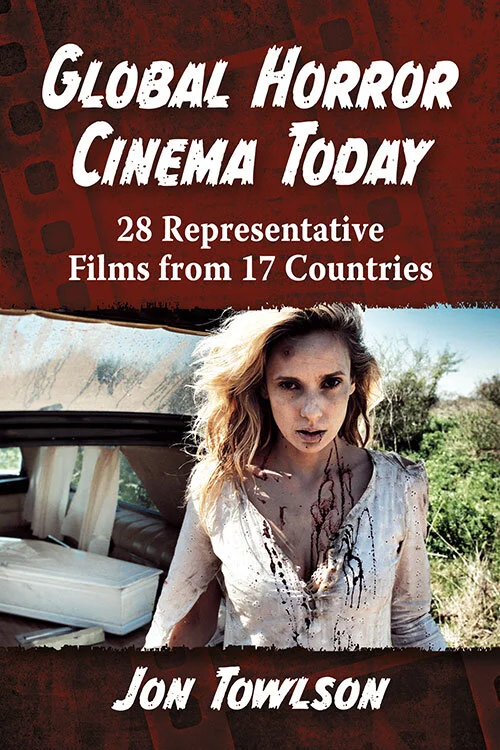
Train to Busan. The Babadook. A Girl Walks Home Alone at Night. Creators who work in horror around the world have continued to expand the genre’s footprint in innovative, mesmerizing ways. Journalist and film critic Jon Towlson strove over the past several years to celebrate these films in his recently released book, Global Horror Cinema Today: 28 Representative Films from 17 Countries.
A lecturer at both the University of Leeds and the University of York, Towlson has written for the British Film Institute, and his work appears in highly acclaimed publications, including Diabolique Magazine. Towlson has also produced a number of fascinating books, including Candyman, part of the Devil’s Advocates series from Auteur Press; The Turn to Gruesomeness in American Horror Films, 1931–1936; Close Encounters of the Third Kind, part of the Constellations series which explores sci-fi film and TV, also from Auteur; Subversive Horror Cinema: Countercultural Messages of Films from Frankenstein to the Present; and has other forthcoming works on George A. Romero’s Dawn of the Dead and the film Midnight Cowboy.
With a focus on horror films released over the past 10 years, in Global Horror Cinema Today, Towlson explores recent films from across the world, detailing what frightens audiences and how these experiences translate to international audiences.
What initially drew you to horror?
I grew up in the UK at a time in the 1970s and early 1980s when “horror” was all pervasive. It loomed so large in the cultural firmament that you couldn’t avoid it. There was folk horror on children’s television; The Exorcist phenomenon; great public interest in the paranormal, the occult, and the “unexplained”; late-night horror double bills on BBC TV; Marvel horror comics; [The House of Hammer] magazine; CND films about nuclear war, the rabies scare campaign, all sorts of public information films about “danger”; Video Nasties; James Herbert novels; and so on. As a young kid, I just tuned into it. Like many, I started as a horror fan and became a horror scholar. By the time I was a teenager, I was seriously into film—not just horror but all forms of cinema, and was making Super 8 films (and later 16mm films). I went from filmmaking into teaching and later into journalism and film criticism. All these things converged in my writing on horror cinema.
What was the inspiration for your forthcoming book?
For the past ten years, I have been reporting on horror festivals in the UK—Frightfest, Mayhem, Celluloid Screams, and others—for popular genre publications. So I was able to see a lot of new international horror films, many of which were made by low-budget independents. I also interviewed emerging filmmakers for magazines like Starburst and Digital Filmmaker. Then, in 2016, I ran a film appreciation class at the City Screen cinema in York called States of Terror: An Overview of Horror in Contemporary World Cinema. The idea for the book took shape from that, as an analysis of current trends and emerging voices in global horror cinema since 2012. My previous book for the publisher McFarland was a micro-historical study of pre-Code horror (The Turn to Gruesomeness in American Horror Films, 1931 to 1936). Because I was taking a revisionist approach to classic horror, I wanted to rely on primary sources where possible, so I spent a lot of time in the archives at USC, UCLA, and the Margaret Herrick Library in Beverly Hills, going through scripts, production paperwork and correspondence, and censorship reports from the 1930s. I loved doing this research, but when it came to writing the book, referencing all these sources made it feel like I was trying to build a cathedral out of matchwood. It drove me crazy! So, I wanted to get back to film criticism with the current book—you know, watch a bunch of movies and write about ’em. Naturally, Global Horror Cinema Today turned into another mammoth task as the number of films, and countries covered in the book kept increasing. In the book I include close readings of 28 films from 17 countries, with further discussion of between 75 and 100 others. That’s a lot of movies to watch and write about! About four years’ worth! What sustained me during this time was finding some really interesting international films that I might not have seen if I hadn’t been writing the book.
What informed your decision on what movies to include and specific focus on certain elements?
The first big decision was how to organize the book: Do I structure it thematically or country by country? I ultimately chose to do the latter, as I didn’t want to write an academic work, but one that hopefully crosses over. However, I also decided to include a lengthy introduction discussing themes and trends in global horror cinema to give the book context and address transnationalism. Each chapter offers close readings of two representative films of each country, and then there’s a survey element of current horror production and a short history of horror cinema in each country. In the preface I make it clear that this book is not claiming to be an exhaustive A to Z of every horror movie produced by every country in the world in the last 10 years! It’s intended to be a snapshot or a selection of films that, in my view, represent the current state of play of contemporary horror cinema around the globe. There are actually a number of countries that I do not include—India, for example—because their output is simply too big to do them justice in a book that I wanted to keep to a certain length; I felt that there were other scholars who would do a better job of those countries than I could.
Who are some of the up-and-coming directors and writers in the genre that you've been most impressed with recently?
The explosion of women filmmakers over the last 20 years has been incredible. I remember a time when there was really only Mary Lambert working in the genre (and few women directors, per se). But several years ago I started to notice, when I was at film festivals, that the stand-out films (for me, anyway) were directed by women: the Soskas, Ana Lily Amirpour, Jennifer Lynch, Ana Asensio, Jennifer Kent, Julia Ducournau, to name just a few. What impressed me was that they were using the genre in new ways, and not just the genre, but rewriting the rules of filmmaking itself. They were using film in a different way. Look at how these directors approach syntax—sophisticated and brilliant.
In your work across wide swaths of the genre, what are some of the most timely, important ideas that horror has to teach us about the world we live in today?
I find it striking that despite its transnational language, horror cinema continues to explore specific national trauma in many countries, whether it be previously repressed historical trauma or present-day anxieties. In Spain, Australia, and Austria, to give three examples, filmmakers are engaging with the histories of their countries, questioning official discourses that have stressed political continuity at the expense of historical fact. I see current horror cinema functioning much like ’70s German reunification cinema did in this respect—Austria’s Ich Seh, Ich Seh (Goodnight Mommy, 2014) even opens with a clip from a Heimat film, showing a von Trapp-like family on a TV screen, a reference to Austria’s abiding postwar self-image—a comment on the Heimatfilme as an avoidance of historical truth. Australia’s Killing Ground (2017) evokes a sense of that country’s violent present coexisting with its colonial past. The story’s three time frames (the present, the recent past, and the distant past) inevitably coincide; history is presented in terms of repeating cycles of violence. As Killing Ground’s director Damien Power has commented, “It happened 200 years ago, it happened last week, it’s happening right now. And the chances are, it’s going to happen again.” It’s a comment that might relate equally well to a number of contemporary horror films from different countries. Other horror movies are using transnational tropes to explore current national anxieties—military violence and war (Israel), tensions with neighboring countries (South Korea), issues of immigration (Austria), political oppression (Iran), and ecological catastrophe (Brazil).
What do you hope to see explored in horror more in the future?
I hope that more women, Black, and Indigenous filmmakers are able to make radical films and get them distributed. I hope that similar developments in the genre aren’t closed down by a reactionary backlash. And it would be great if more filmmakers could come along and show us alternatives to the impending apocalypse! Give us some social and political solutions to help stop the end of the world, people!
Interview by Laura Kemmerer
Laura tuned into horror with an interest in what these movies and books can tell us about ourselves and what societies fear. She is most interested in horror focused around the supernatural, folklore, the occult, Gothic themes, haunted media, landscape as a character, and hauntology (focusing on lost or broken futures).

In The Buffalo Hunter Hunter, blood carries the violence of colonialism, while a settler’s journal controls whose story survives. This essay examines how Stephen Graham Jones uses vampirism and layered testimony to confront historical erasure.