“The Night He Came Home!”: Michael Myers as a Revenant of (and Against) Capitalism
Like the ghosts and revenants of Gothic literature, there’s something about the horror genre that guarantees its return in popularity, again and again. Movie fans and laymen can see this no more clearly than in the return of the most notable slasher icons: Michael Myers, Jason Voorhees, and Freddy Krueger. What began as titillating accounts of murder soon devolved into a seemingly endless number of reboots—to date, the Halloween series, the first of which predates even Friday the 13th, has twelve movies at the time of writing, with a thirteenth planned for an October 2022 release. (NOTE: The author has not seen Halloween Ends.)
At first, slashers were a ground-breaking subgenre—subject to criticism from both right and left—but became enjoyable for their repetition, horror fans often admiring the “kills” and how the body count continued to rack up. But for characters like Michael Myers, with such a physical impact by killing in close quarters with a chef’s knife, there is a thematic throughline of Myers as the Boogeyman. Or, as I would argue, Myers as revenant—a supernatural motif that both highlights the connection the genre still has to Gothic literature, and is itself indicative of the reanimating power of capital. Myers is a figure of supernatural capitalism—a figure that returns again and again, driven by an immaterial force that exerts a very real influence on the physical world around him. Yet he also subverts the oppressive structures, such as the failed mental asylum system, he represents.
1.The Revenant in Literature
The revenant, lesser known in Gothic and supernatural literature than its ghostly counterparts, can either be depicted as something more like a ghost or a reanimated corpse (Pulliam 272). What makes them most terrifying, in the stories they’re featured in, is their revenge drive: their ability and compulsion to do harm to people. As editor June Michele Pulliam notes,
“The word revenant is believed to be derived from the Latin word reveviens, which means ‘returning’; therefore the revenant is best understood as a deceased human being that returns from death to right a wrong, or, in the case of a revenging revenant, to simply inflict harm because of mistreatment during life” (Pulliam 272).
While this serves as a workable baseline for the reader’s understanding of a revenant, it’s already clear that quantifying supernatural beings remains a challenge. (As written before, revenants can also appear as ghostly, rather than simply reanimated corpses driven solely by revenge.) Based on this ambiguity of interpretation, there remains space for iconic slasher figures like Michael Myers to themselves be considered revenants, driven by similar insatiable drives for destruction. The supernatural throughline even follows Myers’ story in the original Halloween.
In previous iterations of the revenant story, as it appeared in medieval European literature, revenants were driven by the souls of the deceased who were possessed by demons. They could also be potential spreaders of disease. The only way to get rid of a revenant, however, was to decapitate and burn the body (like older stories of vampires) (Pulliam 273).
The slasher heart of the revenant story dates as far back as the 12th century, in which William of Newburgh recorded several purportedly true revenant tales. In one such story, an outlaw died while spying on his wife and her lover. Soon after, the outlaw rose from his grave at night, striking fear into the hearts of the local citizens. What gives this story the slasher turn, though, is, as Pulliam notes, “The undead creature was credited with various murders in the town, until the townspeople raided the cemetery, exhumed the corpse, and burned it” (Pulliam 273).
2.Horror Films in the 1970s
In Horror: The Film Reader, edited by Mark Jancovich, author Robin Wood posits in his article, “The American Nightmare: Horror in the 70s,” that “The most immediately obvious characteristics of life in our culture are frustration, dissatisfaction, anxiety, greed, possessiveness, jealousy, neuroticism: no more than what psychoanalytic theory shows to be the product of patriarchal capitalism” (Wood 25). In Halloween, Laurie deals with her own repression of all these things, but Myers, on the other hand, has been out of the world of patriarchal capitalism for the past 15 years. He is the Other, something that, Wood notes, is foreign to the dominant paradigm but that it nonetheless must deal with. What we repress, however, we must dream.
Films, like the supernatural Other, can also be seen as supernatural objects —they are akin to dreams—and this attitude certainly appears in horror from the 1960s and '70s. But these dreams can also certainly be nightmares. As Wood writes, “The conditions under which a dream becomes a nightmare are that the repressed wish is, from the point of view of consciousness, so terrible that it must be repudiated as loathsome, and that it is so strong and powerful as to constitute a serious threat” (Wood 30).
Though the persistent re-emergence of Michael Myers from the original Halloween into several sequels would suggest that he’s been a source of nightmares for audiences for decades, it’s precisely this repetition of appearance that makes him a revenant, driven by both repression and the power of capital. As author Brandon Shoaff writes in, “The Truth About Halloween’s (1978) Bizarrely Low Budget,” Halloween racked up several million at the box office, on a meager $325,000 budget. From the start, John Carpenter’s Halloween showed itself to be a diamond in the rough, showing potential for a run of sequels, though with diminishing financial and audience returns.
The lineage of the slasher continued with franchises that sought to replicate the success of Halloween, with Friday the 13th and A Nightmare on Elm Street bringing their own iconic killers into the slasher legendarium. But rather than focus on the atmosphere and mood of Halloween, the second Halloween and the first Friday both pivot into body counts and extreme kills, according to author Jason Bailey in his article “‘Halloween’ and the Problem with Its Sequels.” Though attempts to break new ground lasted through the Season of the Witch, technically the third Halloween installment though it didn’t feature Myers, the entire franchise remains incredibly malleable—as does the slasher genre itself, according to Bailey. Though there have been diminishing returns over the years, fans remain as riveted by slasher stories as they did by stories of revenants in medieval Europe.
It also remains important to note that the early slasher films, especially movies like Halloween, were financially driven by distribution executives, not so much the theatergoers that were spending money for multiple rewatches. In “‘There’s More Than One Way to Lose Your Heart’: The American Film Industry, Early Teen Slasher Films, and Female Youth,” author Richard Nowell notes that early teen slashers were largely independent affairs, not financially backed by larger distribution companies. Independent distributors could only afford to pay filmmakers after the film had generated revenue, and were known for being unstable businesses, according to Nowell. One of the most significant film decisions in 1970s horror was to include women in the marketing picture, and, finally, Michael Myers (and Halloween) had gained enough financial traction to further haunt the younger generation of movie fans (Nowell 51).
3.The Revenant and Capital
As slashers haunt moviegoers’ consciousnesses, and as movies are a kind of dream, characters like Michael Myers become reanimated by the power of capital—the potential earnings made from sequels, expanding into new market demographics, and new merchandizing opportunities. When discussing the nature and behavior of markets, the phrase “the invisible hand” is often used—representing an idea of some immaterial force that self-corrects the market.
Citing Adam Smith’s heavily quoted The Wealth of Nations, author Stefan Andriopoulos writes that the “invisible hand” of Smith’s concept of the market can be likened to similar disembodied accounts in classic works of Gothic literature, like Horace Walpole’s The Castle of Otranto. Andriopoulos indicates that there may be a criticism of this line of thinking implicit in Walpole’s very own Castle, highlighting that how Smith uses the “invisible hand” and how Walpole uses it put them inherently at odds. Smith uses the “invisible hand” as an indicator of how the market will eventually self-regulate, specifically how “the economic reconciliation of individual and social interest as the natural, ordinary course of events” (Andriopoulos 740). On the other hand, Walpole uses the same phrase to indicate Manfred’s, one of the main characters, bad intentions, roused to an unnatural height due to the influence of the supernatural. The criticism lies in the connection between the two being negligible.
Andriopoulos goes on to argue, however, that in Smith’s first use of the “invisible hand” emerges in a similarly supernatural context in his work “The History of Astronomy,” referencing how natural weather events, like thunderstorms, evoked the sublime in Edmund Burke’s work. In “History,” Smith writes that prehistoric people attributed these same events to the favor of their gods, also considered invisible forces. As Andriopoulos also writes, “This inversion of the ‘invisible hand of Jupiter,’ disrupting the regular descent of heavy bodies, to an impersonal ‘invisible hand’ which causes the ‘gravitating of the nominal … toward the natural price,’ can be grasped as a naturalization of the supernatural” (Andriopoulos 741).
The interference of some external, immaterial force seems to ignite Manfred’s madness, and a similar influence could be said to influence the market, according to Andriopoulos. But, as the author also writes, “The sublimity of a consumption without limits or boundaries threatens to render the reconciliation of private and social interest impossible” (Andriopoulos 745). Here, the uncertain ground of limitless consumption and the haunting, driving power of capital, is where we see Michael Myers emerge as a revenant.
4. Michael Myers as Supernatural Being & Literary Revenant
Finding discourse around whether Michael Myers is actually supernatural isn’t difficult, but there is certainly evidence to support it in the film. Throughout Halloween, multiple characters refer to Myers as the “Boogeyman”—a threatening presence that is felt, but not taken quite seriously. Even when characters don’t take the threat of his presence seriously, there is already an alternation in their behavior, from talking about his story, to one of the kids Laurie babysits screaming about seeing the Boogeyman outside their house.

In one conversation, between Laurie and Tommy—the boy she’s babysitting—he asks her to read a story to him. When she thinks King Arthur is his favorite, Tommy pulls out comic books he’s hidden from his parents, and as Laurie says, “I can see why,” she goes through the comics and says, “Tarantula Man? Neutron Man? The Boogeyman?” This establishes a fantastical and supernatural lineage in how the film considers Michael Myers. Though this dialogue can also be explained by seeing Myers’s strength and power on par with that of a superhero, the imminent threat of Michael Myers as Boogeyman makes him something far more dangerous—much closer to the role of revenant.
Though Michael Myers does not begin his story dead, in the literal sense, the cutting short of his childhood by his murderous actions acts as a form of death in Halloween—he becomes cut off from the world as many children his age experienced it. When other kids were out trick-or-treating, he was stabbing his sister to death. He becomes completely disconnected from (and dead to) the world of the familiar.
But when he winds up locked away in an asylum, there remains a haunting, here, too, of the decline of the mental institutions in the U.S. during this period—another failing system that destroys and animates just as much as the power of capital. In “The Folklore of Deinstitutionalization: Popular Film and the Death of the Asylum, 1973–1979,” author Troy Rondinone notes, “In Halloween, the horrors of a failed asylum are embodied in Michael Myers, whose murderous energy resides in his being at once human and inhuman, an ‘interstitial’ being correlating to Carroll's definition of horror.” The author goes on to write that the “System”—the structures that oppress us—are deeply compromised in Halloween. From this perspective, Myers is more than a revenant of capital, driven to break through oppressive structures to fulfill his need for violence. His very persistence and presence dismantle the very foundation of the structures that oppress us, financial, medical, or otherwise—doctors can’t stop him, and the police certainly can’t either. He is beyond the control of any power structures, but he may be driven away by fire (Dr. Loomis’s gun) all the same.
Rondinone goes on to further highlight Myers’s supernatural nature when he writes, “Michael Myers is, as Loomis says, ‘the Boogeyman.’ He is a folkloric monster. With his blank mask and mechanical movements, we understand that he is not a real person but rather a symbol of evil, a thing (or ‘The Shape,’ as the credits call him) that stalks the ‘woods’ of modern suburbia” (Rondinone). In being called the Shape, Myers also evokes the presence of Frankenstein’s Monster. (In James Whales’ 1931 Frankenstein, there is no actor attributed to the role of the Monster.)
5. Halloween at the End: 50 Years Later
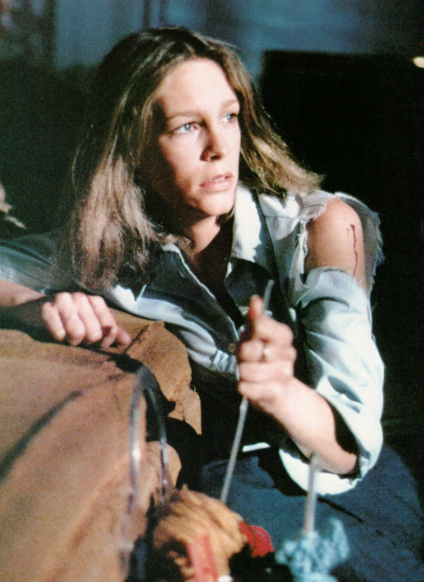
In the 2018 Halloween, directed by David Gordon Green, all of the sequels between the 1978 original movie and 2018 were functionally erased, in terms of story. Released in celebration of the 50th anniversary of the original Halloween, Green’s version provides a snapshot of Laurie as a grandmother, trapped in a personal maze of alcohol abuse and agoraphobia. Her home is heavily fortified, and she can’t seem to trust others. Between all of these elements—the retcon of all the sequels, and Laurie’s own new, seemingly finalized story in the 2018 movie—there’s an ongoing theme of death.
The retcon fundamentally erases all of Myers’s stories that came before, marking an ending and the birth of something new. In franchises, retconning is a commonplace practice in order to wipe the slate clean and give the story a new place to start from. Multi-decades-long franchises, like Star Wars and Friday the 13th, eventually become weighed down by so many years of storytelling, and the sheer volume of movies, shows, and books may make the franchise inaccessible to new fans. While retconning can be seen as the death of a certain story, in Halloween, it works, especially if Michael Myers is considered a supernatural force—he will always reappear, driven by audience demand and capital.
And, in a way, the retconning is also a point of further subversion and exploitation, all at once: Though the figure of Michael Myers subverts and slashes his way through oppressive power structures, by becoming the figure of so many reboots and now a retcon, he is a figure animated by the demands of audience interest and capital. But as with the very chef’s knife that Myers uses to kill his prey, you can use the same knife to prepare meat, just as much as cut off fingers. In that way, Myers is an incredibly powerful icon that subverts power structures by the very fact that he’s a revenant. As a story, he may be exploited, but he still has power—as do we all.
In the 2018 Halloween, Laurie herself also becomes more and more like Myers, beginning with isolating herself in the tomb of her home, unable to move forward from her traumatic past. And in this, too, there’s a kind of death—the loss of what would be considered in the U.S. a “normal” life. Laurie’s persistent alcoholism and self-isolation are the price she pays for living with trauma, and emblematic of the side effects of the oppressive structures we all live under. Trauma is also certainly not a rare occurrence, either: According to the U.S. Department of Veterans Affairs, five out of 10 women experience something traumatic in their lives, whereas six out of 10 men also experience trauma at some point.
Unable to let go of her trauma, Laurie becomes more and more like Michael as a revenant—her potential for a normal life has died, and she remains animated by desire for revenge, as well as fear. In one fight with Myers, she even vanishes—mirroring their similar struggle at the ending of Carpenter’s film. But even as Laurie’s family, successfully reunited past the point of Laurie’s trauma, ignite the house and set the revenant to rest in a blaze of fire, his breathing after the credits indicates that he has not died. Laurie is doomed to repeat this cycle of survival, herself becoming a revenant.
In this way, the haunted (the traumatized) become the haunter, becoming a functional revenant if their own trauma is left to go unresolved. The ostensible self-correcting “invisible hand” of the market has ultimately led to the oppression of those living under capitalist societies. The traumatized are locked away since they cannot be profitable.
Initially, horror icons like Michael Myers are born under independent ingenuity, but become animated by the invisible hand of capital once the sequels start rolling in. But Myers also represents the irrepressible part of the human mind—he subverts power structures by his very existence. He cannot be stopped by doctors or police. He is the Other that the dominant culture must deal with, but his very existence empowers the oppressed to subvert the same systems. Myers is both exploited and powerful, terrifying the locals and eroding the foundations of power. As Laurie also becomes traumatized and begins to represent a revenant herself, she signifies to the audience their own power, and how we can use our trauma to fight back.
-
Andriopoulos, Stefan. “The Invisible Hand: Supernatural Agency in Political Economy and the Gothic Novel.” ELH, vol. 66, no. 3, 1999, pp. 739–58. JSTOR, http://www.jstor.org/stable/30032092. Accessed 22 Aug. 2022.
Bailey, Jason. “The ‘Halloween’ Franchise and the Problem with Its Sequels.” The New York Times, 29 Oct. 2021, www.nytimes.com/2021/10/25/movies/halloween-franchise-problems.html.
Nowell, Richard. “‘There’s More Than One Way to Lose Your Heart’: The American Film Industry, Early Teen Slasher Films, and Female Youth.” Cinema Journal, vol. 51, no. 1, 2011, pp. 115–40. JSTOR, http://www.jstor.org/stable/41342285. Accessed 28 Aug. 2022.
Pulliam, June Michele, and Anthony Fonseca. Ghosts in Popular Culture and Legend. Greenwood, 2016.
Rondinone, Troy. "The Folklore of Deinstitutionalization: Popular Film and the Death of the Asylum, 1973–1979." Journal of American Studies, vol. 54, no. 5, 2020, pp. 900–925. ProQuest, https://www.proquest.com/scholarly-journals/folklore-deinstitutionalization-popular-film/docview/2460661912/se-2, doi:https://doi.org/10.1017/S0021875819000094.
Shoaff, Brandon. “The Truth about Halloween’s (1978) Bizarrely Low Budget.” Looper, 1 Nov. 2021, www.looper.com/648024/the-truth-about-halloweens-1978-bizarrely-low-budget.
“VA.Gov | Veterans Affairs.” How Common Is PTSD in Adults?, www.ptsd.va.gov/understand/common/common_adults.asp. Accessed 27 Aug. 2022.
Wood, Robin. “Horror, The Film Reader (In Focus: Routledge Film Readers).” The American Nightmare: Horror in the 70s, edited by Mark Jancovich, 1st ed., Routledge, 2001, pp. 25–32.
Article written by laura Kemmerer
Laura tuned into horror with an interest in what these movies and books can tell us about ourselves and what societies fear. She is most interested in horror focused around the supernatural, folklore, the occult, Gothic themes, haunted media, landscape as a character, and hauntology (focusing on lost or broken futures).